


How Stitch Fix is using AI and customer feedback to build its private brands
Stitch Fix is going narrow and deep with its private brands, a strategy it says is contributing to revenue growth.
In its fiscal year 2025, Stitch Fix had 16 private-label brands. It has since consolidated the portfolio to 10 brands, but has expanded within those brands into categories such as bags, footwear and jewelry. This way, it can better meet customers’ needs, foster brand loyalty and help people build more complete closets, said Amy Sullivan, who oversees private brands for Stitch Fix as vp of merchandising.
“You can build a brand a few ways,” she told Modern Retail. “One is saying, ‘This is our workwear brand.’ ‘This is our everyday brand.’ What we realized was that’s not how clients operate. We wanted to build our brands [to fit] the actual lifestyle needs of what our clients are experiencing.”
Now, she said, the philosophy is to have fewer brands, “but brands that can do more [and] can be more versatile and intentional, while still being highly differentiated from one another.”
Data has been crucial to this process. Stitch Fix, a personal shopping and styling service founded in 2011, had 2.277 million active clients by the end of August. Its stylists collect feedback from clients, and the company uses these insights to figure out existing gaps it can fill via its private and national brands. Stitch Fix also uses AI to summarize trends, kick-start its design process and collect client ratings.
Because Stitch Fix manufactures 10 brands in-house, it can quickly tweak that assortment to meet customers’ needs. For fall 2026, for example, Stitch Fix launched women’s belts and cold-weather accessories across its 41 Hawthorn, Market & Spruce and Montgomery Post private brands. It launched bags for Montgomery Post in spring 2026 and bags for We Wander in fall 2026.
“We have historically leaned really heavily toward tops and bottoms and more casual products,” Sullivan said. “What we heard from clients was, ‘I would love to get more of the products I need from Stitch Fix.'”
Going into accessories like sunglasses or triangle scarves helps position Stitch Fix’s private brands as “a one-stop shop,” Sullivan added. “We think there’s a lot of opportunity to expand within non-apparel,” she said.
Stitch Fix offers national brands like Beyond Yoga, Madewell and Dolce Vita, in tandem with its private ones. But Stitch Fix is seeing “strong growth” year over year in private-brand revenue, Sullivan said. Private-brand awareness among clients is also increasing over the prior-year period, she said. Today, the top three brands within women’s at Stitch Fix are private brands. The same goes for kids’. Within men’s, private brands make up three of the top five brands.
Stitch Fix’s business overall grew 6.4% year over year for fiscal 2026. For its fourth quarter, which ended in August, the company reported net revenue per active client of $592, an increase of 7.8% year over year. However, citing “a more challenging consumer environment,” Stitch Fix said that revenue could “temper” in the year to come.
Stitch Fix launched its first women’s private brands in 2013. It expanded into men’s private brands and kids’ private brands in 2016 and 2018, respectively. Today, some private brands span multiple demographics and categories. The men’s brand 01.Algo, for instance, largely offers activewear, but traces 20% of its revenue back to what people may consider “workwear.” Other private brands under Stitch Fix include Hawker Rye, Rumi + Ryder, Bixby Nomad, The Commons and Alesbury.
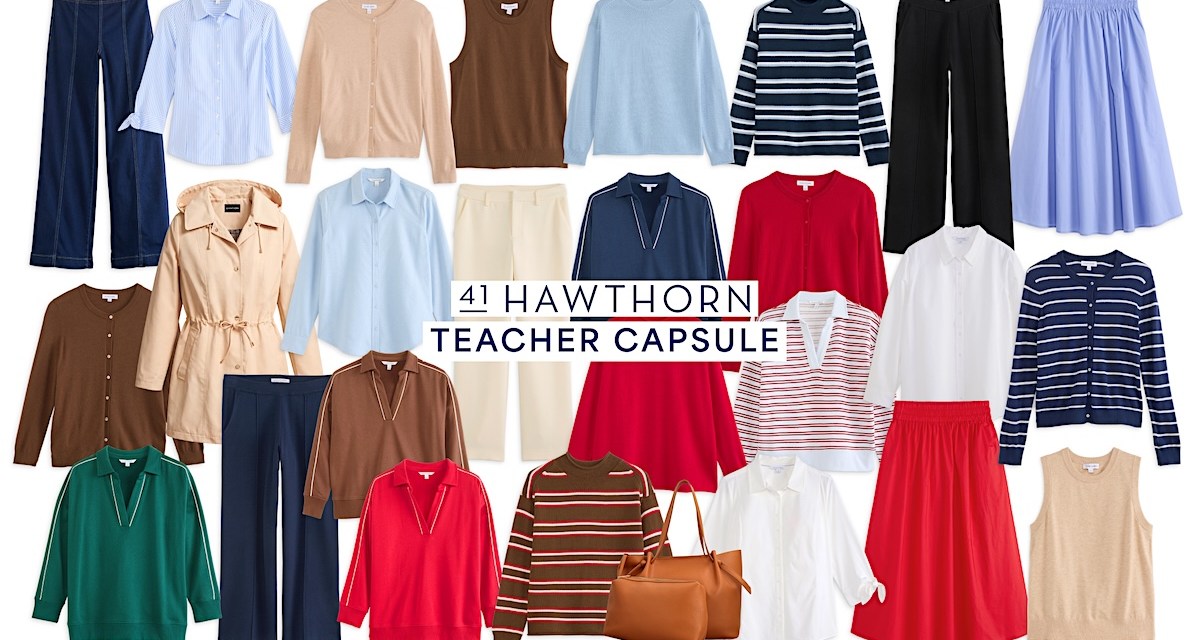
In August, Stitch Fix launched a teacher-focused capsule for 41 Hawthorn, drawing from more than 5,000 notes from clients who work as teachers. More than half (57%) said they wanted clothes that could meet practical needs like movement, coverage, stretch or storage via pockets. About one-third (35%) asked for coordinated, capsule or mix-and-match options. One kindergarten teacher told Stitch Fix that she spends about 80% of her time on the floor, but also needs to look presentable for parent drop-off.
Stitch Fix took this data and then designed products to meet teachers’ needs in time for the back-to-school season. One of 41 Hawthorn’s new shirts is a 3/4-sleeve button-down, so “you don’t have to worry about actually rolling up your sleeves” to correct papers, Sullivan said. Other items in the collection include the Lessons to Lounge Trouser and Cozy Cash Cardigan. All items are machine washable.
Many items in the 41 Hawthorn collection have been some of Stitch Fix’s best performers for fall, for teachers. At the same time, the styles are resonating with Stitch Fix’s other customers. “That was a big piece of it, too: making sure that, at the end of the day, we can meet a lot of our clients’ needs,” Sullivan said.
Stitch Fix often turns to AI to ensure its private brands are staying on trend. It uses AI tools to analyze pictures taken by Stitch Fix employees going comparison shopping in Paris, New York and London. “[It] gives [us] a sense of, ‘OK, let’s take this. … Let’s pick out the most relevant things. Let’s start to separate [styles] based on different brand aesthetics,'” Sullivan said. The AI can help determine that a bandana theme might resonate more with Market & Spruce, while loose-fit denim may be a better fit for The Commons.
Stitch Fix stylists also use AI prompts to accelerate the design process by putting in a request like, “I need a sweater in a yarn that is not going to be itchy and that is going to allow for stretch.” Stylists then go in and tweak designs from there. Stitch Fix also built a capability called “Style Shuffle” to gather client feedback on AI-designed clothing concepts for its private brands. In 2026, clients submitted more than 14 million ratings on nearly 2,800 images to help inform upcoming collections.
Stitch Fix isn’t alone in focusing more on private brands as inflation-weary shoppers look to trade down. Today, private brands have become ubiquitous across retail, from the snack-food aisle to the home-goods section. Aldi recently revamped its private-label packaging, while Walmart announced a redesign of its Great Value brand earlier this year. Private brands represent more than 50% of JCPenney’s total business, and its top-selling brand is a private one.
Private brands remain popular among budget-strapped shoppers. A 2025 Gartner survey found that 77% of respondents said store brands can be just as good as, if not better in quality, than name brands. At Stitch Fix, private brands can help with the “cost-per-wear” value of an item, Sullivan said. “I often ask my team, ‘Could she wear this multiple times a month?'”
Stitch Fix will continue to build out its private brands in 2027, and customers can expect to see them featured in Stitch Fix’s holiday messaging. It’s the company’s hope that each brand maintains an avid following as Stitch Fix continues to grow.
“When you have clients who are asking their stylists for the brands by name, that’s the best indication that we’ve been able to be successful with the assortment,” Sullivan said.