


Why Aldi, Walmart and more are redesigning their private-label packaging
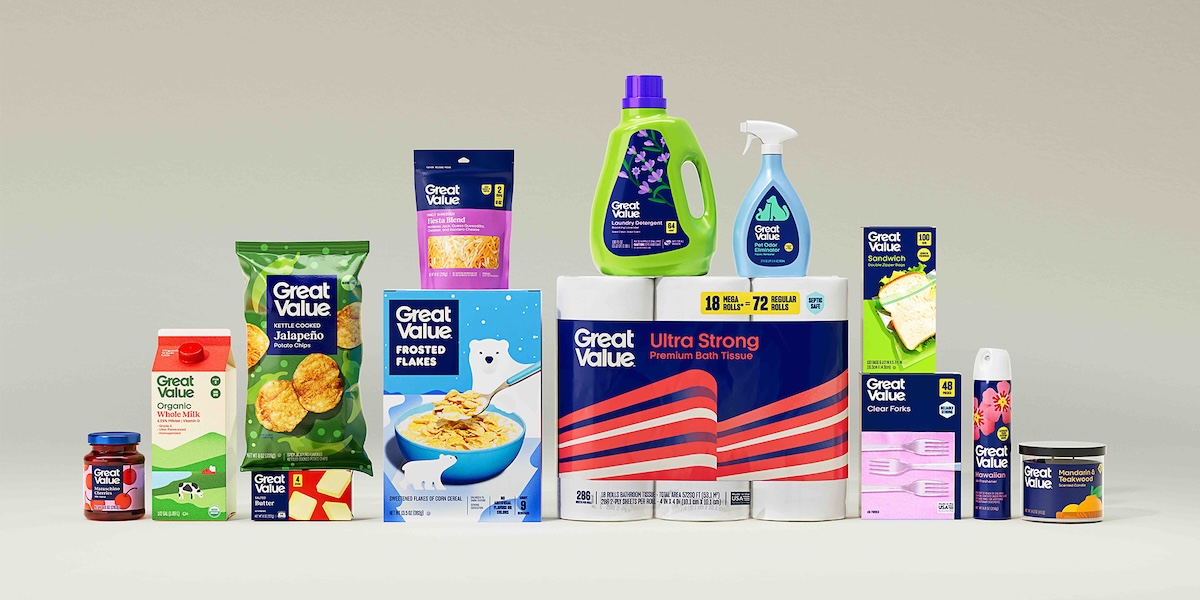
As more consumers embrace store brands, many major retailers have decided they need to improve the way they look.
In 2024, Target introduced new, colorful packaging for its Up&up brand designed to make it easy to identify products as customers shop with large product names. Last year, Aldi began a refresh of its branding and packaging to put its logo on every private-label product in the store, and to bring consistent fonts and graphic design to all Aldi-branded products. In April, Walmart announced a redesign of its Great Value brand, its first full brand refresh in more than a decade. The refresh aimed to provide consistent placement of nutritional information, clearer visual cues to help customers pick the correct items and a modernized look.
The recent string of redesigns signals new investment in how private-label products are perceived, especially as consumers become more price-sensitive. More than half of global consumers said in a survey they are increasingly purchasing more private-label products, according to a 2025 NeilsenIQ report. And according to a recent report from consulting firm BRG, 67% of Gen-Z shoppers said they believe private-label products are just as good as national brands.
“As long as the product is meeting their standards of quality … but is hitting the price point that they would like, they don’t care what the brand is,” said Sara Lavi, senior managing consultant for BRG.
Ryan Poole, managing director in retail performance improvement at BRG, said private label is more and more a key way to attract Gen-Z consumers who especially desire quality at lower price points. Investing in brand development and marketing to meet that standard, Poole said, requires the right data, infrastructure and relationship with factories. “It can be done very well and very efficiently to be able to offer a low price point and deliver a much higher margin structure, versus a national brand,” Poole said.
David Hartman, vp of creative at Walmart, said in a news release that the company believes great design should be accessible to everyone. “At our scale, that means creating something that works clearly and intuitively across thousands of individual items, so customers can find what matters, faster. We’ve built a system that does exactly that, bringing consistency, clarity and a sense of discovery to every shelf.”
The redesigns are also an example of how retailers are trying to stay relevant, alongside how private label brands are also tapping into cultural trends like high-protein and high-fiber products. Kroger, for example, added two dozen new products to its Simple Truth Protein product line earlier this year, including high-protein cereal and beef sticks made with grass-fed beef.
“The table is set, … with the way things are going right now in the economy, for private label to still have a very significant place in this CPG space,” said Jim Olson, senior retail insights manager for Spins. “Their ability to tap into relevant trends — whether it’s protein and fiber or global flavors — while still offering that eternal value proposition sets them up for long term success.”
The desire to change the look of private-label products goes beyond the biggest national chains. Hannaford, a chain of grocery stores across the Northeast, said in March that it would refresh its design in a rollout that will continue through 2027. The new designs feature clear product descriptions, updated photos, a more prominent quality guarantee, and a side panel with its brand promise around connection and transparency around ingredients.
Sarah Guzmán, vp of marketing at Hannaford, said it was important after a decade with the same packaging to do a refresh and have conversations with its customers, both those who buy the store-brand products often and those who don’t.
“For folks that were regularly buying our Hannaford private brand, they love our private brand, they love the quality of the products, and they felt like there was definitely an opportunity for the packaging to reflect that same quality,” Guzmán said in an interview. “People want high-quality visuals, high-quality photography that highlights fresh ingredients — some of the cues that really help people understand that something’s going to taste good.”
For example, she said the photography on a frozen pizza’s packaging should show all the ingredients on the pizza and what the texture of the crust may look like. “Those little details on packaging go a long way in terms of conveying quality cues and appetite appeal,” Guzmán said.
Another focus for Hannaford and other retailers is on making the product name and other information — like nutritional information — easy to read. Guzmán said if someone is buying whole-wheat flour, that should be clear on the packaging so they don’t pick up a different flour by mistake. Customers “want things that are easy to read and help them make the quick shopping decisions,” she said.
Guzmán also said that customers are increasingly expecting national-brand quality from private labels at a good value. “More and more, they want the private brand to be something that they’re proud of, that they’re proud to have in their pantry, that they’re proud to put in their cart,” Guzmán said. “The package can work hard to convey the quality and to connect with customers in a way that feels like it meets their lifestyle.”
Scott Patton, chief commercial officer for Aldi, said in an email that the grocer has submitted about 60% of its new product artwork to suppliers, and that many have started to appear in stores.
“What we’re seeing so far is exactly what we hoped for — customers are recognizing our products more quickly on the shelf,” Patton said. “Our goal from the start was to make Aldi private labels easier to spot and reinforce the trust our shoppers already have in both our brand and the products they’re adding to their cart.”
In addition to modernizing its packaging, Aldi also made the choice to put the Aldi logo front and center on its products. “Shoppers were already referring to so much of what they buy as ‘the Aldi brand,’ whether it said that on the package or not,” Patton said. “We had built a level of trust and recognition that wasn’t fully showing up on shelves.”
Part of the goal for Aldi was to make its products easy to spot, with a panel system that highlights the product name, key claims and benefits while still allowing flexibility in color, imagery and design depending on the category.
“We needed a system that could do a lot of jobs at once. It had to be unmistakably Aldi but still allow our different products and categories to shine,” Patton said. “When 90% of your store is private label, you have to make sure everything feels cohesive, but still distinct enough that it’s not a wall of sameness.”