


Legacy retailers like Party City and Staples are increasingly teaming up on shop-in-shops in a bid for relevance
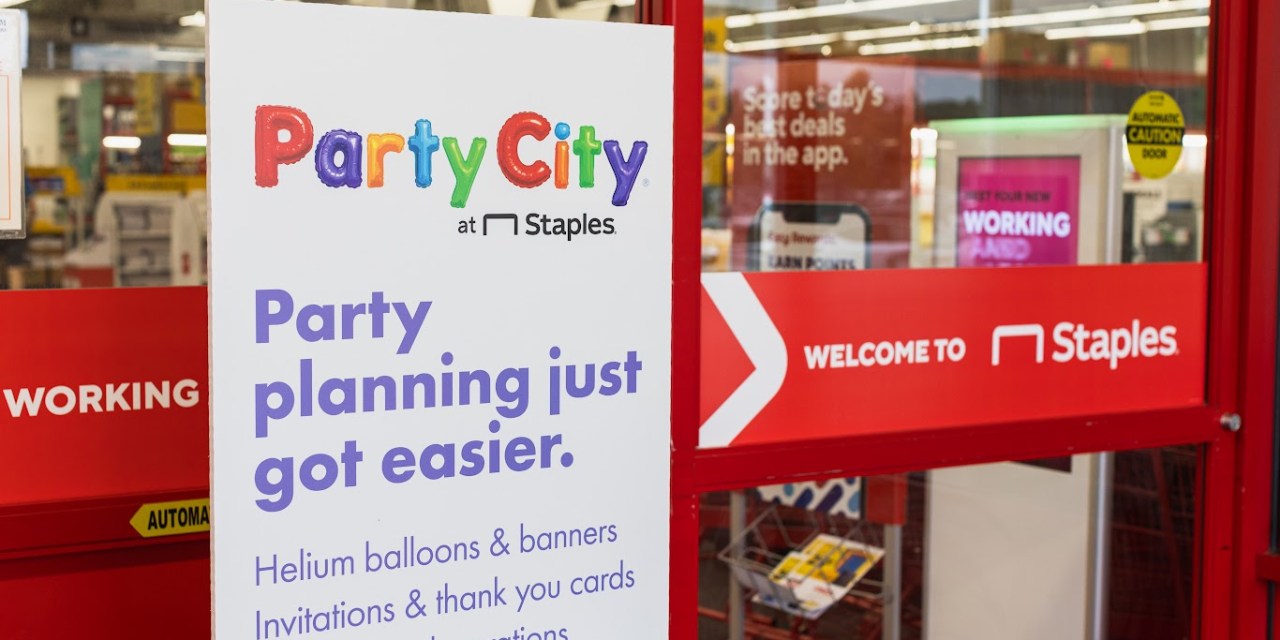
After filing for bankruptcy in 2024 and closing its stores over the past year, Party City is making a return. But this time, it’s taking up space within another familiar retailer: Staples is launching Party City store-within-stores at 700 of its locations this summer, offering a selection of party supplies, decor and balloons.
“By bringing Party City into Staples stores, we’re expanding what customers can accomplish in one place — combining helium balloons and party supplies with our print and marketing services to offer a complete solution for celebrations, from graduations to grand openings and everything in between,” Marshall Warkentin, president of Staples U.S. Retail, said in a statement.
But Party City and Staples aren’t the only large-scale brick-and-mortar retailers that are partnering up. In recent weeks, Bed Bath & Beyond announced the acquisition of The Container Store for $150 million. The Container Store had previously filed for bankruptcy at the end of 2024 as it struggled under a pile of debt.
The deal will entail a redesign, as 98 existing Container Store locations are rebranded The Container Store + Bed Bath & Beyond. Moreover, The Container Store is set to eliminate 30% of its merchandise to make way for Bed Bath & Beyond merchandise.
It all points to a similar trend: Legacy retailers with a sprawling brick-and-mortar presence are teaming up with familiar brand names in a bid for relevance and to modernize their assortments. The trend is not new — Macy’s, for example, previously revived Toys “R” Us with in-store shop-in-shops. However, the strategy has been gaining momentum, as seen by Staples and The Container Store. The hope is that a sense of nostalgia will drive former fans and customers to visit these shop-in-shops — and help both brands present an in-store assortment better suited to the modern customer journey.
Sunny Bonnell, co-founder and CEO of branding agency Motto, who has worked with companies like Disney and Spotify, said that these brands’ relaunched forms “feel strategically deliberate.”
“It raises a fair question: ‘If these brands couldn’t sustain themselves before, why bring them back now?’” Bonnell said. Part of the answer, she said, is likely more cultural than commercial. “These brands didn’t vanish from memory; they just couldn’t stay relevant in a specific operating model,” she said. “What’s being revived is the connection, not the original structure.”
Bonnell added that the acquiring retailers that are swooping in are extracting value from what still resonates about the zombie brands among consumers. “In today’s market, attention is expensive and trust is fragile,” she said. So a legacy name offers a level of immediate recognition that would otherwise take years to cultivate from scratch.
However, Bonnell noted that companies behind the brand revivals are not trying to rebuild what failed. These brands are being reimagined within new systems like shop-in-shops, partnerships and licensing models. That reduces the risk of operating these brands through built-in distribution. “They’re no longer carrying the full weight of retail,” Bonnell said.
Ivan Kayser, CEO of brand consultancy Redscout, agrees that the appeal of the brand resurrection points to just how hard it has become to grow a retail brand from scratch.
“I think [the trend] has less to do with tapping into what these brands stand for, nostalgia or otherwise, and more to do with how extremely hard and expensive it is to build brand awareness today,” Kayser said. Investors are making an arbitrage decision that it will be cheaper and faster to entirely redefine brands rather than build new ones, he said.
Some of the co-branded comebacks also speak to how the physical retail experience is still largely impacting consumer behavior and shaping expectations. “Those things are very hard to recreate in e-commerce where CAC means every bit of friction risks making the brand unprofitable,” said Kayser.
It’s not just long-dead retailers like Toys “R” Us that are being brought back to life by other retailers. Some of these comebacks are now happening almost immediately, as competitors realize the value of scooping up a bankrupt brand’s IP. In 2025, Michaels acquired the IP assets and private labels of competitor Joann following Joann’s bankruptcy and store closures.
Then, last September, Michaels unveiled its Knit & Sew Shop. These are co-branded sections featuring Joann’s logo, offering an assortment of threads and yarn, among other sewing supplies. And long before The Container Store jumped on the opportunity, Overstock quickly acquired Bed Bath & Beyond’s assets during the liquidation process in 2022 and relaunched it on Overstock’s website.
“My guess is we’ll see more of these, and we’ll see these old-new brands be more innovative when it comes to unique experiences,” Kayser said.
While nostalgia can pique people’s interest, Bonnell said it cannot sustain a business long term. As such, the risk of another failure doesn’t go away after the brand comeback. “The danger is treating the comeback like a sequel no one asked for,” Bonnell said. “If the story doesn’t evolve, audiences will move on quickly.”