


Marketplace Briefing: How Whatnot’s AI-powered recommendation system gives it a competitive edge
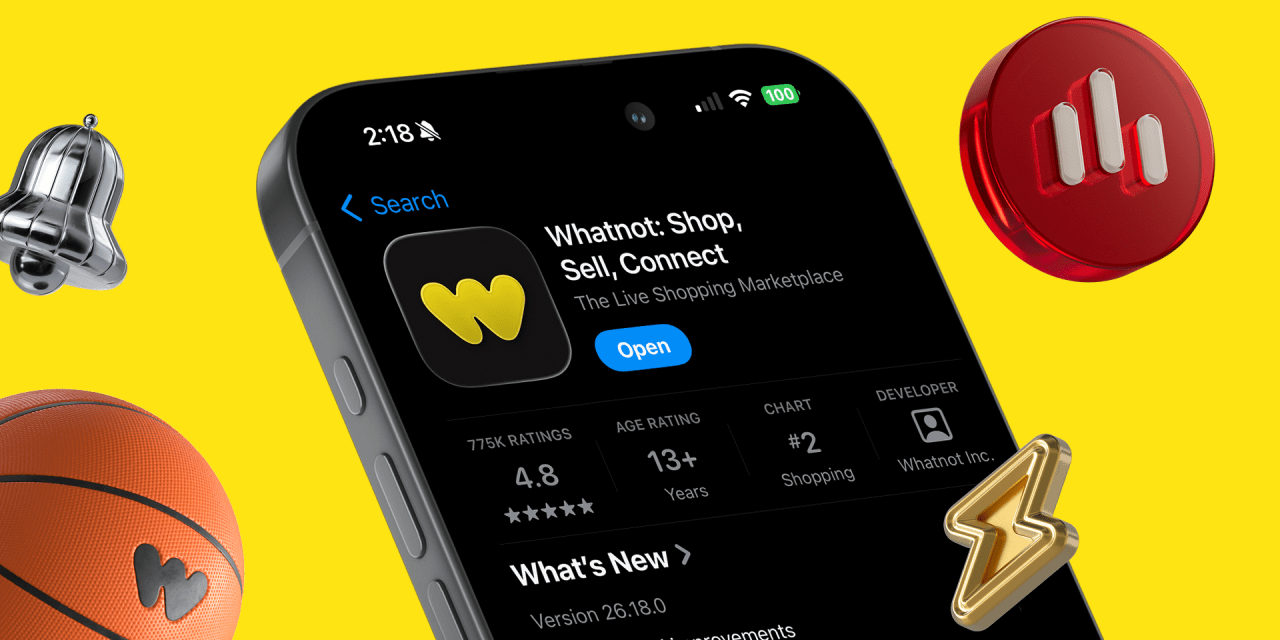
Live shopping marketplace Whatnot has a need for speed — more specifically, to deliver product recommendations to shoppers more quickly.
Improving Whatnot’s discovery and recommendation system has been a major focus for Chief Product Officer Tom Verrilli over the years. The latency on its recommendations is now down to just minutes, meaning Whatnot’s technology can now quickly ingest information — like, if a product has sold out on a particular livestream — and use that to inform what products it recommends to buyers.
The desire to keep improving its recommendation systems is what drove Whatnot to acquire machine learning startup Shaped in a deal announced last week. Shaped, founded in 2021, bills itself as a “real-time retrieval engine for search, feeds and agents.” The company has worked with companies like Vox Media and QVC, using its technology to develop a more personalized news feed for New York Magazine as just one example.
According to Verrilli, discovery is one of the things that has “historically set Whatnot apart.” Recommendations are uniquely challenging in live commerce, where inventory changes quickly, sellers don’t know ahead of time what questions a shopper may ask, and buyers are clamoring to get their hands on collectibles and rare items ahead of everyone else.
But it’s the job of Whatnot’s product team, in the face of these challenges, to serve up recommendations that are not only accurate but will also keep shoppers engaged, viewing and clicking around on Whatnot.
Verrilli spoke with Modern Retail further about how Whatnot approaches recommendations and why he doesn’t really see his team as having “AI priorities.” This conversation has been lightly edited for clarity and length.
Can you explain more about what makes recommendations for live shopping uniquely difficult, and how AI helps with that?
“Genuinely, the thing that sets live commerce apart and makes it a uniquely hard recommendations problem is the speed. Inventory changes second by second. We actually don’t know when a show is going to end, right? So you can’t necessarily turn through [things] like if you’re recommending movies.
[With something like movies] you understand this person’s probably got an hour [to watch something] at 7:30 pm on a Friday night. They’re probably settling in for something; you can recommend long-form content.
[With live shopping] you don’t actually know what’s going to happen in a show. … And so our systems have always been built to make sure they are as quick as possible. The latency recommendations are now down to literally minutes, and we can update features in a model at the minute level.”
Can you elaborate more on why latency is so important? Why has improving the speed of recommendations been such a focus for you?
“One of the things that makes sellers choose Whatnot more than anything else is that you can make more money on Whatnot than anywhere else, and that’s because you can be running auctions quickly. You can also just respond to whatever your customers want in real time, as opposed to the traditional model where I buy a million dollars of inventory, upload it to a website, and kind of just wait and see what will sell.
When you list things on Whatnot, they’re going to sell because there are very high-intent customers, and I can move through inventory quite quickly. Therefore, in an environment like that, where you’re quickly turning things over, you need to make sure that you’re not recommending things to viewers based on what you sold yesterday, because you may have different inventory today. You need to be recommending to folks based on what’s in the show today and what that seller is selling today. And ultimately, buyers and sellers choose Whatnot because we can best match the two of them together.”
Tell me more about how, prior to the Shaped acquisition, Whatnot has been investing in AI? Do you have a dedicated AI organization within the company? Or does it touch a lot of roles at this point?
“It is a mix of both. Emmanuel Fuentes is our VP of data and AI at Whatnot, and Emmanuel’s been with the company since its earliest days.
But AI is actually in use across all development teams at Whatnot. We use it internally for tools — as you might imagine, in a software company, it’s very prevalent within our engineering organization. But we actually already have it live in a whole bunch of our customer-facing tooling.
We don’t believe that the best use of AI is trying to replace the seller who is actually merchandising the goods.
We think fundamentally that human connection — of having a live seller selling — is the thing that generates trust and expertise. It’s the reason that buyers spend 95 minutes a day on Whatnot.
But we do believe that being a seller is too hard. There is just an awful lot of work around: How do you upload your inventory? How do you manage which things you should be selling? How do you make sure you are packing and shipping all of your things on time? We have AI baked into our listings product to help people turn an image directly into a listing. We have it baked into a bunch of our recommended products so we can make sure you use the right shipping label or provider. We have it baked into a bunch of our scanners, so the sellers can better mark inventory as checked off, and then it’s already built into our recommendations system.”
I have seen some comments on social media from some buyers thinking that sellers are using AI creative [for show thumbnails]. Everybody has their own opinions on whether AI-generated creative makes sense — I’m curious how you’re thinking about that at Whanot?
“At the moment, sellers are able to create their own thumbnails to best merchandise their show. We think it’s really important that sellers have the capacity to merchandise themselves and describe their show and their brand themselves. If they want to use AI tools to do that, I’m OK with that. We have no intent to try and manage that out of the system. I will say, as a customer, I prefer a real image of a seller and some of their goods, but I am one of many.”
Looking ahead to the rest of the year, as chief product officer, what are your priorities involving AI?
“I actually don’t have AI priorities — I have seller and buyer priorities. So I think, for sellers, we want to continue to take the work out of being a seller. At Whatnot, we’ll continue to deploy AI to do that across all of their listing flows, show management — even to understand their own data and how we can better help them analyze their own performance and improve their business.
And for buyers, we’ll continue to invest in discovery so that people can find great sellers. [We want to] route them to the right shows, as well as help them with any kind of post-show support that they may need in talking to sellers.”
What we’re reading
- On Tuesday, Amazon announced that its business sales unit, Amazon Business, reached $60 billion in annualized gross sales in Q2, while serving over 11 million organizations worldwide. (Amazon News)
- Nike revealed plans to cut off thousands of online distributors in China, streamlining online sales in the region to its own website and app, plus official storefronts on Tmall, JD.com and Douyin. (CNBC)
- Just on time for the back-to-school shopping season, Foot Locker, Kids Foot Locker and Champs Sports have partnered with the Uber Eats app for on-demand delivery from 1,000 stores. (WWD)
What we’ve covered
- Bookshop.org reinvented itself for post-pandemic survival. It worked
- Albertsons’ new ‘micro sitcom‘ is a big deal for retail media
- The World Cup provided a much-needed boost to the retail industry this summer