


Live-shopping platform Whatnot taps Shopify to reach millions of merchants as it chases growth
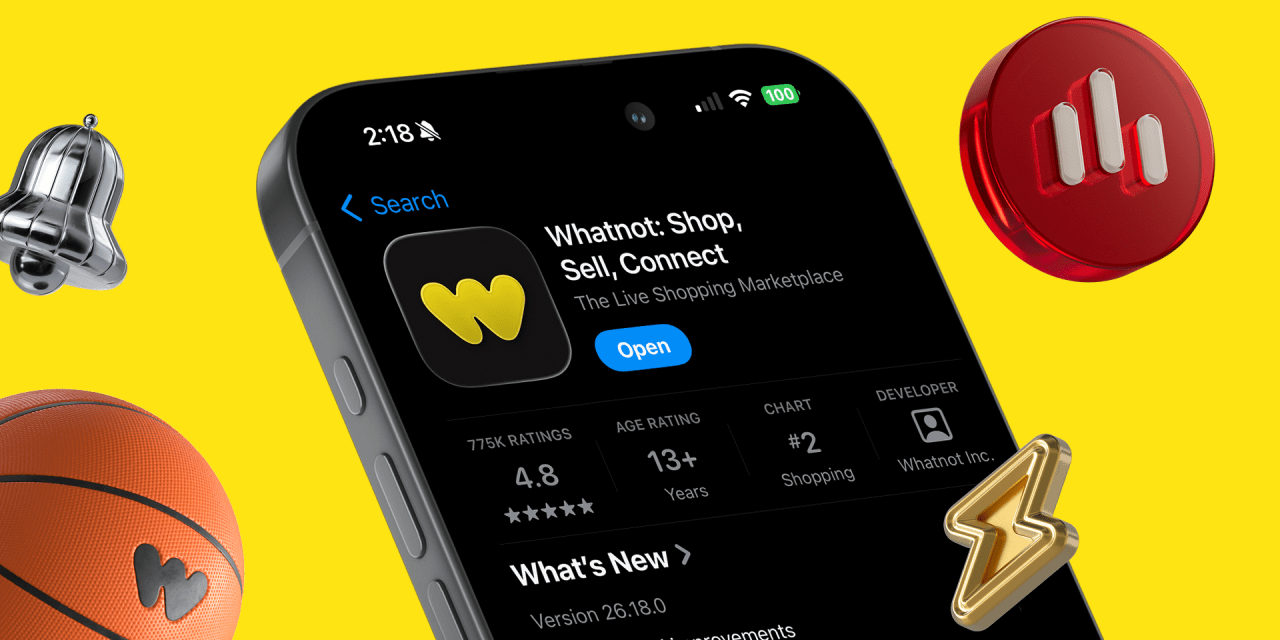
Whatnot, the livestream shopping app, now integrates directly with Shopify, opening the door for millions of merchants to sell on its platform as it looks to drive growth and wider mainstream adoption of live selling.
The integration, which launched Wednesday, lets Shopify merchants sync products, inventory and orders automatically to Whatnot, ensuring listings stay accurate and stock is consistent across both platforms. Previously, Shopify merchants selling on Whatnot had to duplicate their catalogs or manually track inventory across platforms.
Product details, pricing, condition, variants and inventory can be managed within a merchant’s Shopify admin, while live shows are run through Whatnot. When a customer makes a purchase, the order is sent back to Shopify, where the merchant manages fulfillment.
Since it launched in beta at the end of last year, businesses using the integration — around 30 — have generated more than $10 million in sales across nearly 20 categories, including collectibles, pets, fashion and food, according to Whatnot. The integration is available in the Shopify App Store across the U.S., Canada, France, the U.K., Germany, Belgium, the Netherlands, Austria and Australia.
Founded in 2019, California-based Whatnot has grown by letting mom-and-pop sellers and small businesses hawk their wares on its peer-to-peer, auction-style live shopping app, with collectibles, trading cards and memorabilia driving most of its sales. Now the company is trying to level up. By opening the door to Shopify’s vast merchant base — which powers the websites of millions of merchants and accounts for 14% of U.S. e-commerce — Whatnot is betting it can attract more sellers, including bigger brands across a wider range of categories, and in turn drive more revenue through its marketplace.
“A lot of what we’re working on right now fits this vein of: How do we make sure we recognize that Whatnot isn’t only for small sellers?” Tom Verrilli, Whatnot’s chief product officer, told Modern Retail in an interview. “It’s increasingly for folks who want or need to move a very large amount of product.”
“Merchants grow when they can meet buyers wherever they are shopping,” Jeff Kennedy, Shopify’s partnerships lead, told Modern Retail in a statement. “Whatnot’s live commerce community is one of the most engaged in e-commerce, and now it connects directly to the products, inventory and orders that merchants already manage in Shopify.”
Whatnot has emerged as a rare bright spot in a cooling e-commerce sector, raising more than $500 million across two funding rounds last year. The data suggests investors are bullish on livestream shopping, which has struggled to find its footing outside of China, where live shopping is a $703 billion industry, according to eMarketer. Whatnot is one of the few U.S.-based platforms to gain meaningful traction with live shopping, which has been slower to take hold in the West.
Sellers on Whatnot had $8 billion in sales last year, more than double the figure from 2024, the company announced in January. Whatnot’s seller base is growing, as well: One in eight sellers now operates full-time, a 20% increase year over year, according to the company. Sellers who go live three to four times per week average more than $13,000 in monthly sales, and the platform added more than 20 million new user accounts in 2025.
Still, as Whatnot pushes to bring live shopping further into the mainstream, it faces stiff competition from larger platforms, particularly TikTok Shop, which is now the size of eBay. TikTok Shop’s sales from big-name brands — those with at least $30 million in annual revenue — nearly doubled year over year, the company previously told Modern Retail.
For Whatnot, getting more merchants onto the platform with its new Shopify integration doesn’t guarantee success. Live shopping works very differently from a typical online store, and not every brand is set up for it. On Whatnot, sellers need to host live shows, talk through products and interact with viewers in real time. That takes time, effort and a different kind of skill set than listing products on a website.
“If you’re a brand, you still have to figure out how you’re going to be the ones who are broadcasting something to your audience,” said Juozas Kaziukėnas, an independent e-commerce analyst. “These are not regular retail channels.”
Whatnot hopes its new Shopify integration could help bring more sellers onto the platform at a time when many are curious about live shopping but haven’t tried it yet, according to Verrilli.
“There is nothing that is sold on the internet today that isn’t better sold live,” he said. But, he added, “it can feel quite daunting to get started” if it means changing how a business already operates. “A lot of what we believe this could do is lower the difficulty for somebody to get started on Whatnot,” Verrilli said.
The partnership also comes as Shopify has been pushing further upmarket, adding features designed for larger, more complex businesses and signing a wave of big-name brands like Estée Lauder, Barnes & Noble and E.l.f. Beauty. That expansion could benefit Whatnot by making it easier to reach more established retailers already using Shopify’s tools to manage large catalogs and multiple sales channels.
“I’m very interested to learn how big brands want to work on Whatnot over time,” Verrilli said. “We genuinely believe that live is a really important channel for sellers of all sizes.”
Some early users say the Shopify integration is already having an impact. Gaines Pet, a brand specializing in all-natural dog treats, said inventory management had previously limited it to going live about 10 to 12 hours a week. Now, the brand is streaming nearly 30 hours a week and expects to increase that by another 30% next month, according to Dewar Gaines, the founder of Gaines Pet. “I can now confidently say that Whatnot is our fastest-growing (and arguably most powerful) sales channel,” Gaines said in a statement.
For Whatnot, that kind of growth from sellers is the goal. As Verrilli put it, “If this helps [sellers] continue to scale their businesses, then it helps scale ours.”