


Hims & Hers says its first-ever gummy prescription is driving a high adherence rate
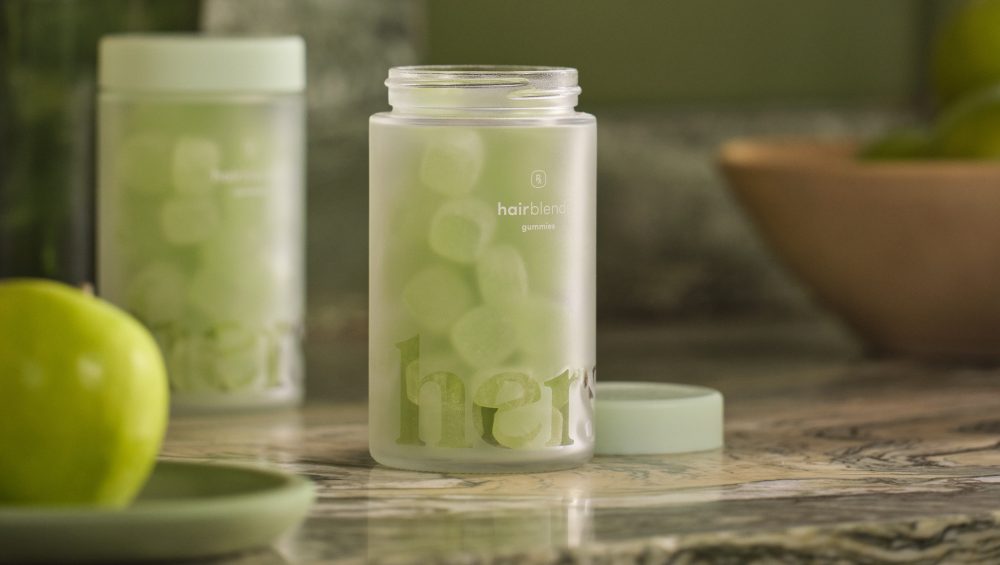
Expect prescription drugs to look and feel more like CPG brands as they adopt form factors like gummies and packaging like luxe glass jars to appeal to wellness-focused customers.
When Hims & Hers launched the Biotin + Minoxidil Gummy for hair growth back in June 2025, it was the company’s first-ever attempt at a prescription gummy product. Dan Kenger, chief design officer, said it’s part of the company’s larger strategy to differentiate itself from other prescription drug providers by offering a more contemporary look and feel.
“A big core of what we do is taking what’s happening in other industries and bringing it to pharma,” he said. “I think that’s one of our superpowers because we deal with familiar form factors from non-pharmaceutical spaces, and bring them here.”
One year in, the results are promising: Hims & Hers surveyed 300 customers and found that 88% said they take the gummy every day, an adherence rate that indicates people took to the form. While the green apple flavor was a key reason 79% said they keep taking the gummy, nearly 2 in 3 of those surveyed said the packaging itself — a frosted glass jar simply labeled “Hair Blends” — made the experience more positive.
The product’s success points to how the pharmaceutical and CPG industries are continuing to blend as the definition of health and wellness evolves. Pharmaceutical companies are increasingly addressing wellness and nutrition demands around hair growth, skin health or beauty standards, especially with the breakthrough popularity of peptides and the rise of GLP-1 drugs. At the same time, CPG and beauty brands are doing more science-backed research around their products to appeal to shoppers who want to buy products that will give them bona fide results, evidenced by the claims made in the “skinification” movement.
Gummies in particular are playing a big role in this convergence, showing up as sleep aids, beauty supplements or nutrition products. Though they’ve taken a bigger share of the vitamin aisle over the last several years, they’re showing up with new formulations as customers seek new solutions. Grüns, one of the fastest-growing companies in the category whose signature product combines superfood greens with prebiotics and adaptogens, crossed a $300 million annualized revenue rate just 24 months after launch.
Gummies are also showing up in new places: Ulta’s new wellness boutique that piloted earlier this year, for instance, includes gummy wellness companies like Olly and Lemme.
Kenger, who oversees all creative touch points at Hims & Hers, from product design to flavor to advertising, said the company aims to use design as a way to drive business. Part of that is meant to de-stigmatize prescription products around sexual wellness, mental health or self-improvement, he said — and adopting a familiar, friendly form factor like a gummy can help do that.
The company’s latest earnings report, released in May, showed $608.1 million in revenue during the first quarter, a 4% year-over-year increase, with a full-year guidance of $2.8 billion to $3 billion.
“We’re really creating a category,” Kenger said of the gummy. “It’s prescription, but it has the self-improvement aspects of a supplement. ‘I want my hair to grow.’ ‘I want clearer skin.’ ‘I want to lose weight.’ Those aren’t necessarily chronic conditions. They’re things where someone has proactively decided they want to make themselves better, and I think showing up with the product in a considered way really pays off.”
Form, flavor and packaging
But as Hims & Hers discovered, getting the gummy experience right on a prescription basis was easier said than done. That included finding the right manufacturing equipment. “There aren’t a lot of prescription-grade gummy machines that can accurately dose every gummy,” Kenger said. “Acquiring, tweaking and customizing that machine was a big part of the process.”
The formula itself also had to get dialed in. The green apple flavor at first was too much like candy, and dialing it down made it more palatable for users to take in the morning. Then there was ensuring the right formula gummy didn’t get too sticky, he said. “We went into a huge exploration with gummy shape,” he said. “What color should it be? What should the shape be? We made 3D samples. How did it feel in your hand? How did it bite? How did it handle light?”
Beyond how the product looks, the team wanted to zero in on a packaging format that felt elevated. Kenger said it was the first time they did a frosted glass jar that shows the product inside. That wouldn’t work as well with a white or blue pill, he said, but the apple-green gummy can be seen through the bottle.
Kenger said packaging is a big part of product development because that’s how the company interacts with the customer on a daily basis.
“We’re always using the judge of, ‘Would you put it out on your counter?’ You don’t have to hide it beneath your shelf. You don’t have to hide it in the towel closet. Would you just put it there next to the soap as a decorative ornament?” he said. “When people take medication every morning and look at that, they’ll feel a little less like, ‘This is a gnarly thing to take.'”
But making physical products, Kenger said, “is always such a marriage between design and operations.”
That means making sure the glass jar wouldn’t crack under the bottling machinery and would hold up to shipping processes. The team also had to find a place for a clear label that tells pharmacists whether it’s a 30- or 60-day dose, and Kenger said it took a few tries to come up with the right placement. It also developed a new box that could hold up to three jars and survive a five-foot drop without breaking.
Using design to drive habits
Kenger said the overall goal in making the gummy product feel elevated was to ensure that it was something people wanted to take every day.
“Adherence is the No. 1 thing with all medication,” he said. “Our whole thing was: Can design drive adherence? And I think the data says that it can. We’re thinking through those nuances of how you pluck it out of the jar, how sticky it gets, what it tastes like.”
Ellie Rubenstein, co-founder and managing partner at private equity firm Manna Tree who focuses on the health sector, said one of the biggest indicators of a product’s success is the “daily moat” factor, or whether people can form a habit around a product. “That’s my new standard of saying if something’s going to make it, because you just don’t have that much time,” she said. “What do you do that actually sticks?”
Design and form factor are two key ways products can work their way into the daily moat, and Rubenstein said gummies check both boxes because of their convenience compared to powders, injections or pills. “Gummies are easy. They travel well. You take your two sleep gummies, you feel good, and you really do notice that you feel better,” she said.
To that end, Kenger said the company will consider gummy formats for other products down the road.
“I’m excited about continuing to bring innovative products to market, to help people and to use the power of design so it continues to drive different business results,” he said.