


That’s it. launches new fruit bars with varying fiber content as ‘fibermaxxing’ interest explodes
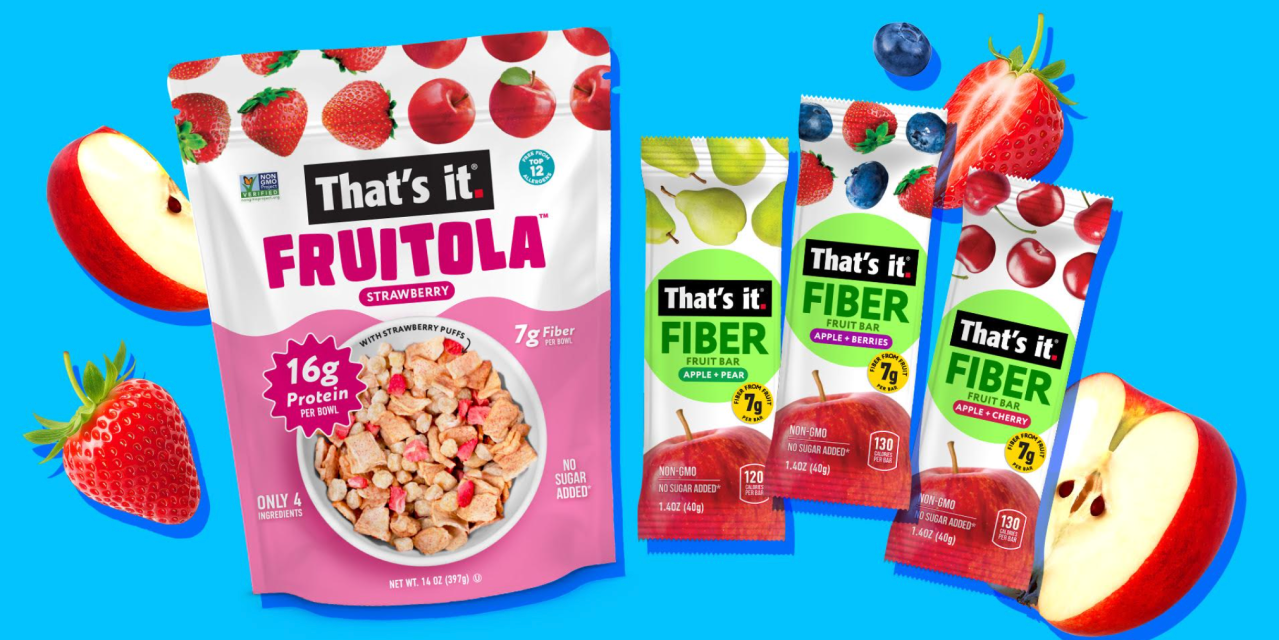
That’s it., known for its chewy two-ingredient fruit bars, is upping the fiber content in its new products.
That’s it., founded in 2012, currently brings in over $100 million in annual revenue. Its name speaks to the fact that its bars contain no added sugar or preservatives — “packed with 100% real fruit and That’s It.,” its website proclaims. Now, for its next growth phase, the snacking brand is venturing further into the hot fiber space.
That’s It.’s newest line of fiber fruit bars features three versions of the same product, but with different amounts of fiber. There’s a fun-sized version of the bar that contains just two grams of fiber and is designed for kids. Meanwhile, the full-size option offers seven grams of fiber, the highest amount the company has offered in a bar to date. An “in-between” mini option with four grams of fiber will be exclusive to Sam’s Club. The new fiber fruit bar line is set to debut at Expo West next week, along with the brand’s new “Fruitola,” a fruit-based, four-ingredient granola with no added sugar that delivers 16 grams of plant-based protein and seven grams of fiber from fruit.
The new line will begin rolling out nationwide in mid-March across several retail partners, including Target, Walmart and Sam’s Club.
Katie Eshuys, president of That’s it., said that while “protein is obviously still king,” consumers are increasingly looking to increase their fiber intake — including some who are leaning into the “fibermaxxing” trend — to improve gut health and promote satiety.
“Everything we do ties back to consumer insights,” Eshuys said. “And the data shows that 95% of Americans are lacking adequate fiber in their diets.”
This surge in fiber demand prompted That’s It. to start pitching buyers on an expansion of its bar line, with a tweaked recipe and packaging. In a post-GLP-1 world, major manufacturers – from Kraft Heinz to PepsiCo – have increasingly highlighted macros like protein and fiber per serving. “So we put a massive fiber call out on the front and back of our packs,” Eshuys said. “We also wanted to create a differentiation between our core fruit bars and the new fiber fruit bar line.”
But while fiber has been catapulted to the forefront of the snacking industry in 2026, Eshuys said, not everyone can digest that much fiber without discomfort. Many health experts also recommend that people increase their fiber intake gradually, so their bodies can get used to it.
The new fiber fruit bars are an evolution of That’s it.’s popular fruit bars, but contain more fiber than the classic version. “It was actually an easier lift for us because it was a simple formula change,” Eshuys said. A lot of fruits’ fiber source comes from the peel, she said, so it was just a matter of tweaking the formula to add more peel and naturally increase the fiber dose.
These different versions are also tied to the brand’s retail strategy, with each fruit bar launching in different retailers and targeting specific shopper groups.
“We partnered with each of the retailers based on what their needs were for their particular [snack] aisle,” she said. For example, Target was ready for a smaller-sized bar with kid-friendly packaging for its lunchbox assortment. “Whereas, when we were talking to Walmart, their goal was a larger format, and they wanted seven grams minimum,” said Eshuys.
Kantha Shelke, a trendspotter at the Specialty Food Association, said she expects deeper personalization of macronutrients such as protein and fiber in the Make America Healthy Again era. “The MAHA era is seeing a fundamental shift where consumers no longer want one-size-fits-all nutrition,” Shelke said. They want products to be calibrated to their biology, age and goals. “Retailers are picking up on this because their shoppers are asking for it,” Shelke added.
Now, this demand is seeping beyond supplements and medical nutrition and into the mainstream snack aisle. Shelke said the new high-fiber line by That’s it. is an example of this hyper-customization because it segments fiber by both portion size and physiology. It also helps brands target the right customer and their needs as more Americans consider their daily fiber intake.
“Fiber needs differ significantly across life stages,” Shelke said. For instance, children ages 4-8 need about 17-20 grams per day, while adults need 25-38 grams depending on age and gender. “While a seven-gram fiber bar is a functional contribution for an adult, the same dose in a child’s lunchbox could cause real digestive discomfort,” she said. “Getting the dose right matters.”
Eshuys said that for That’s It., one of the driving forces is that “we’ve adapted our product hierarchy and structure based on some of the retailer’s needs.” She also noted the growing competition within the functional snacking category as a major incentive for That’s it. to differentiate itself.
“We wanted to be very clear about the amount of fiber in each product, because there aren’t a lot of brands doing that yet,” she said, specifically in the bar category geared at casual family snacking. “That is going to change as more consumers look for it.”