


Guitar Center plots its turnaround, with a focus on serving ‘serious musicians’
Nearly six years after it declared bankruptcy, Guitar Center says its turnaround efforts are striking a chord.
A privately held company, Guitar Center just marked its ninth quarter of positive growth, CEO Gabe Dalporto told Modern Retail. Guitar Center’s most recent quarterly sales are up 5.2% to total $635 million, per Bloomberg. Meanwhile, time spent in the brand’s 300 stores is up 16% year over year, while store traffic is up for the first time in more than a decade, Dalporto said. The company also expects to see about $16 million in tariff refunds.
It’s been a long road toward recovery for Guitar Center. The company, which is based in California, started in 1959 and catered to famous clientele including Eddie Van Halen. In 2007, it was acquired by private equity company Bain Capital for $1.9 billion — a move that saddled the instrument seller with approximately $1.6 billion in debt. In 2014, Ares Management Corp. took controlling ownership of Guitar Center, therefore reducing its debt, but also failing to fully kickstart growth. Then, Guitar Center filed for bankruptcy in 2020 amid the pandemic. It exited bankruptcy under Ares, Brigade Capital Management and Carlyle Group.
Today, Guitar Center is still chipping away at millions of dollars in debt, and it’s fending off competition from digital-first players. “I’ll be the first to say there’s still a ton of work to do,” Dalporto told Modern Retail in an interview. But Guitar Center is also reaping the rewards of several changes it has made on the marketing and merchandising sides, Dalporto said. These include returning to Guitar Center’s core customer (the hardcore musician), as well as holding more events in stores and using AI for everything from recommending products to scheduling guitar lessons.
While Guitar Center caters to beginners, its most avid customers are “serious musicians,” Dalporto said. They don’t necessarily need to be playing gigs, but they do tend to view music as “a big part of their identity,” he explained. “It could be a kid who’s just picked up an instrument and is playing a couple of hours a day. It could be a major touring artist who’s going across the country. It could be someone who has just enjoyed playing music their whole life.”
Dalporto said he understands this well, being a musician himself. “I am the target customer,” he said, gesturing to his office lined with guitars. He’s also not a retail insider, having come to Guitar Center from Lending Tree and the online education platform Udacity. But he believes his passion for music gives him a window into what musicians expect. Today, Guitar Center is becoming “an experiential environment, with knowledgeable people and great products,” he said. “That’s worked incredibly well.”
“Everybody told me retail was hard,” Dalporto added. “And it’s a lot of work and a lot of discipline. [But] it’s not hard. It’s just like, ‘Talk to your customer and give them what they want.'”
Fine-tuning Guitar Center
Dalporto joined Guitar Center in 2018 as a member of the company’s board of directors. He then became CEO in 2023, after Guitar Center continued to see sales falter. When announcing Dalporto’s leadership, Guitar Center said he had “deep expertise” in “digital transformation, customer acquisition and maintaining a best-in-class customer experience.”
While Guitar Center had emerged from bankruptcy a few years earlier, the move “didn’t fix the underlying problems,” Dalporto said. “We made a lot of decisions that, maybe, in isolation made sense — cut a little cost here, cut a little cost there — [but] in aggregate, really pissed off our customers.”
Dalporto, a longtime guitar player, set out to hear from shoppers in his first weeks on the job. Many voiced frustrations with the company’s selection. Most of Guitar Center’s customers are dedicated musicians, but about 70% of the merchandise consisted of lower-end products.
What’s more, Guitar Center had scaled back on employee training after conducting a series of cuts. Customers wanted advice from store associates, but the company “had taken away the knowledgeable salesperson,” Dalporto said.
Products also weren’t accessible; instruments were often locked up or located on high shelves. If a customer wanted to try a guitar, they had to wave over a store worker, who often needed a ladder to retrieve items. “If you’re trying guitars, you’re going to try 10 or 15 of them before you find the one you like,” Dalporto said. “Imagine just the terrible experience that is [when products aren’t immediately available].”
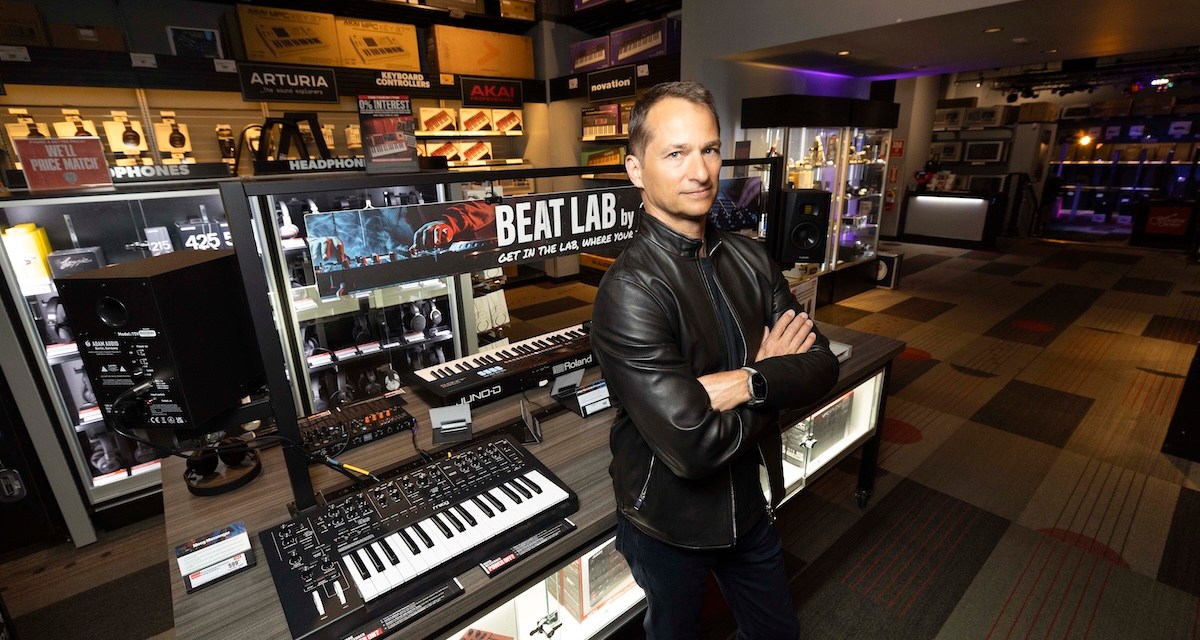
It was important, Dalporto said, to make the company a place where people “want to come and play.” First, Guitar Center flipped its inventory from being 70% “entry level” to being 70% “serious musician.” It unlocked guitars and keyboards, placed them at eye level, and hooked everything up to speakers. It created an experience called Beat Lab, in which customers can try out electronic mixers. It installed guitar pedal tables and sound walls.
Events took center stage, too. Guitar Center started holding monthly workshops, with topics like modifying your guitar and building a pedal board. In February, Guitar Center’s Hollywood store held a masterclass with Kiki Wong from The Smashing Pumpkins. In April, the band Periphery partnered with Guitar Center to host listening parties for its new album. In June, Guitar Center’s Atlanta store brought in record producer Zaytoven for a Beat Lab demonstration. “There were just lines out the door,” Dalporto said.
Guitar Center is also setting up talent competitions. In May, it brought back its Drum-Off event for the first time in nearly a decade. Participants could go to any Guitar Center store, sit at a drum kit, take a video of themselves drumming and submit a clip using a QR code nearby. Contestants are now being whittled down from 2,000 people to six finalists. In August, those finalists will perform in Hollywood, along with the drummers from No Doubt and Green Day. The winner will get $25,000 in cash, an endorsement deal and Guitar Center gear. A future contest will focus on bands.
“What we’re trying to do is to engage with all the incredible local musicians in all of our markets locally and provide a national stage for them,” Dalporto said. “The last thing we want to be is Best Buy — a completely and utterly standardized national box retailer. We want to feel like the local music store who has deep personal connections with local artists.”
Tools in the works
It’s a mixed time to be a guitar seller. Per the National Association of Music Merchants (a nonprofit global trade association), fretted instruments and related products — including amps, effects and strings — remain the industry’s largest product category by dollar volume. “It’s safe to say that industry success depends on a vibrant guitar culture,” NAMM spokespeople wrote in a 2026 report shared with Modern Retail.
Still, sales haven’t been consistent across categories. In 2025, as a K-shaped economy arose, sales of entry-level instruments lagged, while sales of $1,500-and-higher guitars jumped. In 2025, the estimated retail value of fretted instruments declined 2% to $2.4 billion. The ERV of acoustic guitars went down 8%, while the ERV of electric guitars went up 2%.
On one hand, NAMM noted, guitar influencers on TikTok and Instagram helped to drive demand. On the other hand, some consumers were deterred by tariff-related price increases. “Ten and fifteen percent price hikes at the entry level unquestionably cost sales,” the NAMM report reads. Looking for savings, consumers also gravitated toward used products, thereby affecting sales of new products.
However, guitar fans will soon have another guitar option on the market. That’s because, this year, Guitar Center is developing a new private-label guitar.
Initially, staffers proposed a Guitar Center version of a Fender Telecaster — a model the retailer calls “the essence of what an electric guitar is.” But, Dalporto said, “The last thing the world needs is another Telecaster.” If Guitar Center was going to put out a guitar, Dalporto said, he wanted it to be different from others on the market. And he wanted it to have modern-day technology, noting that most guitar designs date back more than 50 years.
Dalporto was also adamant that the product be built from customer feedback. In March, he and some engineers at Guitar Center set up a subreddit called r/GuitarLab to ask guitar players about their biggest frustrations and needs. “Come build a guitar with us from the ground up,” the page’s description reads. So far, Dalporto has posed questions including, “Hardware — what stays solid, what falls apart?” and “Controls — how much is too much?”
Internally, Dalporto got “a lot of pushback” on the idea, he shared. Reaction from Redditors has been mixed, too. “Gabe, I love what you’re doing here. This is exactly the kind of thinking the guitar world needs,” one person wrote. “DONT [sic] GIVE THESE CORPORATE JACKALS ANYTHING!” someone else wrote, highlighting terms that say the company can use people’s submissions “without any payment or attribution obligation of any kind.”
It will take approximately a year to make the private-label guitar. In the meantime, Guitar Center is investing more in AI, including by holding hackathons and giving ChatGPT licenses to employees. Earlier this year, Guitar Center rolled out Rig Advisor, an AI tool that answers customers’ specific queries, like, “I want to sound like Jimi Hendrix on ‘Purple Haze.’ What should I play?”
Employees can also use an AI tool called Pitch Practice to simulate talking to customers and answering their questions. The employees then get feedback on their responses. “The goal is, every morning, before they hit the sales floor, they do one or two of these practices,” Dalporto said. What’s more, Guitar Center is revamping how it schedules its guitar lessons with the help of AI and is building a database of resources for lessons. Dalporto stressed, “It’s all in support of the human instructor.”
There’s still room for improvement. For one, the company is still trying to cut down its debt. In July 2025, it was able to push back its loan repayment deadlines from 2026 to 2029. Last month, the company completed a sale-leaseback on its headquarters to free up $19.3 million in extra cash.
But Dalporto is also optimistic about the future and what Guitar Center can provide. “We don’t want to be the place where you just come and buy your string instruments and leave,” he said. “We want to be the place where you feel comfortable hanging out, playing [guitar], forming bands. … We’ve invested hugely in making Guitar Center a theme park for musicians.”