


Fitigues is back after its founders reclaim the ‘90s casual brand
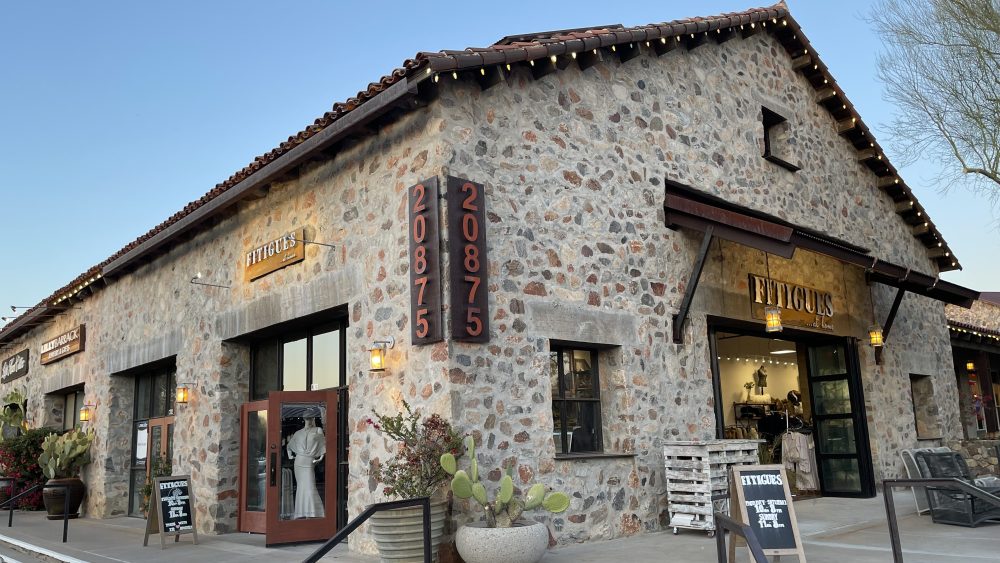
Fitigues, a popular ’90s casualwear brand, is back in business after founders Steve and Andi Rosenstein regained control of the brand’s intellectual property, kicking off with a new flagship in Scottsdale, Arizona.
Some fashion insiders may remember Fitigues for its elevated sweats and standalone stores in up-and-coming neighborhoods. Fans can still score some of its ‘90s and early 2000s designs, which are being sold as vintage on eBay. But the Rosensteins left the brand in 2007, about a year after selling it to Chico’s, at odds with the cookie-cutter corporate culture that comes with scaling within a portfolio company.
But last year, the Rosensteins secured the brand’s IP from Sycamore Partners, paving the way for a new chapter of Fitigues. In December, the Rosensteins opened a brand-new Fitigues flagship in a luxury shopping center in Scottsdale. It also has a store in Newport Beach’s Fashion Island and a burgeoning e-commerce presence. And from a consumer demand perspective, the Rosensteins are betting that people are ready for more elevated yet comfortable casual wear.
“We have so many people coming in, whether it’s in the stores or just people that we’re reconnecting with online because they know we have Fitigues back,” Andi Rosenstein said. “And so many of them say the same exact thing: ‘It feels like it is so your time right now.'”
“It’s our baby again,” Steve Rosenstein said.
The Fitigues revival is a rare instance of a founder recouping their brand after selling it off to a corporate portfolio. But the retail world has ample examples of founders who boomerang back to where they started after selling or losing control of their first brand. Hamdi Ulukaya, founder and CEO of Chobani, regained majority control of the company in 2018 after a prior investment from TPG. Others choose to relaunch a new brand, albeit on their own terms this time. Cosmetics founder Bobbi Brown, for instance, started Jones Road Beauty after selling her eponymous brand to Estée Lauder and waiting out a 25-year noncompete.
The revival of Fitigues also comes at a time when there’s heavy competition in the “casual luxury” apparel space. Lululemon, for instance, has dominated, while the Nike x Skims collections are stealing headlines.
Jean-Pierre Lacroix, president of brand consultancy SLD who specializes in brand transformations, said there’s room for competitors to shake up the market if they can have a strong vision to communicate to their potential audience.
“Not everyone wants to say, ‘I’m wearing Lululemon,'” he said. “There is room in the marketplace for a new competitor to the established brands. But they have to be extremely focused. This is a very crowded category.”
Building a brand for the first time
Steve Rosenstein and his wife, Andi, first launched Fitigues in 1988. He worked in the surf apparel category, and they aimed to create a brand that could work “from gym to happy hour to back home again” for young professionals.
“We were bumming around on the weekends in our old college sweatpants and inside-out sweatshirts. And that started to spill into where we were spending our leisure time, which was in gyms after work,” he said.
At the outset, Fitigues aimed to be a throwback to sporting goods stores or vintage Army/Navy stores. It sold both men’s and women’s clothing, then eventually maternity and kids’ gear as the Rosensteins’ own family grew. “We didn’t go into any shopping malls. We looked for that great corner in the city where we could actually be part of an up-and-coming neighborhood,” Steve Rosenstein said.
By the early aughts, the brand had operated as many as 30 stores across 20 states. It also sold wholesale through Nordstrom, Neiman Marcus and Bergdorf Goodman, and was hitting $30 million in annual revenue.
Andi Rosenstein said the brand stood out to shoppers because it went beyond basic sweats, with more tailored cuts, draped fabric and unique embellishments. It was also made in an elevated, soft fleece, which sold at the higher end of the price scale, at around $20 a yard.
“It has a little bit more style. You don’t feel like you’re just running home from the gym and throwing a sweatshirt on,” she said.
But expanding further required the kind of capital the brand didn’t have. So, in 2006, the Rosensteins made the decision to sell to Chico’s, which also owned White House Black Market and Soma. Chico’s acquired 11 of Fitigues’ 14 stores, and said in a press statement at the time that it would operate the chain as a “new branded division of Chico’s.”
Steve Rosenstein said the hope with the sale was to build a bigger footprint. Chico’s started to turn its priorities elsewhere due to downturns in the market, and any direction it was offering wasn’t what the Rosensteins wanted to hear. The founders disagreed with putting Fitigues stores in bland shopping malls versus neighborhoods and couldn’t run the show the way they wanted to in this new environment.
“We lost all control,” he said. “[We lost] the soulfulness of the brand and the organic approach we took to everything, from design to packaging, to the looks of the stores, to the locations of the stores.”
Getting Fitigues back to founder control
Steve Rosenstein said he didn’t pay much attention to what was happening with Chico’s after his and Andi’s departure. And though Fitigues was a relatively new investment, Chico’s shut down the brand’s stores within a year. “I knew when we left that they were going to shutter the brand,” he said.
After leaving the company, the Rosensteins embarked on different business ventures. First, they renovated and operated an entertainment venue in downtown Phoenix called The Duce. And in 2011, they launched a new brand called R&R Surplus that had a similar look and feel to Fitigues, and sold through their former department store accounts at Phoenix-area resorts. The output was small, hitting around $2.5 million in sales. And they began to think about getting back into retail in 2024 after one of their Phoenix resort boutique partners was converted into a pastry shop.
Around that time, Steve Rosenstein also saw news that Chico’s was in trouble. The company had lost as much as $178 million due to Covid-19-related shutdowns and, with a deal announced in September 2023, was then acquired by Sycamore Partners. He had his attorney, Jamie Sprayregen, call Chico’s to see if they could buy Fitigues back. There was no response.
Then, in January 2024, Steve Rosenstein saw the headlines about the Sycamore Partners deal getting finalized. Sprayregan sent another inquiry, and a few months later, Sycamore responded.
Sprayregen told Modern Retail that the deal happened without any money exchanging hands, though, of course, there was some paperwork involved to ensure that the Rosensteins could operate the brand again. There was little commercial value left in the brand, according to Sprayregen, making the handoff more symbolic than financial. And it’s unlikely Sycamore, which took Chico’s FAS Inc. in a deal valued at $1 billion, saw much competition in Fitigues.
“I applaud Sycamore for being willing to do that,” he said. “It was basically for the sentimental value.”
A 21st-century revision
Once a fresh trademark for Fitigues was back in hand, the Rosensteins refocused their plans to open an R&R Surplus store, deciding to instead open a Fitigues store. They began scouting for a location near their home in Phoenix, landing on a large, stone-walled corner location in North Scottsdale that’s adjacent to dining, supermarkets and other bounties. “It’s probably the coolest retail location I’ve ever had,” Steve Rosenstein said.
Sales in the first month exceeded expectations by 50%. Future stores aren’t out of the question, but the Rosensteins said they plan to first focus on the first two locations and continue to grow e-commerce. They’re also hosting events, like a fundraiser for the Children’s Hospital of Phoenix.
Lacroix, the brand consultant, said re-launching brands comes down to a three-point playbook: ensuring the product and vision are relevant, defining the customer experience, and nailing basic operations before scaling.
“The risk is that they’ve been out of the market while a lot has changed — in technology, consumer trends and behavior,” he said. “They’re doing the right thing by scaling slowly and making sure that when they hit the market — and potentially scale to multiple stores — the model is baked.”
Andi Rosenstein sees the brand as a bit more edgy and elevated than typical athleisure, with ankle-length cardigans and lacy and stud accents.
But it features the same soft fleece and high-quality fabrics from the same supplier the brand has worked with for over 30 years. She said Fitigues will continue to roll out men’s, women’s and kids’ collections, with her younger son Luke contributing to design on the men’s side.
“Obviously, dressing casual and comfortable is something that’s here to stay — it’s not going anywhere. But I think people are ready to take it up a notch,” she said.
Sprayregan, a longtime friend of the Rosensteins, attended the grand opening in Scottsdale in December. As a longtime bankruptcy attorney, he said he knows the retail industry can be tough. But, he said, he’s glad to see the Rosensteins have their brand back — and he’s also excited for more comfy gear.
“I get made fun of a lot because I keep a lot of my clothes for a long time,” he said. “I still have my Fitigues clothes, and so I was glad that there was gonna be some new stuff I could buy.”