


Brands Briefing: Salomon is working to double its US store count by 2028
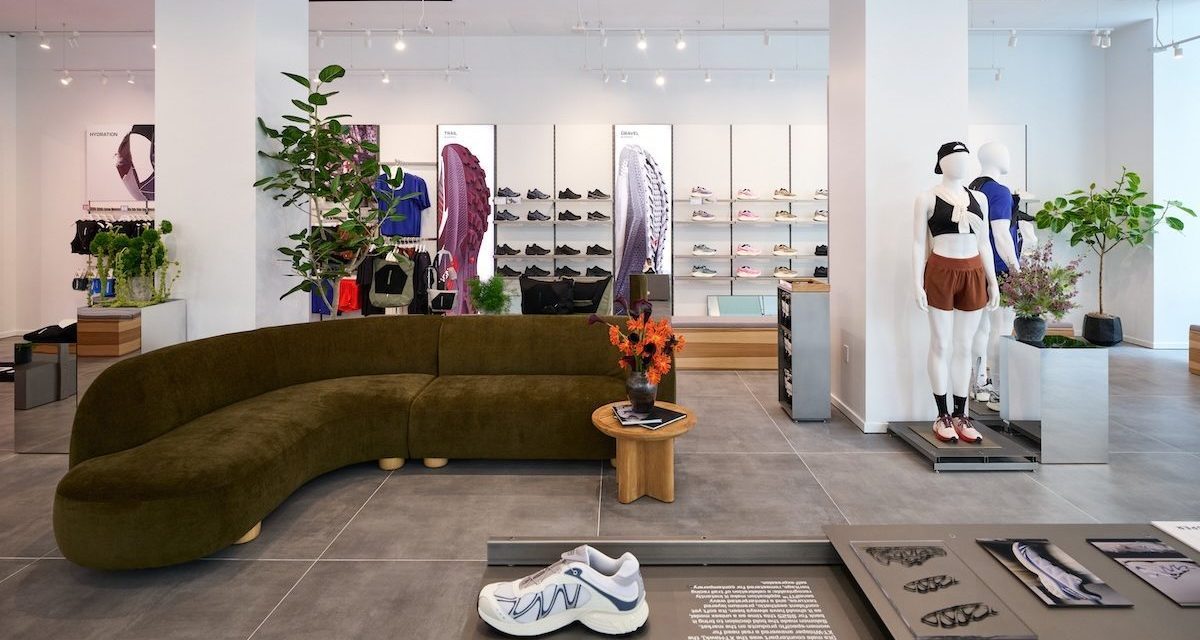
Salomon has its eye on North American store expansion as it gears up for its 80th birthday in 2027.
The European brand — which sells performance footwear, apparel and gear — is looking to plant its flag across the U.S. in a bigger way in the coming years. Salomon opened a new store in New York City earlier in July, bringing its number of standalone U.S. stores to six. The brand also plans to open a location in Beverly Hills this fall and is eyeing markets such as Boston, San Francisco and Miami. In total, Salomon could see its U.S. store count reach 12 to 15 by the end of 2027, said Steve Doolan, Salomon’s general manager and president of the Americas, in an interview.
Salomon currently operates four stores in New York City, a store in Chicago and a store in Los Angeles, in addition to an outlet in New York’s Central Valley and an outlet in Ogden, Utah. When it comes to new stores in the U.S., the company is going “city by city,” Salomon’s CEO Guillaume Meyzenq said in an interview at Salomon’s new store in New York City’s Flatiron neighborhood. As Salomon plays in both performance and lifestyle, it’s focusing on building in large cities, as well as ones where “consumer demand is really popping up,” Meyzenq explained. Salomon’s U.S. stores have achieved four-wall profitability within the first year, Doolan added.
Founded in 1947 in the French Alps, Salomon initially made a name for itself as an outdoors brand popular with skiers, hikers and snowboarders. Nowadays, it straddles the line between performance products and fashion-forward products — or, what the brand calls “sportstyle.” Rihanna, for instance, wore Salomon shoes during her Super Bowl performance in 2023. In addition to footwear, Salomon sells clothing, accessories and hydration products. Salomon has stores in more than 20 markets, including one store in Canada and more than a dozen stores in Mexico.
Salomon is owned by Finnish retail conglomerate Amer Sports, which also oversees Wilson, Atomic and Arc’teryx. In May, Amer Sports said its total first-quarter revenue was up 32% year over year. In February, Amer Sports CEO Jie Zheng called Salomon a “rising star” and revealed that Salomon had surpassed $2 billion in sales in 2025. The brand, Zheng said, grew 35% year over year.
As stores are key to growing Salomon’s profile, the brand plans to make its owned stores into “community hubs” with programming and events. On July 8, Salomon will celebrate its new Flatiron store with a community run, a custom gear bar and an electrolyte happy hour. The brand also tends to tailor its stores to the needs of the surrounding community. Its Upper West Side store, for instance, carries more hydration vests, compared to other locations, due to its proximity to Central Park.
Even as it opens more standalone stores, Salomon isn’t forgetting about wholesale. Under its so-called Epicenter strategy, the brand is working to increase wholesale distribution to key department store retailers. In North America, the vast majority of the brand’s business, about two-thirds by Doolan’s estimation, comes from retail partners like REI, Nordstrom and Fleet Feet. The remaining one-third comes from direct channels, like Salomon’s owned stores and website. In other countries, like China, DTC makes up a much larger portion of the business.
As a brand growing its cultural cachet in North America, it’s crucial for Salomon to have a “full ecosystem” in retail, Meyzenq said. That includes partners who can reach different customers in different geographies. Still, Salomon’s standalone stores typically offer a larger assortment and act as a meeting place for discussions with B-to-B partners. There, Salomon can best show off “the energy of the consumer and the traffic we have,” Meyzenq said.
Salomon is going into 44 Foot Locker doors later in July, and it continues to seek out partners across the Americas, Doolan said. “For us, [wholesale] is an important part of our business and ultimately has to be a healthy part of our business, overall,” he said. Still, Doolan said, there remains a challenge “of making sure that each brand is appropriately reflected in how the product is merchandised and in the messaging that we come up with on both ends and share out.”
Likewise, it’s a challenging time for a brand like Salomon to try to expand, pointed out Beth Goldstein, a footwear industry analyst for Circana. Salomon sits in the fashion space, the performance space and the outdoor space, and “those spaces have gotten a lot more competitive over the last few years — particularly, the running space,” Goldstein said. Major players like Adidas and Nike, as well as newer players like Hoka and On, are “fighting for share,” Goldstein said. Throw in tariffs, macroeconomic uncertainty and a shaky oil supply, and there’s more uncertainty to deal with.
Still, Salomon is confident in its positioning, executives said. “We’re incredibly intentional about every single dollar we spend,” Doolan said. “[And] Salomon has a long heritage of really designing and building durable footwear, as one example, and I think that’s something that is important to consumers.”
In 2026 and beyond, the brand sees ample room for growth — not only in other markets outside of Europe (like the U.S., Australia and Japan), but also in fields like traditional running (in addition to outdoor and winter sports). Some of its new products, like its GRVL concept (pronounced “gravel”), are more specialized to fit consumers’ needs. “It’s just a really soulful aspect of running,” Doolan said. “You’re sort of out there and connected to dirt, which for me, is the piece that I like.”
Ultimately, right now, it’s important for Salomon to lean into its heritage, while also “telling the story of what you’re bringing to the table,” Goldstein said. “Not trying to necessarily be everything to everybody — that’s always a challenge for brands that are looking to grow into broader spaces,” she continued. “How does everything fit into the story that they [Salomon] want to be telling?”
What we’re reading
- Bath & Body Works picked Hilary Duff as the face of its new fruit-forward body line. (Glossy)
- Gymshark’s founder is in talks to buy back a portion of the 21% stake he sold to private equity in 2020. (Business of Fashion)
- Krispy Kreme is hand-decorating donuts to try and appeal to younger customers. (WSJ)
What we’ve covered
- Nike says it expects $986 million in IEEPA tariff refunds.
- OluKai is tapping Hawaiian lifeguards as brand ambassadors and product testers.
- Amy’s Kitchen is championing a new certification for non-ultra-processed foods.