


Why Amy’s Kitchen is championing a new certification for non-ultra-processed foods
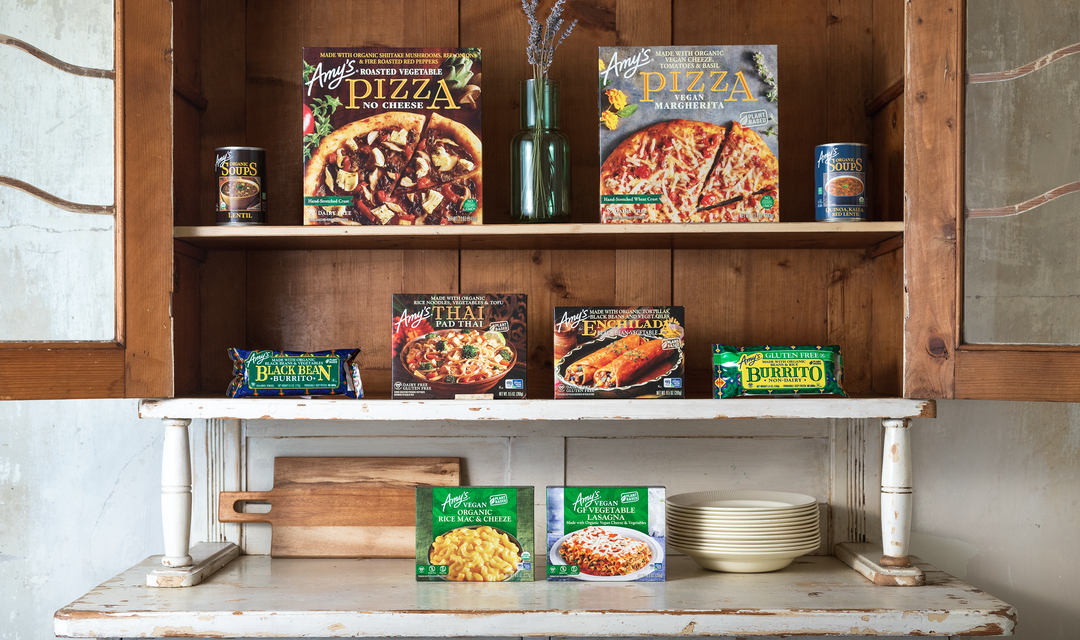
As food and beverage brands try to clean up their ingredient panels, new certifications are popping up to help guide consumers.
One of them is the new Non-UPF Verified, which stands for non-ultra processed verified, launched by the Non-GMO Project under the umbrella of the Food Integrity Collective.
Founded in 1987, food company Amy’s Kitchen was one of the founding member brands. Amy’s Kitchen was also the first frozen food brand to earn the newly-launched Non-UPF Verified certification. The company joined other brands like Simple Mills, Spindrift and Chomps in becoming founding members of the initiative.
A pioneer of the organic food movement, Amy’s Kitchen has been a first mover in pushing new standards; all of its dishes are GMO-free, and the company says it was one of the first in the industry to market non-BPA-lined cans.
In doing so, Amy’s Kitchen has built a big business. It now does approximately $1 billion in retail sales and is in over 57,000 locations.
Paul Schiefer, CEO of Amy’s Kitchen, told Modern Retail that consumers struggle to make informed grocery choices because ingredient panels don’t necessarily reveal how products are grown or produced. Schiefer says that a formal certification, like Non-UPF Verified, is a tangible way to provide customers with clarity on how processed a product is. This interview was edited for length and clarity.
Can you tell us how Non-UPF Verified works and why Amy’s wanted to join as an early brand to earn certification?
“We recognize more and more evidence that ultra-processed foods should be avoided and there are more people looking to make different choices in the grocery store. That is very difficult to do by just looking at an ingredient panel and deciphering it. Ingredient panels don’t tell you the whole backstory of how products were grown and how they were produced. And, therefore, certification really was the only approach that could get to the clarity and visibility we thought was required.
Other brands agreed, and there was a group of us that came together, along with a group of scientists and nutritionists. So the initiative wasn’t just brand-led. The certification means we understand how to verify different aspects of our supply chain, all the way down to what our suppliers do.
The goal is that it should be similar to USDA Organic or non-GMO, a standard that really defines what natural foods are. Some of the bigger CPG companies realize that the strategies of the past are not really working, and they all have to meet what consumers are looking for today.”
What are some of the criteria brands have to hit to get Non-UPF Verified?
“A lot of it is in how you’re trying to drive flavor in a product, and brands should be doing that with the ingredients. If you want to have an oregano flavor, use oregano.
There are a lot of natural flavors in food products that often aren’t. So they might chemically relate to a flavor they are mimicking, but they are not derived from those ingredients. So, it’s about deriving flavor from the source, doing it in a highly natural way. In the case of Amy’s, we only use herbs and spices.
We don’t use any synthetic or even natural flavors that try to emulate flavor. Dyes is another one, where if you need color for some reason, you have to find it through real whole food ingredients and not with Red 40 or whatever. And there are now even questions around synthetic color. Because even if it comes from a natural place, they can have a lot of gums and coagulants and other processing aids in them. So it’s about minimizing the scientific chemical way of extracting flavor, food and nutrients, and going back to the way that I believe food is typically consumed at home. At the same time, we are trying to draw a reasonable line between all-natural and processed.”
How much work went into getting Amy’s certified?
“We had this philosophy centered in our business for so many decades, so it really was not a hard lift. We didn’t have to go out and reformulate, which unfortunately isn’t true for a lot of brands out there. But we’re not in this for competitive reasons. We really believe we can create a better food system over time, and maybe at some point we won’t need the standard anymore, but for now, it helps.”
With all the big CPGs trying to reformulate without artificial food dyes and additives, do you anticipate more label confusion as they try to get around regulatory standards?
“I am not a subject matter expert on dyes because Amy doesn’t use them. But I think a real standard is needed because a consumer can see ‘natural dye’ and not know what that means. So you’d have to take it all the way back to the source. How did they get the coloring out of that ingredient? If they do it in a genuine, credible way, then I applaud it.”