


What’s driving frozen yogurt’s second act, as 16 Handles and Go Greek experience a renaissance
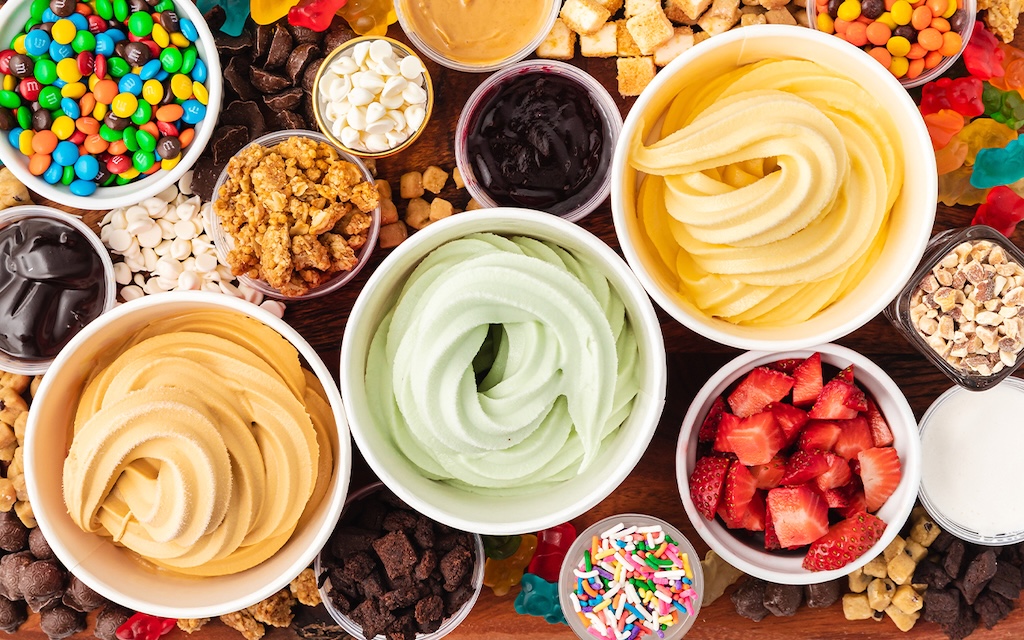
On hot summer days, some people are waiting in line for over 30 minutes to pay upward of $10 a cup for frozen yogurt.
That may sound like a sentence that was written in 2010, but this is a 2026 phenomenon. Frozen yogurt is once again having a moment. Upscale concepts like Mimi’s (which sells Australian-style frozen yogurt) and Go Greek are going viral for generating lines around-the-clock in New York City this summer. Some are even opting to get froyo for breakfast to avoid the crowds.
The resurgence of frozen yogurt shops has been attributed to a confluence of trends. Some of it has to do with Gen Z’s affinity for viral experiential shops, combined with an interest in the wellness benefits associated with yogurt, such as gut health and high protein.
While much of the current buzz surrounds flashy new entrants and pop-up activations, like Mimi’s and Go Greek, established players like 16 Handles say they are also experiencing quiet growth. By leveraging a long-standing operational foundation and a franchise model, the company says its stores are experiencing double-digit growth that can be sustained beyond the current froyo hype. But that hasn’t stopped other brands from hopping on the frozen yogurt bandwagon to promote their own products in an approachable, better-for-you format.
Incumbents adapt
This isn’t the first time frozen yogurt has had a moment. TCBY, one of the big players in the 2010s, actually burst onto the scene back in the 1980s. In the 2010s, the trend was defined by the colorful storefronts of self-service chains like Pinkberry and Red Mango. Customers flocked to chains in search of a healthier dessert, but one where they could also mix-and-match different flavors and toppings.
Popular players opened dozens of stores; after opening its first storefront in 2005, Pinkberry hit 154 locations by 2014. These concepts even made their way into pop culture phenomena, most prominently as a beloved afterlife treat on “The Good Place.”
With the expansion of multiple players came a saturation that led to a decline in sales and eventual consolidation. Pinkberry, for instance, was acquired in 2015 by Kahala Brands, a multi-concept franchising company that owns Cold Stone Creamery and Wetzel’s, among other food service concepts.
One player that has persisted over the years is 16 Handles, which was founded in 2008. Known for its full service dessert shops and 16 rotating soft-serve flavors, the company has been on a high-growth trajectory in the last few years partly thanks to frozen yogurt’s resurging popularity. The company has signed 25 new franchise agreements in the first half of 2026, surpassing the total signed in 2025.
Neil Hershman, CEO of 16 Handles, originally came on as a franchisee in 2019 before becoming CEO in 2022. Since then, he has been on a quest to grow the New York City-based chain.
“To me, frozen yogurt has always been cool, especially in cities like New York,” Hershman told Modern Retail. But he suspects this frozen yogurt renaissance to be a reaction to indulgent concepts such as sugary cookies and pastries that have taken over social media in recent years.
“People were waiting in line for high-calorie cookies, but some want a healthier dessert they can have more often,” he said.
Overall, Hershman said a focus on improving stores’ operational efficiencies and unit economics has been key to expanding.
He said the company has also reacted to the renewed interest by frozen yogurt by investing more in marketing and unique limited-edition releases to drum up buzz. This year, 16 Handles released a limited-edition kefir probiotic soft serve. “We’ve also done these crazy flavors, like a french fry frozen yogurt made with real Idaho potatoes,” Hershman said.
But generally, Hershman said 16 Handles’ growth is due to “great marketing and a team focus on product and customer experience, which has driven more loyalty for us.”
Hershman said that with so many viral newcomers in the category,16 Handles has remained relatively under the radar despite being around the longest. “We’re rarely mentioned because, in some sense, we’re sort of the McDonald’s of frozen yogurt and everybody already knows us,” Hershman said.
“There will be brands that have staying power and ones that are going in for the hype,” he added.
Hershman said that, by far, the biggest challenge in running full-service frozen yogurt shops is the capital-intensive supply chain. “Running a commercial frozen yogurt operation takes a specific type of pasteurization process,” he said. 16 Handles sources its frozen yogurt from a Midwest giant creamery partner.
“We’ve seen same-store sales increase up to 30% from the time I acquired the brand to today,” he said, with some locations having doubled their revenue. “And we’re quietly seeing about 40% year-over-year growth in certain New York stores,” said Hershman. The goal is to continue identifying new markets primed for 16 Handles locations, to allow franchises to tailor their marketing efforts to those communities.
Similarly, Los Angeles-based frozen yogurt shop Go Greek, founded in 2012, is experiencing a new surge of growth. This year, the company opened locations in Dubai, New York City and London, with more locations planned for the coming months.
Julien Borbon, Go Greek Yogurt’s director of strategy and growth, told Modern Retail, “The demand right now is wild, but it feels different from the early 2000s froyo craze.”
When it comes to the better-for-you positioning, Borbon said the company’s low-sugar, Greek yogurt base has allowed it to organically offer a healthier take on the concept. “For us, it isn’t another buzzword,” he said. “People care so much more about gut health and clean ingredients, and what they’re putting in their bodies.”
Borbon added that with this wave, people aren’t just coming in for “a mountain of candy or a sweet treat, they’re looking for something that tastes incredible and fits into their everyday routine.” In turn, this shift is helping drive Go Greek Yogurt’s growth because guests are treating themselves more often. “They’re coming in multiple times a week,” Borbon said.
“It’s given us massive momentum as we expand,” he said. In July, Go Greek opened its first U.K. location in London. “People were wrapped around the block for over an hour. You always hope for a good crowd, but seeing people line up early shows you just how strong the appetite is for what we’re doing and serving,” Borbon added.
The company has planned openings in new markets that include Tampa, Dallas and Seattle. “We are on track to have 50-plus global locations by the end of Q1 of 2027,” said Borbon. To ride this wave into more growth, Go Greek has positioned its wellness-inspired frozen yogurt by leaning into Mediterranean flavor profiles, offering mix-ins and toppings like Greek honey, figs and olive oil.
Brands buy into the frozen yogurt craze
What also makes this froyo craze different from the early 2010s is the wide range of brands looking to ride the trend through pop-ups and limited-edition activations. This summer, Benefiber is kicking off the launch of its new marketing campaign, the Good Gut Club, with a frozen yogurt pop-up to showcase a more fun and approachable way to add taste-free and grit-free, plant-based prebiotic fiber into various foods.
The limited-time frozen yogurt pop-up at New York City’s Washington Square Park served Benefiber-infused frozen yogurt samples this summer. Josh Gabriele, brand director at Benefiber, said that “frozen yogurt is having a moment this summer, making it a relatable and relevant way to introduce the Good Gut Club.”
As interest in personal health and wellness grows, Gabriele said busy consumers are looking for formats and solutions they can incorporate effortlessly into their routine. Gabriele said the pop-up is a way for the brand “to meet people in a fun seasonal moment to show how Benefiber makes it easy to add prebiotic fiber into foods people already enjoy, like frozen yogurt.”
Probiotic yogurt brand Coconut Cult has been on a streak of froyo shop collabs this summer that include partnerships with Nude Miami, Happier Grocery and Sunlife Organics.
Coconut Cult founder Noah Simon-Waddell said the CPG brand is “consistently looking for ways to keep our customers excited about what we’re putting out there.” And so limited-edition frozen yogurt collaborations felt like a natural fit for a seasonal collaboration.
“All of our customers are looking for healthier, but still delicious froyo options,” said Simon-Waddell. “And it felt like a great time to partner with these retailers to do something fun and different.”
16 Handles’ Hershman said that while he understands why froyo comes with a health halo effect, especially when compared to options like ice cream, 16 Handles is trying to avoid tying its marketing to specific health trends. This positioning was further confirmed after testing some health-focused formats.
“I did a high-protein flavor three years ago, but it’s almost impossible to run really high-protein whey powder through pasteurization,” he said. Instead, Hershman said, 16 Handles’ long-term success is predicated on offering diverse dessert options as demand for froyo ebbs and flows. 16 Handles shops also serve smoothies, milkshakes and açaí bowls.
What also aided 16 Handles’ longevity, Hershman said, is “choosing great locations.” He added that while frozen yogurt concepts in major urban hubs are receiving a chunk of the attention among Gen Z and millennials, the company has a broader demographic target.
“Our franchisees are working with local club soccer teams and PTAs and whatever to get people in for the first time,” he said. “That has driven some new stores to achieve $2 million in sales their first year, which was unheard of in frozen yogurt.”
As such, all locations are designed to welcome customers to stick around, with stores being built with at least 25 seats. “We’ve got great franchisees who are really trying to position us as that third place community destination.”
“The hype around some of the newcomers is fine; I just don’t think many will be here in three years,” Hershman said.