


Marine Layer fights digital saturation with print catalogs and whimsical pop-ups
Renee Lopes Halvorsen, chief marketing officer at Marine Layer, likes to joke that shoppers have increasingly become “clickers, not pickers.”
That is, they are clicking on an ad, but they don’t spend much time on a site before returning to their Instagram feed.
At the Modern Retail Marketing Summit in Huntington Beach, California, Lopes Halvorsen spoke about how Marine Layer is combating digital saturation and turning more of these clickers into pickers.
While more shopping is being done online — e-commerce spending hit $88.7 billion in October, up 8.2% year-over-year — there are also some data points to suggest that more people are hitting digital fatigue, according to Halvorsen. Emarketer reports that time spent on social media is starting to plateau. There’s countless research showing that people’s attention spans are shrinking.
So, what’s a marketer to do about all of this? For Marine Layer, the answer has been to lean more into physical experiences and embrace old-school marketing tactics that allow the brand to tell a more in-depth story.
All of this fits with the original value proposition of Marine Layer. The company, founded in 2009, likes to say that it set out to create “absurdly soft” apparel that feels like a comfortable piece of clothing you’ve owned forever. Marine Layer started out in T-shirts, but has expanded into other products across men’s and women’s apparel like pants, sweaters and swim.
Print catalogs, for example, have long been a popular acquisition tool for Marine Layer. “We actually were big on catalog before we ever focused on digital media,” Lopes Halvorsen said. “We’re comfortable with our [customer acquisition costs] being higher in catalog because we know the lifetime value of catalog customers is even higher than a digitally acquired customer.”
But recently, Lopes Halvorsen said Marine Layer’s CACs from its print catalog have actually gone down — which provides yet another proof point that physical, tactile experiences are what capture a customer’s eye today.
Marine Layer does a matchback to measure the effectiveness of print catalogs. First, Lopes Halvorsen said the brand works with a partner who strips out personally identifiable information. “We look at usually a one-month period immediately after the catalog is in the home,” she said. “And you’ll look at, more or less, the yield of those buyers [who] received the catalog. We’ve also done a ton of testing over the years to understand if it’s truly incremental in a given time period.”
While print catalogs are primarily an acquisition tool, Lopes Halvorsen said they have also proven useful at reengaging with current or lapsed customers.
“It’s a way to drive full-price growth within your existing file,” she said. “I feel like a lot of the other tools people talk about using – whether it’s an offer to get you to buy if you’ve lapsed, or it’s prompting different sales throughout the year — they can kind of discipline the consumer to expect sales.” But sending a catalog that tells existing customers all about the new products Marine Layer has for summer is a way to strike up another conversation with customers without purely talking about sales.
She said her gold standard for measuring catalog success is: “Did we make it to your coffee table? … Because then it’s not a flash-in-the-pan interaction. It’s actually an opportunity for you to read through and understand who we are.”
Lopes Halvorsen said Marine Layer has seen such success with catalogs that it is experimenting with them more frequently, including with adding more fun, whimsical elements, like hand-drawn doodles, to make it look more like a travel log.
She added that she is looking for other ways to capture this “magic in a bottle” energy around other marketing moments. Marine Layer is looking to do its first creator content trip, for example, this summer.
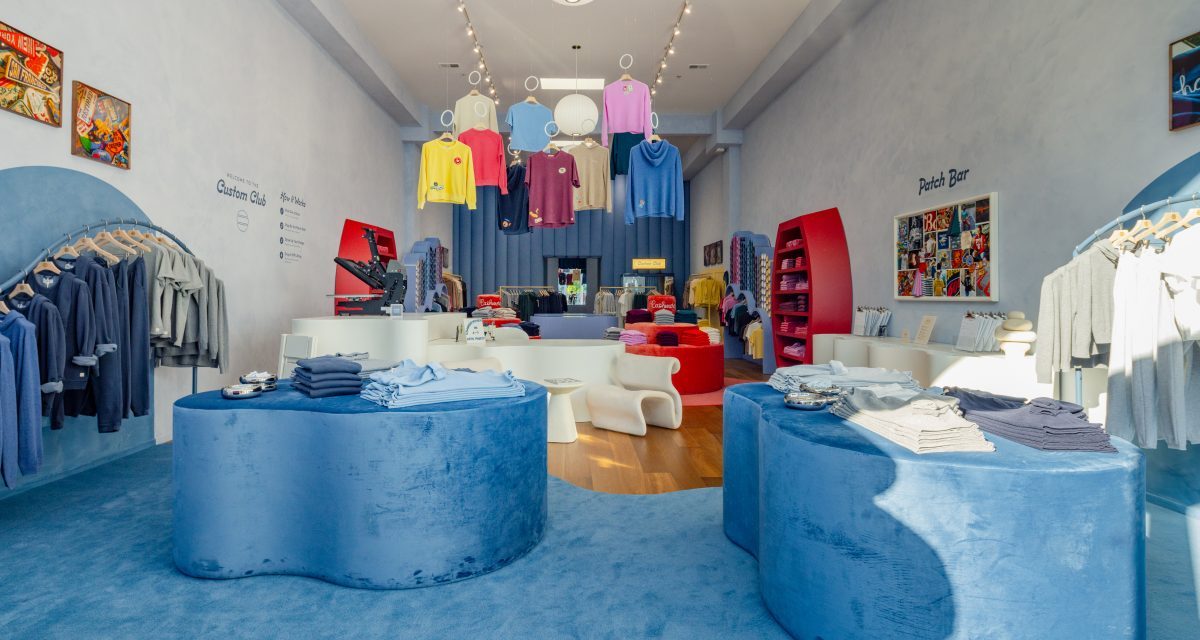
Real-life experiences are also important to telling the brand story. Marine Layer has 54 stores, which helps, but this past holiday season, the company also did two holiday pop-ups — one in New York and one in San Francisco — featuring on-site customization elements like embroidery and chain-stitching. Marine Layer branded these pop-ups as “the custom club,” and installed oversized props in the store like a giant wheel of thread and stacks of oversized sweatshirts.
“We really leaned into this idea of an immersive experience about color and soft [fabrics],” Lopes-Halvorsen said. “They were so resource-intensive within our organization — we had to move mountains to bring them to life.”
But it paid off. There were lines around the block, and Marine Layer got a lot of content from creators out of the pop-ups.
But not everyone can visit a Marine Layer store easily. So, the brand is also thinking a lot about how it can communicate the texture and feel of its products online. Lopes Halvorsen said Marine Layer recently transitioned to a new Shopify 2.0 theme. In addition, it recently brought its UX and UI team into stores to brainstorm how Marine Layer may be able to communicate some of these tactile elements online.
“The language we’ve been using is edutainment,” Lopes Halvorsen said. “How do you think about both educating and entertaining the consumers? Because knowing that their attention span is different, they have a different expectation for their site experience.”