


Gymboree turns to partnerships with brands like Marchesa for its next stage of growth
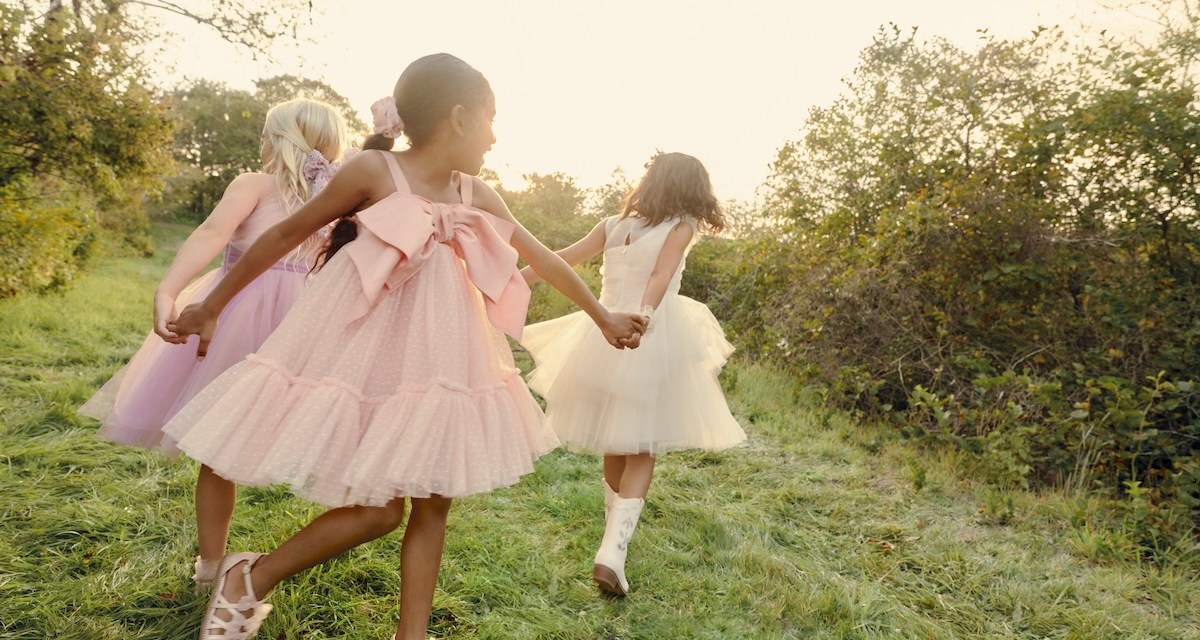
Gymboree is developing co-branded collections for all occasions as it looks to court more customers in its 40th year.
Earlier this month, Gymboree debuted its first collaboration with designer house Marchesa. The limited-edition collection includes tulle dresses, rhinestone sandals and tutu skirts, all priced from $20-$170. Also in February — but on the more everyday side of the spectrum — Gymboree rolled out baby collections with Peter Rabbit and Hello Kitty and Friends. Gymboree launched a collaboration with the New York City Ballet in October and has more partnerships in the works, Smeeta Khetarpaul, svp and head of marketing, told Modern Retail.
The new collections are a key part of Gymboree’s larger brand repositioning efforts. The company launched in the 1970s as an early-learning play-and-music center, before expanding into children’s clothes in 1986. Today, Gymboree is looking to grow market share after a hectic last decade of dealing with debt and increased competition. Gymboree filed for Chapter 11 bankruptcy twice, in 2017 and 2019, and emerged from the latter instance by closing 800 stores. The brand relaunched under The Children’s Place, Inc. in 2020 and is now betting on nostalgic-yet-contemporary collections to “lean into [its] heritage” while taking advantage of “today’s design sensibility,” Khetarpaul said.
“When you’re coming back in the market and coming back in culture, you want to … put out something that’s attention-grabbing,” Khetarpaul said. “These partnerships allow us to show what Gymboree can do and the value we can bring to our customers’ lifestyle.”
Gymboree’s turnaround efforts also come at a time of change for its parent company. In December, The Children’s Place, Inc. — which also owns The Children’s Place, Sugar & Jade and PJ Place — announced that it had secured $450 million in refinancing. Also in December, The Children’s Place, Inc. reported that its third-quarter net sales dropped 13% year over year, to $339.5 million.
Collaboration nation
Gymboree’s new tagline, under its repositioning, is “Born to be iconic.” As such, it’s tapping well-known partners, from upscale fashion houses to beloved children’s book characters, to grow the brand. “Our strategy is multi-pronged,” Khetarpaul said. “We are looking at different tiers of partnerships that serve different purposes, in various usage occasions, for our customers.”
It’s a mission that also fits in with that of The Children’s Place, Inc. The retailer is looking for “a merchandising reset that adds a more balanced mix of fashion and basics to our product assortment,” CEO Muhammad Umair said in a statement.
To better understand what customers want out of the brand, Gymboree conducted consumer segmentation research. It learned that target customers wanted to buy outfits for special occasions like parties, as well as playtime, at different price points. With that, Gymboree is focused on mixing quality with affordability, Khetarpaul said. “You can mix and match and [make] the right basket size for you,” she said.
Sarah Engel, president of the marketing firm January Digital, told Modern Retail that the bar for collaborations is high in 2026. “Parents can tell the difference between a thoughtful partnership and a quick licensing play,” she said. “What works now is authentic alignment and emotional relevance.”
As a heritage brand, Gymboree “needs to show it understands today’s parent, while honoring what people loved about it in the first place,” Engel continued. The Marchesa and Peter Rabbit collections do this, she said, because the former “elevates perception,” while the latter “taps into cross-generational nostalgia.” When it comes to partnerships, though, “I would caution: The risk is doing too many,” Engel said. “When brands chase buzz rather than seek partners that exemplify their clear point of view, they dilute their brands.”
So far, the collaborations are resonating with Gymboree’s audience. A Gymboree spokesperson said that the Marchesa Mini x Gymboree launch achieved sales that “significantly exceeded” expectations. The collection saw more than 32,000 unique site visitors within the first four days of launch. Also, in that period, social engagement surpassed 223,000 impressions across Instagram, TikTok and Facebook.
A growth plan for Gymboree
Gymboree is marketing its new collections in multiple ways, including through paid media and events, Khetarpaul shared. Gymboree recently brought on a new social media agency, and it’s working to increase its influencer program. “[We] have a very digital-first mindset for Gymboree’s [marketing] growth,” Khetarpaul said.
The majority of Gymboree’s sales come from e-commerce. Still, Gymboree wants to appeal to parents who want to shop in person. Gymboree is currently available at more than 80 The Children’s Place stores, and the brand is “looking at expanding our store footprint,” Khetarpaul said. The Children’s Place, likewise, is trying to have “an increased physical store presence,” Umair said.
Gymboree’s growth plans also come at a challenging time for the children’s clothing market. While some players in the space (like Walmart and Old Navy) are expanding kids’ assortments, others (like Carter’s) have closed stores. The industry is also getting hit hard by tariffs. The Children’s Place, Inc., for instance, projected that tariffs would result in incremental expenses of up to $20 million for the 2025 fiscal year. There’s also the matter of demand, as U.S. births declined in 2025, affecting the customer pool.
“Because of the volatility of the category, [children’s clothing] hasn’t been, honestly, a safe haven,” said Jessica Ramírez, co-founder of The Consumer Collective. “The market, in general, is quite tough, and it’s been quite tough in recent years. There have been spurts of births, but they haven’t been consistent enough to say, ‘Here’s a growing market.'”
Still, there are some glimmers of hope, Ramírez said. Off-price retailers like TJ Maxx tend to do well in kids’ clothes, she said, and designer brands are finding a following with matching mommy-and-me outfits. The companies that manage to stay fresh and relevant can “do it well,” Ramírez said.
Despite obstacles in the industry, Gymboree is confident it can grow market share and increase perception. “Our whole job here is to build a new community for this brand, so that it grows with a very strong base,” Khetarpaul said.