


NeeDohs are fetching a premium on resale sites
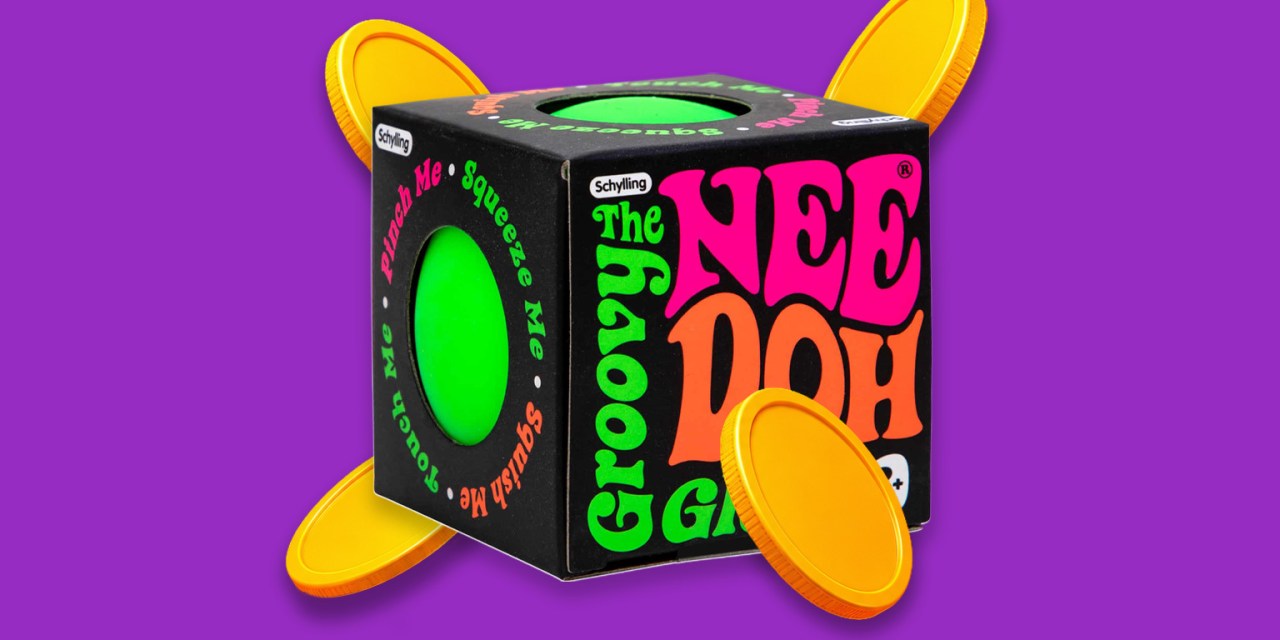
Stationery and Toy World in New York City is packed with all kinds of gizmos and gadgets: fidget spinners, plush toys, frisbees, coloring books. What it doesn’t have — and hasn’t had for weeks — is the colorful, squishy, blob-shaped sensory toy known as NeeDoh.
It didn’t used to be this way; a Stationery and Toy World employee told Modern Retail that two years ago, it was hard to move NeeDoh advent calendars at all. Store workers ended up putting units in the window to get more eyeballs. However, over the last few months — thanks to, what else, viral videos on TikTok — NeeDoh has become the “it” toy. Now, its manufacturer, Schylling, can’t keep NeeDohs in stock. In fact, it sold through the whole year’s inventory within the first nine weeks of the year. Amazon, meanwhile, lists many units as “currently unavailable.”
Today, eager collectors are flocking to resale sites, ready to snap up whatever NeeDohs they can. But the stretchy toys, like last year’s viral Labubus, are selling for a pretty penny, thanks to supply and demand. Most typically retail for $5-$8, although large NeeDohs, special versions and multi-packs can go up to $30. But, on StockX, NeeDohs are going for a premium of more than 400%. On eBay, sellers are listing NeeDohs for hundreds of dollars.
An alternative to slime, NeeDoh is a stretchy sensory toy that comes in many shapes and styles, from a gumdrop to a gummy bear to an ice cube. Schilling launched the first NeeDoh in 2017. Its “Nice Cube” is a top seller, though multi-packs are also driving sales, Schylling CEO Paul Weingard told Business Insider. Since late last year — when TikTokers took notice of NeeDoh’s advent calendars — the toys have become a hit on social media. Videos of “NeeDoh hauls” regularly rack up millions of views on TikTok and Instagram. One video, of a fan cutting up their NeeDoh, “ASMR” style, has 10.4 million views on TikTok.
“The NeeDoh craze is a clear example of how quickly demand can scale up when a brand and a product hit on the right things, from a social perspective and from a cultural perspective,” Drew Haines, the senior director of marketplace at StockX, told Modern Retail. “And then, whether it’s accidental or on purpose, when a product becomes scarce and you can’t find it, there’s clear demand on the secondary market.”
The need for NeeDoh
StockX added NeeDohs to its website in early March, after noticing the brand pick up on social media. StockX has made more than 2,500 NeeDoh sales to date, with sales up 150% from March to April. More than 50,000 people searched for “NeeDoh” in the first four months of the year, ranking among the top 10 most popular new search terms on StockX. It’s currently a top 10 collectible on the site.
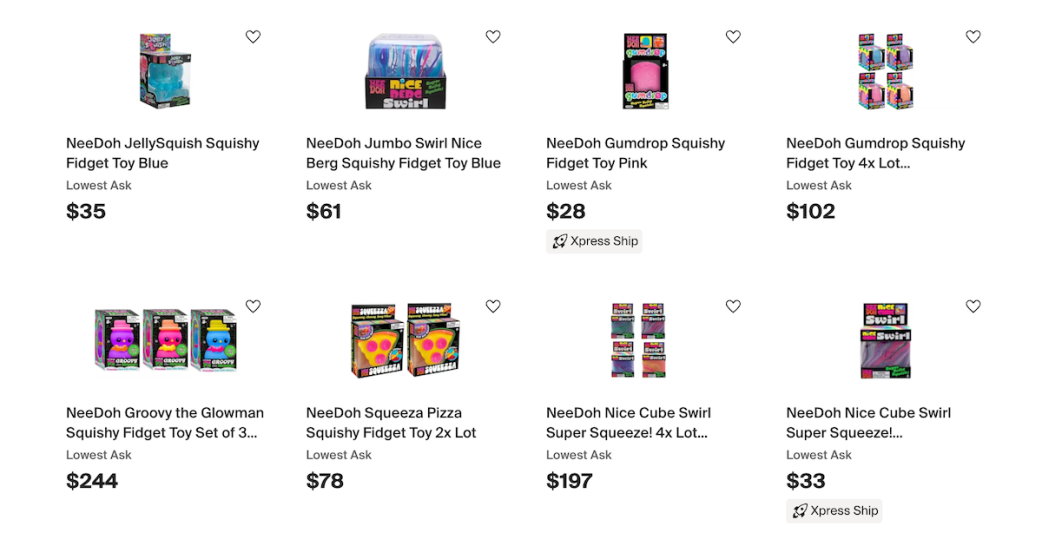
There, resale prices are climbing. In April, the average NeeDoh was $44, up from $42 in March. Meanwhile, the average price premium — or how much a product is selling for on StockX, compared to its MSRP price — was a whopping 449% in April, up from 413% in March. Because there are so many variations of NeeDohs, StockX employees spent “months” cataloging the different types to be in a good position to sell the toys, Haines said.
On other resale sites, the toy has taken off, too. EBay shared that, in March, searches for “NeeDoh” in the collectibles category increased by more than 710% from the month before. Meanwhile, in April, eBay searches for “NeeDoh Donut” jumped more than 190% over the prior month. NeeDohs are even popping up on apparel resale websites, like Poshmark (where they range from $25 to over $500) and Depop (where they’re mostly around $20).
As the products have now become hard to get, fans are sharing tips and tricks on where to snag them. A Facebook group to buy, sell and trade NeeDohs has 91,000 members. Meanwhile, on Reddit, the NeeDoh subreddit has 40,000 weekly visitors.
The trend resembles, in some ways, the hype around Labubus, the wide-eyed, grinning figurines from Chinese toy maker Pop Mart. Those went viral last year, thanks to a mix of TikTok videos, “blind boxes” and celebrity endorsements. Labubus were also popular on resale sites like StockX and eBay, as the toys released in limited batches on Pop Mart’s app.
“I would not be surprised if a lot of the people who were flipping Labubus last summer are now flipping NeeDohs,” Haines said.
Both toys have also become prone to counterfeits on resale sites and other online platforms. In Labubus’ case, a knock-off (usually with the wrong number of teeth) is known as a “Lafufu.” Meanwhile, fake NeeDohs often come in plastic wrap, with blurry pictures and text on the packaging. Spelling is also a dead giveaway; some products listed on Shein say “NooDoh” or “NooDol.” Eagle-eyed fans have set up entire threads on Reddit and Discord to distinguish real NeeDohs and real Labubus from fake ones.
StockX, for its part, is working with its operations partners to authenticate NeeDohs, as it does for sneakers, trading cards and other products. “When we launch a new brand, that’s a big part of our process,” Haines said. “[Counterfeits] are obviously a problem and one that we take very seriously.”
From a fidget toy to a status symbol
As for the real NeeDohs, Weingard, the CEO of Schilling, told Business Insider that the company is stepping up production as much as it can. It hopes to replenish its stock by the summer. “It’s incomparable to anything else we’ve ever done in terms of the popularity and demand,” Weingard said. “It’s certainly challenging in a respect. We never designed NeeDoh to be a viral craze; it wasn’t intentional.”
Those who bought NeeDohs last year, or even several years prior, are transfixed by the recent hype. Reagan Klinger-Neviska, who was also early to the Labubu craze, learned about NeeDohs three years ago. “I was getting a tattoo, and tattoo artists often have fidgets,” she told Modern Retail. “They had one of the cube ones [‘Nice Cube’].” She then went out and got her own in 2023. She purchased another in 2024.
NeeDohs are typically used as stress relievers, akin to a Koosh ball or a fidget spinner. One NeeDoh owner named Ana, for instance, told Modern Retail, “It’s just really soothing when I’m anxious. I use it a lot before a big meeting or an interview.” Similarly, another NeeDoh fan shared with Modern Retail that as a neurodivergent person, they were very excited that a fidget toy like NeeDoh has become extremely popular among the masses.
But there are still challenges with NeeDohs, aside from their scarcity factor. Many of the toys, sources shared, can warp over time. Both Klinger-Neviska and Ana ended up buying additional NeeDohs after theirs began to lose their shape.
There is, naturally, a question of whether the NeeDoh hype will fizzle out. In Pop Mart’s case, Labubus that retail for $28 are now going for as little as $7 on StockX. More broadly, Pop Mart’s U.S. sales are down more than 45% as collectors look for the next big thing.
“I think the initial inclination [around trendy brands] is, ‘Oh, this is another fad,'” Haines said. “And it could be. We don’t know. But, if these brands capitalize on these moments, create a strong community of people that really love and appreciate the products, and keep stock limited, brands can use these moments as a launch pad for something much bigger.”