


Kohl’s is stepping up its creator efforts as it attempts a sales reset
Kohl’s is funneling more resources into working with creators as it looks to reverse revenue declines and court new customers.
The company partners with about 1,500 nano-creators (defined as those with at least 1,000 followers on social media) as part of its Kohl’s Creators program, which it launched in 2024. Now, this year, Kohl’s is giving those creators a chance to earn a commission on every sale, in addition to getting free products, early access to deals and exclusive invites to events. In March, Kohl’s also formed a dedicated Trend Expert Council of four influencers to serve as “style authorities” and appear in marketing materials, including social media content. All the while, Kohl’s continues to build creator storefronts and maintain a roster of some 200 macro-creators.
Kohl’s has worked with influencers since the late 2010s, a spokesperson confirmed to Modern Retail. But the company is updating its approach as it looks to “reshape Kohl’s and how customers see us, particularly [as] this destination for style, trends and value,” chief marketing officer Christie Raymond said in an interview.
Whereas Kohl’s used to work with creators on a one-off basis, including sponsored posts, it’s now investing more in influencer content “across the whole marketing ecosystem” to connect with new and existing shoppers, Raymond said. That includes everything from bringing creators to events like the premiere of “The Reunion: Laguna Beach,” to setting up panels with the Trend Expert Council, to starting social-media series like “Fit Check.”
At Kohl’s, the goal is for creators to be “much more integrated” into the Kohl’s business, Raymond said. “We know our customers are spending time on social [media] and spending time with creators,” she said. “We know [creators] have a strong influence on what our customers wear and buy. So, it’s a really important part of our marketing mix.”
Kohl’s is stepping up its creator efforts as it looks to boost its business. For its 2025 fiscal quarter, Kohl’s reported a 4% decrease in net sales and a 3.1% decrease in comp sales. Its fourth-quarter gross revenue came in “softer than our expectations,” CEO Michael J. Bender said in a press release.
“In 2026, we are committed to further strengthening our foundation by addressing operational opportunities, building on our strengths and modernizing our processes,” Bender added. Kohl’s expects its 2026 fiscal-year net sales and comp sales to be anywhere from flat to down 2%.
One of Kohl’s biggest new creator initiatives is its Trend Style Council. The 2026 members are Allison Bornstein (a wardrobe consultant and author with 280,000 Instagram followers), Kristina Zias (a fashion expert for “The Drew Barrymore Show” with 347,000 Instagram followers), Lilly Sisto (a stylist and brand consultant with 136,000 Instagram followers) and Samantha Dawn (a personal stylist and style coach with 19,600 Instagram followers).
The Council, per Kohl’s, will create content around trends and looks from Kohl’s products, particularly its private-label brands, like FLX, LC Lauren Conrad and Tek Gear. They’ll also act as ambassadors at events and appear in posts on the Kohl’s website.
An earlier iteration of the program last year contained just one member: fashion stylist Kenzie Welch. Welch shot Instagram videos like, “How to style a minimal glam outfit for the holiday season” and “How I’m styling elevated but cozy office looks for fall.” Noticing strong engagement, Kohl’s decided to broaden out the initiative in 2026 to include even more voices, Raymond said.
So far, Bornstein has served as the face of the Instagram show “Fit Check,” which offers fashion advice such as dressing via “the rule of thirds.” Meanwhile, Zias attended the premiere of “The Reunion: Laguna Beach” and interviewed Lauren Conrad on the red carpet. In one video, Zias asked Conrad about her longstanding apparel line with Kohl’s and how she wants women to feel while wearing it. “I want them to feel comfortable and like themselves, but confident,” Conrad answered.
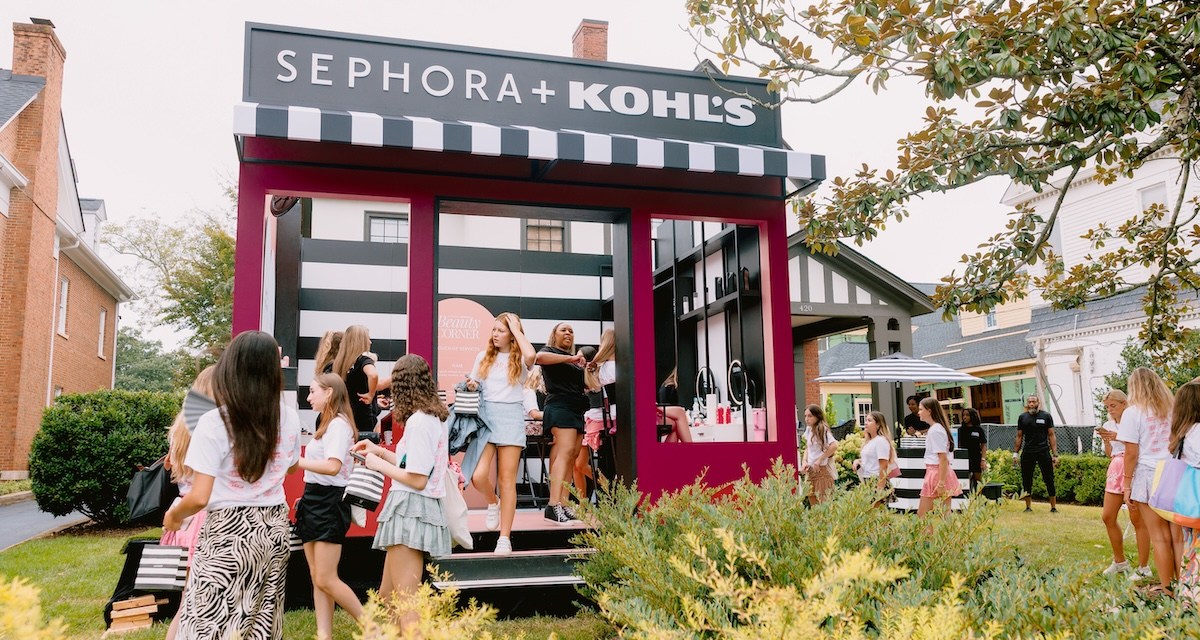
Kohl’s other creators regularly show up in content across channels like Instagram and TikTok. Last fall, for instance, Kohl’s hosted Sephora at Kohl’s “Beauty Corner” pop-ups at three college campuses and tapped TikTok creators including @thesororitysister and @under_my_umbrella to make #RushTok videos. The campaign generated “millions of impressions and an engagement rate that exceeded benchmarks,” per a Kohl’s spokesperson.
Meanwhile, another Kohl’s creator, Kate Steinberg (1 million Instagram followers), attended the premiere of “The Reunion: Laguna Beach;” one of her Instagram videos got nearly 18,000 likes.
Kohl’s picks creator partners based on which customers it wants to engage and which creators fit that profile. Some of its creators focus their content more on family, while others focus more on travel, apparel or beauty. “It’s really about thinking about our more granular objectives and the mix of creators that can help us achieve that, while making sure they’re a great brand fit from a values perspective,” Raymond said.
To that end, Kohl’s various creator partnerships have different goals, as well. For some partnerships, Kohl’s is looking to boost its broad reach. For others, like in the case of affiliate partnerships, Kohl’s is hoping to drive sales for specific events, like Black Friday. “A lot of it depends on what we are trying to achieve, and then, we measure that accordingly,” Raymond said. So far, Kohl’s creator content is resonating with both new and existing audiences, she said.
Outside of Kohl’s, creator programs are becoming popular with all types of brands and retailers. Dick’s Sporting Goods received a record 10,000 applications for its ambassador program this year, while Macy’s is bringing influencers to staple events like the Thanksgiving Day Parade. Kitchen appliance brand Ninja hosts creators at its Boston-area headquarters’ test kitchen to make sure its products are ready for video storytelling.
Kale, a creator rewards app that launched in 2022, is working with partners like Cava, Anthropologie and Sephora. It connects clients with consumers on social media who are already shopping that brand and consider themselves “super fans.” Kale finds that more brands are interested in this type of creator content, because “they understand that the power lies within their community and word-of-mouth marketing,” co-founder Isha Patel told Modern Retail.
She added, “Brands come to us all the time, and they say, ‘Our community is what makes our brand our brand. We’ve selected our name. We’ve selected our colors. But unless our community is talking about our brand and showcasing our ethos and values to the next generation of super fans, it doesn’t really matter.’ Content has become a key vehicle in making that happen.”
Kohl’s, for its part, is eager to work with more of its own “super fans” as it looks to overcome a sales slump.
“We are ensuring that, as we look at 2026, we’re doing everything we can to drive impact,” Raymond said. “If that means we need more creators, then we will certainly do that. But, it’s really [about] making sure we’re thinking about different touch points and what’s right for creators in a way that will connect with our customers.”