


Albertsons is putting digital screens for ads in more than a third of its stores
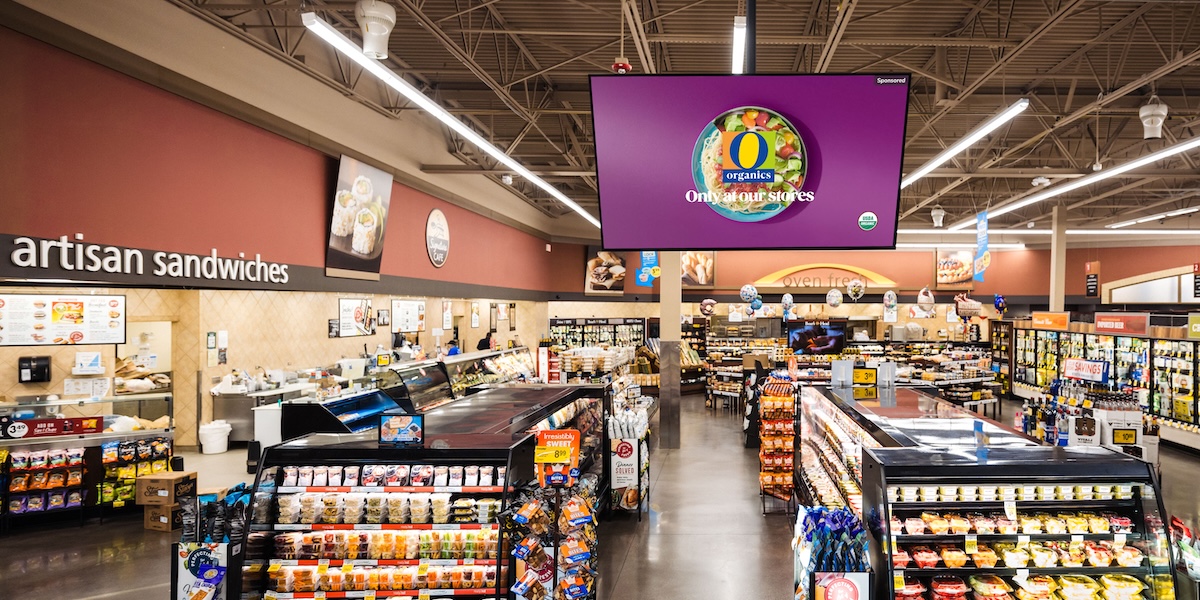
Digital screens may become far more common for shoppers to see in stores this year.
Albertsons’ retail media division, Albertsons Media Collective, began piloting an in-store digital display network last summer. The program spanned 80 stores in partnership with digital signage software provider Stratacache. The major grocer — which operates under the Albertsons, Safeway, Vons and Jewel-Osco banners, among many others — said this month that it has seen enough success in its digital screen network to begin a rollout in 800 of its 2,200-plus stores in 2026.
“The way that we’re planning it is to get as large of a footprint as quickly as possible and prioritize all of our top-performing stores,” said Liz Roche, vp of media and measurement for Albertsons Media Collective. “We’re really trying to get that scale for our advertisers as quickly as possible.”
This shows confidence by one of the nation’s largest grocery chains in the opportunity of in-store digital media. In a news release, Albertsons said it has attracted more than 50 advertising partners since launching the in-store display network last June. Importantly, it also shows Albertsons’ trust in its own ability to measure how campaigns drive sales lift — a key factor in how CPGs and other brands choose to make new retail media investments.
Advertisers can run campaigns on the screens that also span across connected TV ads, off-site display ads and social video campaigns.
Roche said its in-house measurement framework announced earlier this month was the main reason why Albertsons decided to expand its screen network, and that the company wanted to make sure it had a scalable measurement framework that can reach broad scale.
She said Albertsons has been able to prove that the digital screens create an incremental impact on sales, rather than just surface-level attribution. In other words, Albertsons believes it has found a way to measure how sales perform in stores where a given campaign is displayed on screens versus stores where it is not. The control stores without the campaign on screens could be in the same market, but the company is also determining the most comparable stores based on store format, shopping behavior and dozens of other factors, Roche said.
For example, Albertsons ran a campaign with Mondelēz to promote Sargento Cheese Bakes crackers focused on driving household penetration, category growth and incremental sales. The company determined that the screens gave the product a 14% sales lift.
“We have calibrated against a number of factors — I think over 60 factors — to make sure that we’re actually finding that causal [sales] lift down to the store level,” Roche told Modern Retail. “Once we felt really good and really certain that this is an absolutely impactful channel, we wanted to scale immediately.”
Using Stratacache’s Walkbase sensor technology, Albertsons can include impressions as part of its measurement framework.
“We’re just creating a more signal-rich environment for in-store [media] that not only lends itself to real-time optimization, but also lends itself to accountability and transparency for our partners,” Roche said. “We’ve really opted to create this infrastructure to operationalize this in such a way that allows our advertisers to find it to be reliable and repeatable, in terms of results.”
Ross Cloyd, director of grocery retail insights for Kantar, said he expects grocers to continue to push digital experiences in stores as the industry continues to embrace retail media. As previously reported, Kroger and CVS Health are among the retailers that have shared plans to grow their in-store screen networks this year.
Cloyd said bridging the digital and physical shopping journeys is especially important given that more than 90% of U.S. consumers now shop for groceries both online and in-store, according to FMI and NielsenIQ, per eMarketer. Still, he said, grocers need to be cautious not to overwhelm shoppers with screens.
“It needs to be planned out to ensure that the overall experience with the shopper turns into a positive, elevated experience,” Cloyd said. He said retailers should start putting screens in areas they know work — such as in the center of the store — and then, maybe, take them into different aisles. “It needs to be deliberate, well-thought-out, planned and then executed in those areas that make sense.”
Roche said she anticipates retailers like Albertsons will continue to test and learn to see what works in breaking down the silos of online shopping and the store experience.
“Our shoppers are not shopping in channels, and they’re living extremely omnichannel lives,” Roche said. “We need to make sure that we’re simplifying measurement, but also simplifying optimization, to not only carry that journey through when they’re in the store — but also when they’re at home and when they’re researching, and when they’re on the couch, and when they’re watching connected TV. These are all important touch points for us to orchestrate.”