


How toy manufacturer PlayMonster helped engineer a Hacky Sack revival
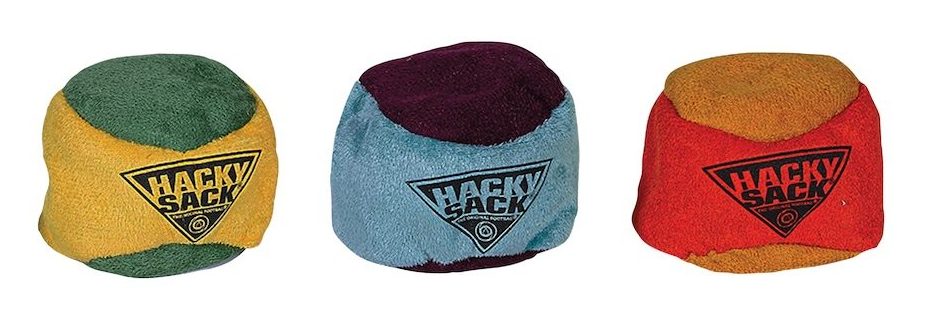
Jonathan Berkowitz, a toy-industry veteran and CEO of PlayMonster, expected “a lot of success” after working with Wham-O — a toy company that also owns the Frisbee and the Hola-Hoop — to relaunch Hacky Sack in February. What Berkowitz didn’t expect was how quickly, and just how much, the small, round bags would become the new “it” toy for today’s teens.
This spring, as the school year wound down and the weather heated up, young people began buying the toys, officially called footbags, in droves. Kids and teenagers kicked around the products at recess and at the park. They uploaded viral videos of themselves or classmates doing tricks on social media. They borrowed footbags from their teachers, in a manner similar to library books. Local toy stores sold out of inventory; other shops began limiting daily purchases.
While “Hacky Sack” is trademarked, many people use the lowercase term as a shorthand for the product category. One morning, in late May, Berkowitz logged onto his computer and was shocked by what he saw. “I remember looking at Google Trends and seeing ‘hacky sacks’ just take off,” Berkowitz told Modern Retail in an interview. “It just started to explode.” Even today, from April 15 to July 15, Google searches for “hacky sack” in the U.S. are up 1,700% year over year.
PlayMonster, a toy manufacturer that also makes Koosh balls, sold out of its branded Hacky Sacks online at the end of May, then began air-freighting in extra inventory as fast as it could. “I would say we were at low stock levels for probably eight weeks,” Berkowitz said.
PlayMonster knew it needed to make a move and “immediately jumped into action,” Berkowitz said. The week after Berkowitz looked at Google Trends, PlayMonster got to work on a new product line of Hacky Sacks, including a light-up version and a version that audibly counts how many times it’s been kicked around. PlayMonster executives jumped on a plane to China to kickstart the manufacturing process. Normally, Hacky Sacks are on a yearly development cycle; that was soon condensed into 90 days.
“We’re getting [the products] to market in record time,” Berkowitz said. “We knew [that] to really capitalize on the trend and give consumers what they wanted, we needed a lot more innovation.”
Today, PlayMonster is developing about 10 new Hacky Sack styles. The line will roll out in late July through September and be branded as part of a larger “Hack to School” campaign. Hacky Sack is also bringing on new retail partners, some of whom got on board after seeing proof that footbags were back.
“All major retailers this fall are going to have [our] product,” Berkowitz said, mentioning Walmart, Target, Amazon and Dick’s Sporting Goods. “My belief is that back-to-school is going to be even bigger than May,” he said. “We’re in a much better stock position and getting much healthier.”
The return of the Hacky Sack
The history of the footbag goes back more than 50 years to 1972, when two friends — Mike Marshall and John Stalberger — kicked around a handmade beanbag in an Oregon basement. The first packaged and branded Hacky Sacks hit stores in 1977. The toys enjoyed mainstream popularity in the 1980s and 1990s, becoming a staple at the playground and the parking lot and earning a following among skaters and punk kids.
But then, the Hacky Sack — and footbags, in general — faded from view as other toys and sports came onto the scene. A few years ago, Berkowitz — who spent years at Hasbro, working on Nerf — saw an opportunity to bring the product back.
Berkowitz started chatting with Wham-O, which had expressed interest in what he had done over the course of his career. In 2025, PlayMonster officially partnered with Wham-O to relaunch Hacky Sack. PlayMonster now has the exclusive license for the product and does its branding, marketing and product development in the United States, Canada and Mexico.
In order to pull off a successful retro relaunch, brands can’t “simply recreate an old product,” according to Americus Reed, professor of marketing at the Wharton School of the University of Pennsylvania. Rather, they should aim to create an emotional experience. “The question isn’t, ‘Can we recreate 1995?'” Reed told Modern Retail. “The question is, ‘What identity did this brand allow people to perform then — and how can that identity be relevant today?'”
For Hacky Sack and PlayMonster, that has meant making the footbags easier to kick around and even film. The refreshed Hacky Sacks, which hit shelves in late winter and early spring, are heavier than those in the 1990s, but also have more “give,” which can help with doing tricks and keeping products in the air. They’re also more performance-oriented to appeal to hardcore footbag players.
“It’s really a sports product more than a toy,” Berkowitz said. “The number of panels, the weight, what’s inside, metal versus plastic — all these things make a difference.” On PlayMonster.com, the Core style retails for $4.99, while a Cornhole version retails for $24.99.
PlayMonster is now betting on social media to market the product. Hacky Sack’s channels often repost players’ content, with some videos reaching more than 1 million views apiece. The brand also collaborates on social-media posts with footbag players, including juggler and mime That’s Ridiculous Nicholas. Hacky Sack’s official TikTok channel has nearly 40,000 followers, many of them new.
Per the brand, Hacky Sack content has surpassed 300 million video views across TikTok and Instagram. And “hacky sack” is a top term on TikTok Shop, where the official Hacky Sack account has sold thousands of units, including a $24.99 three-pack. TikTok data also shows that searches for “hacky sack” for the period between Jan. 1 and May 12 jumped by almost 7,000% year-over-year.
Offline vs. online
Many journalists have chronicled how Hacky Sacks and footbags are having a moment. A variety of factors are likely at play. Toy industry insiders, like Berkowitz, speculate that kids want to take a break from their phones and play outside. “There’s such a strong desire to connect with people and get off screens,” he said.
Tossing around footbags is also a social activity — a welcome retreat from the days of Covid-era lockdowns. “It’s kind of bringing everybody together,” Joey Finke, a senior at Wolcott High School in Wolcott, Connecticut, told The New York Times. And young people today seem to have a soft spot for the 1990s and early 2000s; a recent Vevo study found that 65% of Gen-Z respondents felt nostalgic for cultural moments they never experienced firsthand.
Is it ironic, then, that a product built for “real life” is taking off on social media? Not necessarily, Berkowitz said. In fact, he considers that by design. When people can get together in person, but also do something that’s shareable, “It’s the best of both worlds,” he said.
In fact, a search for “hacky sack” on TikTok results in videos of several footbag leagues, many featuring high schoolers or college students. PlayMonster, for its part, is an official sponsor of the New Jersey Sack Madness Tournament, which has 14,000 followers on Instagram and offered a first prize of $4,000.
In July, Hacky Sack participated in TikTok’s Discover America Tour, an in-person activation that spanned six U.S. cities. Attendees could take part in challenges to win exclusive TikTok-branded Hacky Sacks.
Reed, the Wharton professor, believes Hacky Sacks satisfy two of young consumers’ desires today: authenticity and shareable content. “Hacky Sack delivers both,” he said. “It produces genuine human interaction first — and social media content second. That’s the reverse of how many products are designed today.”
In fact, the less digital an experience feels, the more digitally valuable it becomes, Reed said. His research program is built on the premise that identity is a social process. When people see footbag players laughing in a circle in a TikTok video, “They’re not simply observing a product,” he explained. “They’re observing membership in a community. That’s why offline behaviors can spread so quickly online.”
The most successful brands today, he added, give consumers “something to participate in and a collective permission structure to do so.”
Protecting Hacky Sack
Today, there are many ways for customers to buy footbags, whether they want the original Hacky Sack or a generic version. Five Below and Target carry the actual Hacky Sack, while footbag products abound on marketplaces like Walmart and Etsy. On StockX, official Hacky Sacks are going for $17.
As teens flock to footbags, retailers and resellers are more than keen to cater to demand. The owner of Bomb Footbags, an online retailer, nearly tripled the price tag of one footbag from $13 in October to $34 in May, per Bloomberg. The style, called “the Missile,” still sold out. Meanwhile, Play It Again Sports in Concord, California gets about “15 calls a day” about footbags, a sales associate told The New York Times.
Since PlayMonster owns the trademark for “Hacky Sack,” other companies cannot use the name in their commercial branding or product logos. Berkowitz knows there are other lowercase “hacky sacks” on the market. But he remains focused on differentiation through “performance and quality.” “That’s why we’re spending so much time getting our product development right,” he said.
As an added boost, lately, search interest has been “all around Hacky Sack,” Berkowitz said. “[We were] in the top 10 search terms on Amazon. It was ‘hacky sack’ that was being searched. It wasn’t ‘footbag.'” Retail partners, he added, “want the original, in this case.”
The Hacky Sack resurgence joins other toy-and-game trends over the last couple years, including Labubus and NeeDohs. But those products, like other hot toys before them, tend to have limited staying power. Labubus, once going for hundreds of dollars on resale sites, are going for as little as $3 on StockX.
When asked how he’s working to keep Hacky Sacks from fizzling out, Berkowitz spoke about brand positioning. While Hacky Sacks are often sold at toy stores — and marketed as toys — PlayMonster views them as key items in the sports industry. Sports tend to stay popular longer, “because there’s the social aspect of the play that hooks you in,” Berkowitz said. In the toy industry, meanwhile, things “usually last a year or two,” he said.
Making new products that appeal to avid Hacky Sack players, then, will be key, Berkowitz said. The brand is also focusing on tournaments and hopes to play a larger role in high school leagues. Tournaments are held regionally, nationally and globally, with official rules and guidelines published by the International Footbag Players’ Association. Recently, the 44th Annual East Coast Footbag Championships took place in Brooklyn.
Sports have an “aspirational piece,” Berkowitz said. “Sport has more staying power, and there are levers that you can pull to keep it going. We really believe, for years to come, that Hacky Sack is going to be an amazing sport.”