


Brands Briefing: How oral-care brand Boka made the jump from Erewhon to Walmart
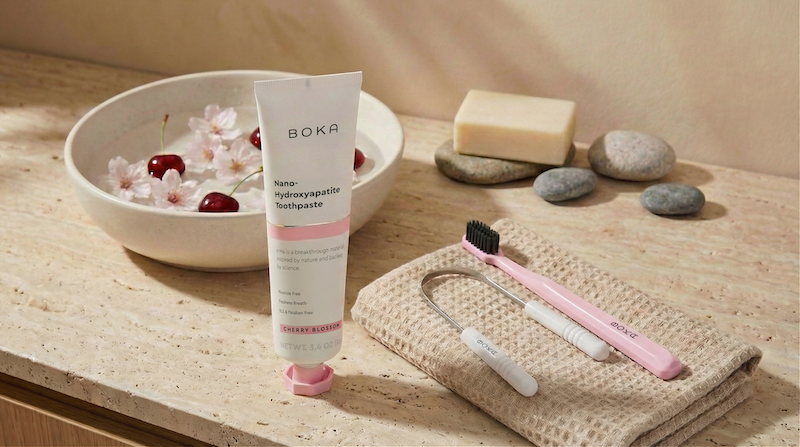
As oral-care brand Boka grows into big box and mass retail, it is betting that consumers will “trade up” in a category traditionally dominated by legacy brands like Colgate and Crest.
Many toothpastes retail for under the $5 price point, while Boka’s range from $10-$12 per tube. But that hasn’t stopped Boka from quickly expanding into retail.
The brand has been around since 2015, gradually moving from DTC and Amazon and now into national retail. The company began testing sales of its two flagship n-Ha toothpaste in late 2025 at 3,000 Walmart locations, and is now going into 4,500 Walmart stores across the U.S. With the location expansion, this week Boka is also growing its Walmart assortment from two to 10 SKUs, which include a sensitive toothpaste and a kids’ toothpaste.
Boka’s year-over-year retail growth hit 481% in 2025 and is forecast to reach a 305% year-over-year increase this year. Boka’s Walmart launch points to the continued premiumization of various CPG categories and to the fact that today’s brands have more potential pathways to growing their retail distribution than ever before.
Kinsey Butler, the senior director of brand marketing at Boka, said the Walmart launch was years in the making. “The brand awareness that we have seen through Amazon, like the search volume and the subscribe and save, is a big part of what led Walmart and other retailers to bet big on Boka,” Butler said.
The oral care brand’s biggest differentiator is its use of nano-hydroxyapatite (n-Ha) over fluoride and its offering of unique flavors like lemon lavender and coco ginger. At Walmart, the ability for Boka to sell at a bigger scale has helped bring the price of most of its toothpastes down to just under $10, the lowest of any of its retail partners.
For Boka, its business strategy now largely focuses on maintaining the premium brand identity it started with, while sitting on thousands of big-box shelves.
Maintaining a luxury perception at mass market level
Butler said that the Walmart launch comes after years of Boka building awareness and demand through specialty retailers like Erewhon and on Amazon, along with its original DTC business.
But it takes a different set of tactics to appeal to the Erewhon customer willing to spend more on personal-care products. (Last fall, Boka even partnered with the luxury grocer on an exclusive Boka-inspired smoothie, for example.)
While the Erewhon distribution has been good for buzz, building demand through mass channels like Amazon is what helped Boka prepare for big-box launches at Target last year, followed by Walmart. “The real acceleration that led to this retail expansion was our Amazon business,” Butler said, specifically when Boka became the top-selling toothpaste on Amazon in 2024, beating out Crest and Colgate.
“To support the volume associated with toothpaste on Amazon, we had to scale up very quickly,” she said. “There has been a big build-up for us in production over the last couple of years that prepared us to go into retail.”
Betting on the “beautification” of oral care
Jaemee Vanden Boogard, Boka’s senior retail sales manager, said Walmart wanted to “go big” on Boka’s first year at the retailer for several reasons. The first was the retailer’s interest in bringing in more fluoride-free oral care options, including those using European-sourced n-Ha, which is less popular among U.S. brands.
“The other piece is that we’re seeing, across retailers and across the oral-care industry, a ‘beautification’ of oral care,” Vanden Boogard said.
For decades, the oral-care aisle was dominated by the blue and red branding of players like Crest and Colgate. “The marketing was really focused on therapeutic benefits, like cavity protection and bad breath,” Vanden Boogard said. Now, brands like Boka offer those benefits but position themselves as part of a beauty routine akin to skin care or hair care.
“We are bringing a beauty customer into the oral care aisle, which Walmart is excited for as it also increases basket size,” said Vanden Boogard.
Boka’s imagery, content and marketing messaging revolve around encouraging customers to build oral-care routines. “We like to show that your teeth and oral care can be part of your beauty routine, much like you have a multi-step skin-care routine,” she said. That is also why Boka’s packaging looks more like a skin-care product compared to traditional toothpastes. “That’s also why the flavor profiles are elevated and created with spa-like botanicals,” Vanden Boogard said.
In turn, the Walmart SKU expansion is meant to offer different formulas and tastes, based on the diverse needs of Walmart shoppers. “Some folks have sensitive teeth, some are looking for whitening and so on,” Butler said.
So it was important to add more unique flavors, Butler said, which is a big draw for Boka as it tries to differentiate itself from generic minty toothpastes.
“We know a lot of people actually don’t like mint in their toothpaste, or prefer a milder version,” Butler said. “So we wanted to offer a nice array of products for those palettes.” One example is the mint-free cherry blossom n-Ha toothpaste, previously released as a limited edition in 2024 and now back in the Walmart lineup.
The kids’ line was also a major opportunity to bring families into the brand, said Butler. Per Boka’s customer data, many individuals who discover Boka eventually end up buying it for the whole family. “We also see that when people start having kids, they start to become more interested in the ingredients in their personal-care products,” Butler said, and so they can now enter the brand through the dedicated kids’ line.
Vanden Boogard pointed to Walmart’s support of this aisle’s reinvention, including in-store promotions, as helping make Boka’s launch in thousands of doors possible.
For the launch this month, the company also ran an end-cap trial in about 2,500 Walmart locations. The promotion focused on the new sensitive toothpaste at the discounted price of $9.88. Running for the entire month of March, the display’s messaging encourages Walmart customers to “trade up” from their old toothpaste to the brand’s science-backed ingredient, n–Ha. According to Boka, as of early March, the fluoride-free and SLS (Sodium Lauryl Sulfate)-free Sensitivity lines already exceeded Walmart sell-through goals by 225%.
Boka’s team acknowledged that one of the biggest changes in growing retail distribution from specialty to mass retail is scaling manufacturing even more.
“We have significantly ramped up production and actually brought on a second secondary supplier,” Butler said, adding that all of Boka’s toothpaste is made in the United States. The company originally had one toothpaste manufacturer, and since the Walmart launch, it has added a second to hit the order volumes on time. “We have also been expanding the number of packaging vendors that we work with to support this retail business,” Butler said.
Manica Blain, an angel investor in beauty and wellness and founder of Top Knot Ventures, said even premium brands need to be where their customers are. It’s why we’ve seen so many premium brands lean into Amazon over the past few years.
“Where this gets more nuanced is with something like Erewhon-to-Walmart,” Blain said. “Because that is not just a distribution expansion, it’s a context shift.” So that customer might technically be the same person, but they’re not necessarily shopping the same way in those environments.
“Boka expanding SKUs is actually really telling for that,” Blain said, adding that it’s a signal that the brand has to re-architect how it shows up in the context of its price, the customer’s entry point and value perception of the brand. “You’re not just adding doors, but you’re kind of rewriting the contract with the customer.”
“I don’t think this is about ‘selling out,’” Blain said. Many brands underestimate how much has to change to make that jump work without diluting their brand and mission. “The best brands will figure out how to exist in both places, but it is harder than it looks,” she said.
What we’re reading
- Unilever has instituted a three-month global hiring pause due to macro challenges like the U.S.-Iran war.
- Allbirds has been sold to American Exchange Group, owner of Aerosoles and Jonathan Adler, for $39 million. It’s a far cry from the $4 billion valuation that Allbirds hit on its first day on the public markets.
- Olaplex, which has also struggled on the public markets, has agreed to be sold to Henkel for around $1.4 billion.
What we’ve covered
- Coach won over Gen Z in North America. Now, it’s stepping up its focus on young consumers abroad.
- Home brands like Havenly, IKEA and more are increasingly targeting renters as home ownership remains out of reach for many.
- Poshmark unveiled its first major app redesign in 15 years.