


Brands Briefing: 40-year-old Travelpro invests in video, creators to compete with Béis, Away and other digitally-native players
This is the latest installment of the Brands Briefing, a weekly Modern Retail+ column about the growth strategies of modern brands. More from the series →
Travelpro, a brand long known for its durable luggage and loyal base of airline employees, is carrying on with a new marketing playbook as it tries to win over younger consumers.
The nearly 40-year-old company is investing more in short-form video, creator partnerships and educational content to better connect with Gen Z and millennials, Jennie Kaylie, Travelpro’s head of marketing, said. As part of this, Travelpro is launching an ambassador program later this year, and it’s airing a new campaign called “Made to Move” on channels like TikTok, Instagram and YouTube. Travelpro is also funneling more resources into Snapchat and connected TV as it looks to grow awareness.
“Historically, we’ve been doing lower-funnel [marketing]; when people are in the market for luggage, we’re targeting them,” Kaylie said. “But, if they’ve never heard of Travelpro, we’re already too late.” The brand’s new approach, she said, “allows us to reach a broader audience and resonate with them more emotionally.” Travelpro largely sells its products via its website and Amazon; it operates outlets but does not have its own retail stores.
Travelpro launched in 1987 and was the brainchild of a pilot. It has since gone on to become the luggage of choice for employees at dozens of airlines. The brand is growing in revenue, with a spokesperson sharing that sales of Travelpro’s Platinum Elite hardside collection are up 70% year over year. But while Travelpro is still marketing itself to airline professionals, it’s also trying to win over more consumers at large. That includes “the next generation of travelers,” Kaylie said.
“We were really popular a couple of decades ago, and those folks are still very loyal to the brand,” Kaylie said. “But millennials and Gen Z aren’t as familiar with the brand, because we haven’t targeted them, historically. We’re trying to get that younger audience — those that are traveling for work, with their families, and need gear to keep up with their very busy lifestyles.”
Travelpro’s shift in strategy comes as the brand tries to keep pace with the ways in which people are traveling today. Many young people are combining business and personal travel via “bleisure,” especially after the pandemic. Now, Travelpro wants to position itself as the leader in luggage that can go from the boardroom to a rooftop dinner. “We stopped leading with the bag and started to lead with consumer behavior and consumer aspirations,” Kaylie said.
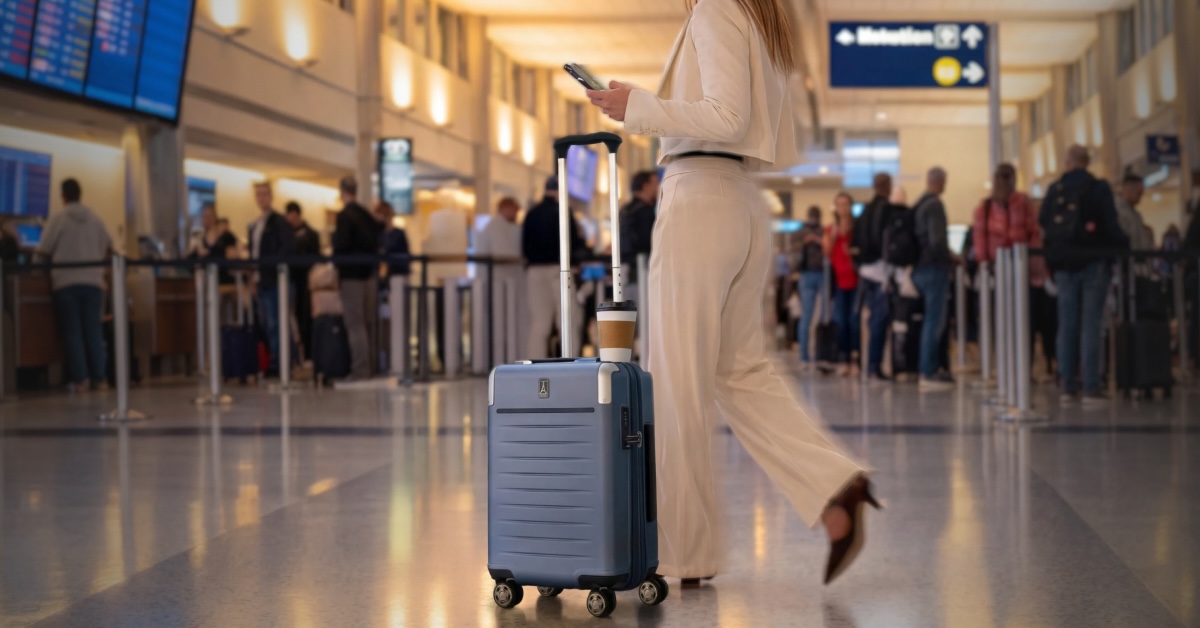
Travelpro’s marketing content still stresses the technical aspects of its bags, such as its “PrecisionGlide” system that helps bags coast, hands-free. In a video for Travelpro’s “Made to Move” campaign, for instance, a woman walking in an airport takes her hand off her bag’s handle to take off her jacket. Her bag keeps moving alongside her, and a passerby tries to do the same with his bag, only for it to tumble to the ground. The woman shares a knowing glance with a pilot, and the words “Roll like a pro” appear on screen.
With content like this, “We’re targeting a traveler who doesn’t want to choose between performance and design, because they expect both,” Kaylie said. Features like Travelpro’s patented wheel system “aren’t a feature you can copy with a colorway,” she continued. “It’s that innovation that comes from 40 years of listening to travelers, so we’re hoping our marketing reflects that differentiation.”
Travelpro is building out its ambassador program to accomplish a similar goal. It’s moving away from partners based on follower count and toward people who travel for work or pleasure. The brand will launch the program in the coming weeks with about 10-15 creators. It hopes to grow to around 50 creators by the end of the year. Travelpro plans to feature creator content on social media, including Snapchat, which it started prioritizing in Q4 of 2025. There, the brand found that campaigns were “getting 70% more ROAS than we thought,” Kaylie said.
With content on social media, Travelpro wants to tap “people who can speak to performance with real authority, not just make the bag look good in an Instagram post,” Kaylie said. “That’s the content that we’ve found really converts — getting our bags in the hands of real travelers that are traveling all the time, and Travelpro is making their lives easier in many ways.” Already, Travelpro is working with creator and athlete Edward Rinda (@soflo_bjj), who has 100,000 Instagram followers.
Instagram remains a big channel for many of Travelpro’s competitors, including DTC brands like Béis (which has 1.3 million Instagram followers) and Away (728,000 Instagram followers). Both Béis and Away are popular with Gen Z and have made a name for themselves through everything from exclusive drops to Super Bowl activations.
As Kaylie sees it, Away and Béis “are playing a different game” from Travelpro, because she considers them more of a “lifestyle accessory.” “That’s a fine positioning, but it’s different from ours,” Kaylie said. “When you see a flight crew rolling a Travelpro through a jet bridge, that’s the most credible product review in the industry. And no startup can really manufacture that.”
Travelpro is looking to grow at a challenging time for the luggage industry, which has come down from recent highs. Luggage sales had a strong post-pandemic recovery through 2023 but have since slowed, per Circana data. In fact, sales were down 2% from 2024 to 2025.
Right now, luggage brands are starting to “play with materials a bit more,” said Circana analyst Beth Goldstein. “Collaborations are gaining steam, as well as special-edition colors,” she told Modern Retail. “Innovation is very important in this space, and brands are continuing to add function. The challenge is to best convey the features and benefits to consumers, especially in a wholesale environment.”
Travelpro is especially focused on the last point, as it mainly sells products via its website and channels like Amazon. At around $200-$400, many of Travelpro’s products are more expensive than others on the market, but Travelpro is trying to stress that it provides “the best value for your dollar,” Kaylie said. As it grows, Travelpro is also highlighting higher-repeat categories like backpacks and packing cubes.
“Next year, for our 40th anniversary, we’re going to have a lot of innovations to talk about,” Kaylie said. “We want to unlock the full potential of a brand that I feel like has been under-leveraged for years. … We’re really becoming a movement company, not just a luggage company.”
What we’re reading
- The Texas attorney general opened a probe into Lululemon over potential “forever chemicals” in its products, per USA Today.
- Nike innovation chief Tony Bignell is leaving the company after less than a year “to pursue his creative and philanthropic passions,” a spokesperson confirmed to Retail Dive.
- Chipotle is relaunching its rewards program to feel more like a game, Fast Company writes.
What we’ve covered
- Gummy brand Grüns grew quickly in the three years before its acquisition by Unilever.
- Michaels is working with Jonathan Adler on new decor collections.
- Candy brand Behave bet everything on TikTok Shop and secured a Target launch.