


Bookshop.org reinvented itself for post-pandemic survival. It worked
When e-commerce website Bookshop.org launched in January 2020, its goal was to take share from Amazon and deliver some of its profits to local bookstores. According to The Nation, the House Judiciary Committee found in 2020 that Amazon controlled more than 50% of the print book market and more than 80% of the e-book market. Many bookstores at the time had no e-commerce presence.
“I understood the importance of independent bookstores to the entire market, where I would liken them to coral reefs in the ocean,” said Bookshop.org founder and CEO Andy Hunter. “They might not be more than 10-15% of book sales, but they’re where so many communities interact with authors, they’re working with their local school systems, they’re working with their local businesses — they’ve got this huge, outsized impact that is way beyond the portion of sales they have.”
Amazon doesn’t publicly share its book sales figures. However, in 2024, Business Insider reported, based on leaked documents, that Amazon made $16.9 billion in gross merchandise sales from the books category in the first 10 months of 2022. That included e-books and audiobooks.
Hunter and his team raised only $750,000 of their $1.2 million goal at launch, providing only enough runway to survive about eight months. But Hunter saw it as important to take the risk, fight Amazon and get ahead of consumer habits. Two months after Bookshop.org launched, the pandemic hit, and bookstores couldn’t serve their customers at all, so it was a massive tailwind for the company. But this was just the start of a long journey for the platform, which eventually had to find its footing again once the pandemic subsided.
Bookshop.org isn’t a marketplace where bookstores sell their own inventory. Instead, it’s a B Corp that sells books from distributors and donates profits directly to bookstores. As such, during the pandemic, it was giving bookstores a revenue stream when they weren’t otherwise selling anything. “Everybody benefits from competition,” Hunter said. “[Books] are critical to free expression, the free exchange of ideas; you don’t want those all controlled by a single company whose politics can change, and who can emphasize or de-emphasize certain titles.”
Shoppers can designate a specific store to receive proceeds from their purchase, or they can allocate it to a pool that’s divided up among the 3,000-plus bookstores on Bookshop’s platform. “We were there for them, and we had an onboarding process that was super simple; it took them about a half hour to sign up and get fully online and start selling books,” Hunter said. “We onboarded 1,200 stores in two months, and grew from zero to $60 million in revenue in the first eight months of our existence.”
Post-pandemic blues
Hunter said that while the company had another great year in 2021, after customers started frequenting bookstores again in 2022, the business shrank about 40%. That was when Hunter and his team realized they had to rebuild the website and reconsider how it operates to get back to growth. They were successful; Bookshop.org exceeded its pandemic revenue in both 2024 and 2025, according to Hunter. In 2025, it grew sales about 55% from the year before, and Hunter expects sales to grow another 25% this year.
The key to that turnaround between 2022 and 2024 was reengineering the website. The website was built in 2020 with an e-commerce platform called Solidus that allowed the team to customize and build quickly, but it was not built for what Bookshop.org was trying to do, Hunter said. “Once it was showing its wear and tear and showing its age, we realized that we needed to rebuild this thing,” he said. He hired several new members for the company’s product team and rebuilt the backend using Go programming language and the frontend using Next.js. The company also rebuilt its search engine with Meilisearch, which improved search performance.
“Metrics that affect consumer experience and things like organic search results, site speed and responsiveness, those all went way up,” Hunter said. “We started A/B testing regularly, every different element of the site, to increase the conversion rate. We ripped out our old checkout and built an entirely new bespoke checkout that is, like, one page; it’s very fast. That increased our conversion rate significantly. There was a combination of technical improvements, user experience improvements, SEO stuff, … And we were getting serious about email marketing and segmenting our audience better, and creating email flows for new customers, returning customers and inactive customers.”
Hunter said that all these improvements have made the shopping experience better and as frictionless as possible, while not being starkly different for end users than what the website was before. “We were really a ragtag group of misfits from the publishing industry; we didn’t know a ton about D2C e-commerce,” Hunter said. “We learned it all and started following best practices and then innovating and just making it better.”
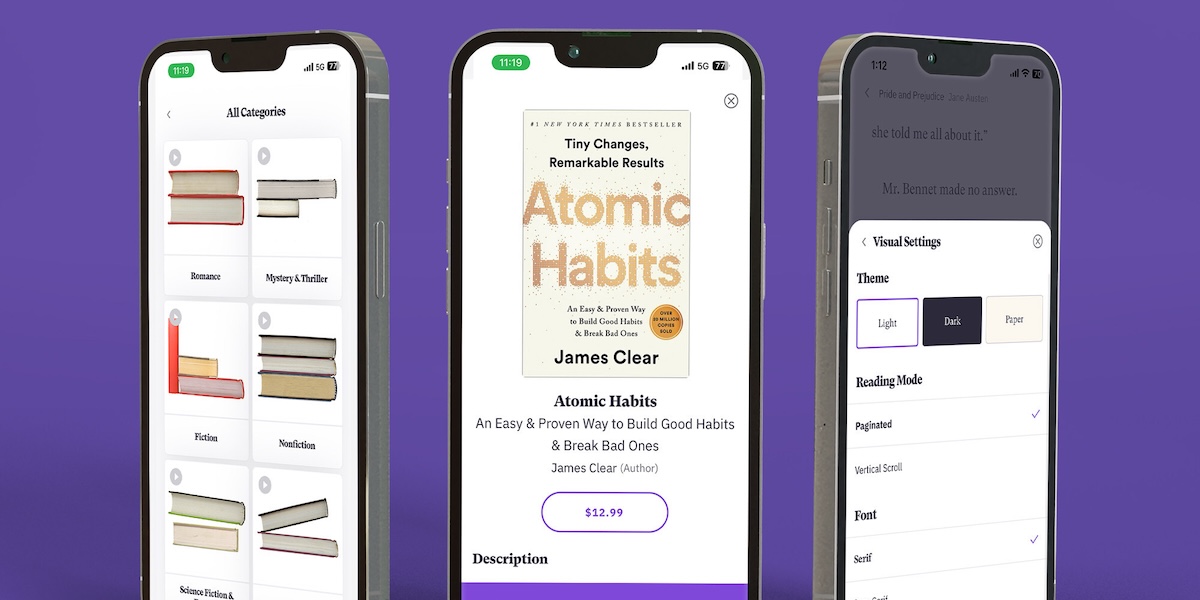
The platform launched e-books in 2025 — another attempt to cut into Amazon’s market share — where customers can read the books in a browser, on the Bookshop.org app, or on iPhone and Android devices. Bookshop.org donates a portion of its sales to bookshops, which can add e-book sales to their own websites and keep 100% of the proceeds. In February of this year, Bookshop.org launched a partnership with digital publishing platform Draft2Digital where independent bookstores can profit from self-published e-books.
Bookshop.org has also continued to hold “anti-Amazon” sales around Prime Day and in 2023 added merchandise for the sale, including a tote bag that says, “I love bookstores.” During the brand’s Anti-Prime campaign last month, Bookshop.org generated $1.48 million in revenue and grew orders 11% year over year to 39,000, while raising $210,000 for local bookstores, according to the company.
“Offering an independent bookstore customer a way they can buy and read e-books and still support their local bookstores was a really important move, and it also meant that we could carry an extra million, two million books, including self-published books that weren’t even carried by our wholesale partners,” Hunter said. “That has been a really great source of growth and convenience, and it helps with customer loyalty, too; you don’t want to tell customers, ‘Shop us for physical books, but if you want an e-book, you’ve got to go somewhere else,”
Continued success amid bookstore boom
Hunter said he expects company revenue to hit $80 million this year after $68 million last year. He also anticipates hitting a milestone in August of $50 million total donated to bookstores. Bookstores get the full profit margin — 30% of the cover price — from Bookshop.org if they initiate the sale, such as through email, social media or a QR code in the shop, according to Hunter. When other affiliates send customers, the affiliate gets a third of the profit margin, Bookshop.org gets a third, and the other third goes into a profit-sharing pool of the participating bookstores. Hunter said Bookshop.org tries to keep expenses at 12.5% of revenue.
“We don’t usually make it, but we’re always under 14%. And because we want to give the most possible back to bookstores, we have to stay as lean as possible,” Hunter said. “We’re twice as big now as we ever thought we could be, and we’ve made a much bigger impact than even I thought we would have.”
A revival of independent bookstores over the past few years has also worked in Hunter and his team’s favor. A total of 605 bookstores opened in 2025, an 87% increase from 2024, according to the American Booksellers Association’s 2025 annual report. The organization found 3,783 independent bookstore locations in 2025, up from 3,281 in 2024.
“We need to continue to help these bookstores, because right now, they’re thriving, but what if there’s a big economic downturn?” Hunter said. “We’ve got to make sure they’re more sustainable in a real, solid way, and I think we are just beginning. In the next six years, I think we can be five times the size we are now, while giving five times the support that we do now.”
Allison Hill, CEO of the American Booksellers Association — which invested in Bookshop when it launched in 2020 — said people have gravitated toward independent bookstores over the last couple of years out of backlash against billionaires and algorithms and in support of the role these stores play in their communities. She also said the most profitable indie bookstores also happen to be fully participating in Bookshop.
“We have people really hungry for in-person experiences and community gatherings, so the bookstores are always going to serve that purpose in a way Bookshop can’t, but Bookshop becomes this way to meet people everywhere they are,” Hill said. “The indie shoppers can shop in store. They can also shop on the e-commerce site for an individual store, or they can shop on Bookshop. They can be part of the indie-channel community in all these different ways.”
Hunter said he’s never been more confident that Bookshop will continue to last, whereas he didn’t know if it would be successful back in 2020. “I think we’ve converted about 2% of Amazon’s customers to support local bookstores, and 2% may not sound like a lot, but it’s a ton for the stores,” Hunter said.
“You want an environment where you’ve got 3,000 iconoclastic individual booksellers featuring books, recommending books,” Hunter said. “That is going to create a more dynamic, diverse ecosystem of storytelling and ideas than any kind of global monopolistic outcome, [which is] the path that we were on before.”