


How Dollar Shave Club decides when to use AI-generated creative
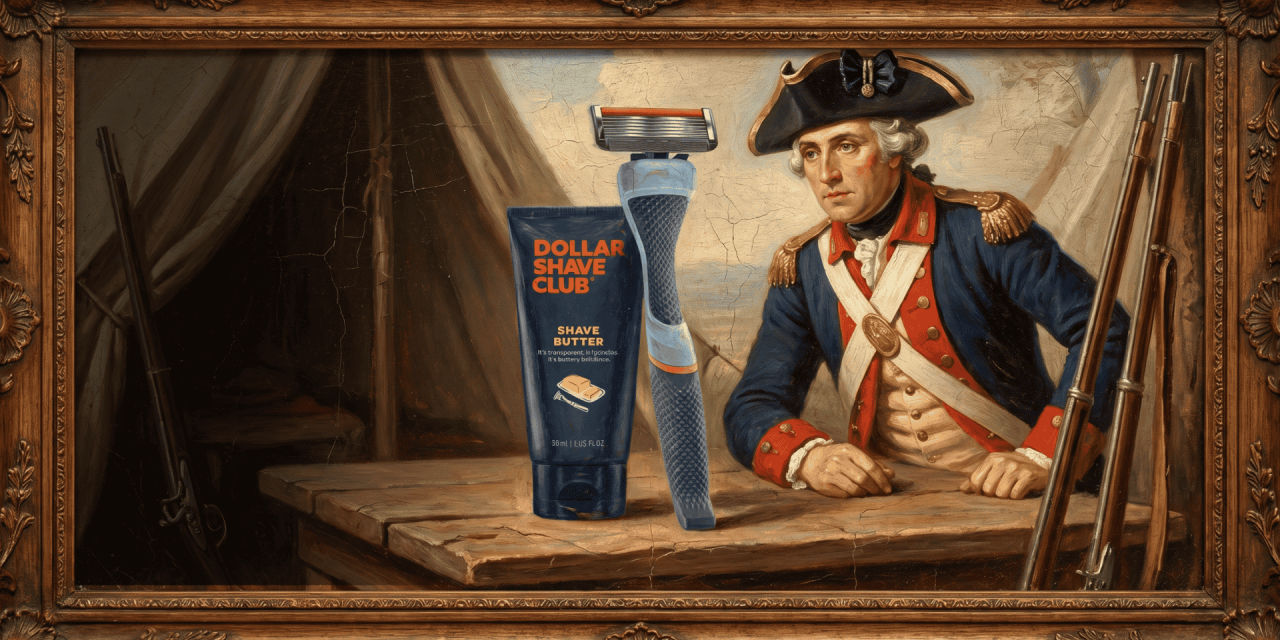
On July 1, Dollar Shave Club launched its “250 Years. No BS. Still Free” campaign, created by its in-house team utilizing generative AI.
The series of digital ad spots features America’s forefathers in hyper-stylized images fighting back against big razor monopolies.
The campaign is also promoting Dollar Shave Club’s ongoing promotion of $2.50 starter kits, one of the largest discounts it has offered since launching in 2012. According to Dollar Shave Club’s chief brand and innovation officer, Laura Higgins, the use of generative AI is quickly becoming an effective solution “to bypass legacy agency models” and allow the in-house creative team to execute campaigns at a faster rate. Despite increasing backlash toward AI-generated social media content by brands, Higgins says AI is a tool and not a full-on strategy in Dollar Shave Club’s marketing playbook.
Higgins has only been with Dollar Shave Club for a couple of months, but the July 4th holiday presented a unique opportunity for her team to quickly test generative AI creatives.
“When I got here, we didn’t have anything planned for the 4th of July, and that surprised me,” Higgins said, especially given that it coincided with America’s 250th anniversary this year. “So I wanted to use AI to bring that ‘revolution’ theme into a campaign quickly,” she explained. In the case of Dollar Shave Club, Higgins said its “enough is enough” stance against expensive razors is a nod to America’s founding fathers’ rebellion against the pricing structures imposed by monopolies on consumer goods like tea and sugar.
“So we really leaned in by creating a very obvious AI-generated ad integrating famous paintings,” she said. They include a depiction of Washington crossing the Delaware and the Boston Tea Party, among other Revolutionary War imagery. The campaign video also features Easter eggs, like Dollar Shave Club razors and shave gels in almost every scene. “But we are using AI as a tool rather than a strategy of trying to trick people into thinking something is real,” Higgins said.
Perhaps the most important aspect was how quickly her team was able to pull the campaign together in time for the America 250 anniversary. Higgins said the campaign was brought together in about three weeks, from connection to launch. “We have a very small and scrappy internal agency team, so this was done 100% in-house,” said Higgins. “What we use AI tools for is the execution.”
Higgins and her creative team began by brainstorming the campaign’s concept and potential sequences. From there, the team used Claude and Higgsfield AI to bring multiple iterations of the video to life. “I have a copywriter who then blew it out into a storyboard within a couple of days using Higgsfield,” Higgins said. “There is still so much human that’s involved.”
According to Higgins, the team will not be using the AI approach in every campaign. The company has been testing a few AI-generated ads over the last six months to experiment with what audiences gravitate toward.
“Some were executed better than others, we admit,” Higgins said. “Our first try was actually a video that made fun of AI campaigns, so it was still very self-aware.”
With time, the marketing team fine-tuned its concepts to get more specific and strike a tone reflective of the brand. For example, an ad promoting the launch of the brand’s electric razor line in June ended up receiving largely positive reactions.
The ad starred an animatronic Pinocchio character proclaiming to be a “real man,” as he showcases using the brand’s electric shaver on his wooden body. The ad was Higgins’ first personal attempt at creating an AI-generated ad at Dollar Shave Club, done in partnership with an external agency. It recently ran another successful AI-generated spot for the launch of Dollar Shave Club’s new women’s line in April.
Higgins said these videos act as animated comedy sketches that lean specifically into the brand’s humorous social media voice, which she believes made them successful.
As brands continue to push the envelope with AI-generated marketing campaigns, they risk facing mixed reactions from their customers.
“There is pushback today on AI, in general, and I totally understand that because there has been a lot of deception that has been generated through it,” Higgins said. There have also been instances in which brands like Quip have been accused of posting “AI slop” even though they had not used any AI tools to create their ads.
Jamie Domenici, chief marketing officer at Klaviyo, said Dollar Shave Club’s America 250 campaign is an example of how quickly AI is changing the economics of content creation for brands.
“But it’s really a signal of something much bigger,” said Domenici. AI has opened up the ability to be more creative than ever before, but the challenge for brands is still knowing their customer well enough to ensure these AI-generated ads are relevant, consistent and personal every time.
It’s tricky because, naturally, Domenici said, customers don’t want to be marketed to. “They want to be understood, and they can tell the difference between a brand talking at them and a brand that gets them,” Domenici said. “AI only earns its keep when it closes that gap.”
But for Dollar Shave Club, Higgins said these AI tools help take the minutiae out of executing a marketing concept, freeing up the marketing team’s time and resources for more projects. Higgins also noted that as more regulations around AI-generated content are put in place, it will become clearer for brands on how to communicate its use to their audiences. New York State, for example, recently passed a law that requires advertisers that use generic AI to disclose it.
“We want to use AI to be irreverent, funny and to also move faster,” she said. “So I do want to continue to lean into that.”