


Why Dame is refunding $10,000 in tariff surcharges to customers
Dame is refunding customers who paid its “Trump Tariff Surcharge” last year, becoming one of the first brands to proactively return money tied to President Donald Trump’s now-invalidated tariffs.
The sexual wellness company began adding a visible $5 line-item fee at checkout in 2025 as the Trump administration’s trade war pushed up costs and squeezed brands’ margins. After the Supreme Court struck down many of those duties, Dame co-founder and CEO Alexandra Fine announced on LinkedIn that the company would automatically reimburse shoppers who paid the surcharge, rather than wait for clarity on whether the federal government will issue refunds to importers.
The company is issuing “automatic refunds to every customer who paid it” instead of “waiting around for a rebate that may never come,” Fine wrote in a statement.
The move is one of the earliest signs of how brands are thinking about tariff refunds in the wake of the Supreme Court’s ruling. Many U.S. companies were directly hit by last year’s tariffs, and thousands of firms have sued the federal government to recover tariff payments. The Supreme Court decision raises the question of whether importers will receive refunds for the roughly $170 billion they’ve paid since the levies took effect.
Dame’s decision to issue refunds was driven by a sense of fairness after the legal landscape shifted, Fine told Modern Retail in an interview. Refunding customers for the tariff surcharge was “the right thing to do,” she said, adding that she wanted Dame to “lead by example.”
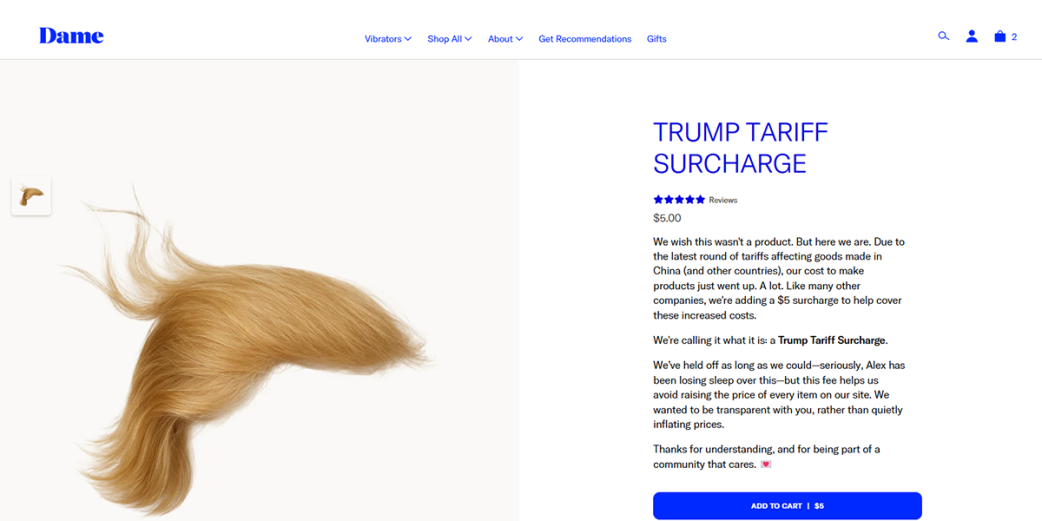
The surcharge appeared as a standalone line item at checkout and applied to all direct-to-consumer orders while it was active. But it was short-lived, running from April to the end of May, when the company removed the fee after the U.S. reached a temporary trade deal with China.
In total, Dame sold roughly 2,000 surcharge line items. Fine said the company is preparing to refund about $10,000 to customers. The refunds will be automatic and processed within 15 business days, according to the company’s website. The surcharge never fully offset Dame’s higher import costs. The company has paid $100,000 in tariff bills to U.S. Customs, Fine told Modern Retail. In addition to the surcharge, Dame selectively adjusted prices across parts of its catalog, though most items remained unchanged.
Fine framed the original surcharge as part protest, part education. “I’d like to call it, this advocacy, marketing — let’s educate people,” she said. Fine added that the surcharge “really killed our conversion rate.”
Dame isn’t alone in rethinking how it handles tariff-related costs. While some companies never added explicit surcharges, several have said they would pass along any government tariff refunds to customers.
Cards Against Humanity said in a recent blog post that it would pass along any tariff refunds it receives from the Trump administration. “As soon as the Trump Administration refunds the illegal tariffs they illegally forced us to pay, we’ll give you your money back,” the company wrote, adding, “Unfortunately, not even God Himself knows how long that will take.”
The company directed retail customers to submit an online form to receive any tariff refunds the company obtains.
FedEx has taken a similar stance. After suing the federal government for a refund of tariff payments, the shipping giant said in a statement on its website, “Our intent is straightforward: if refunds are issued to FedEx, we will issue refunds to the shippers and consumers who originally bore those charges.”
“These announcements are aiming to generate some positive PR and sense of goodwill among consumers who have probably heard about the tariff being overturned by the Supreme Court but haven’t yet heard much from retailers or other brands about refunds,” said Sky Canaves, a retail analyst at eMarketer.
Still, the reality of refunds may be far more complicated. “There hasn’t been any process established for any kind of timeline,” Canaves said. “The Trump administration has indicated that they want to fight any refunds and that they’ll fight the lawsuits that have been filed.”
Companies are still waiting for clarity on whether they’ll be repaid for past tariff payments, as the U.S. Court of International Trade weighs how — and when — any reimbursement mechanism would be implemented.
But online merchants previously told Modern Retail that they won’t cut prices — at least not in the near term — despite the Supreme Court ruling. Many say they’re waiting for clarity on whether the federal government will issue refunds, and that last year’s price hikes didn’t fully offset the cost of tariffs.
Among them is Chuck Gregorich, an Amazon seller and the owner of Net Health Shops, which imports patio heaters and fire pits. He said he has paid roughly $1.5 million in tariffs over the past 13 months, about $1.1 million of which he believes could be refundable.
“If I get the $1.1 million refund, then you’ve got to look at it and say, ‘Well, alright, I can take this now and start adjusting my pricing,'” Gregorich said.
But he is also bracing for the administrative fallout if customers demand refunds. “If we get a refund, we’re going to have a million people coming back to me and saying, ‘I bought this, give me the product cost, give me the tariff rate. You owe me $1.37, or you owe me $4,'” Gregorich said. “The cost to administer all that will be much more than a dollar per transaction. I’m just going, holy cow, hopefully it doesn’t happen.”
Even if companies ultimately receive repayments, figuring out what to pass along to customers could prove complicated. “It’s also hard for retailers to say, if they’ve absorbed some of the tariff costs, how much they have passed on,” Canaves said.
Canaves added that she does not expect the strategy to become widespread. Brands “may be hesitant to make announcements about issuing refunds when there’s just so much uncertainty,” she said.
When asked whether Dame plans to take part in litigation to recover tariff costs, Fine said the company is hopeful that larger corporations pursuing litigation will pave the way for a broader reimbursement process.
“I’m hoping that the bigger brands out there that are fighting for this are going to make headway,” she said, adding that she would be “super happy” if there were a formal refund mechanism, “no matter how much it is.”