


Zales launches new store concept, The Edit, to boost revenue and court young shoppers
Jewelry company Zales is hoping a new store concept can help it sparkle with Gen-Z and millennial shoppers.
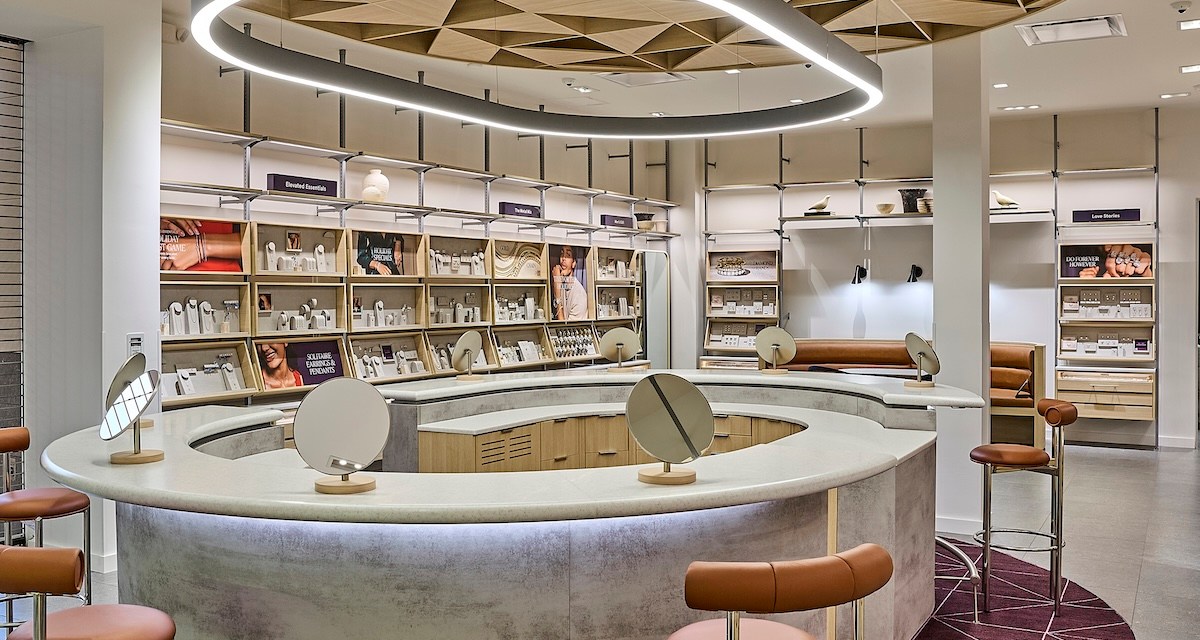
The format, called The Edit, involves a more open layout, consultation areas and rotating product display zones. There’s a big emphasis on personalization, with a charm bar and a customization studio for shoppers to design their own jewelry. There’s also a focus on digital shopping, with an app called Z Curator that customers can use to build “digital trays.” Merchandise is also more accessible, with products on the walls and on stands, instead of behind glass cases.
Zales, which celebrated its 100th anniversary last year, is hoping to create a more modern feel with The Edit as it moves into the future and “looks at opportunities for sales,” said Kecia Caffie, Zales’s president. The company hopes to cater to a more digitally-minded, younger shopper, as well as customers looking for a more immersive shopping experience, she explained. The Edit also fits into Zales’s larger growth plans as it competes with contemporary brands like Mejuri and Gorjana. While Zales is typically associated with bridal jewelry, it is trying to position itself as a major player in everyday accessories, and it’s betting on The Edit and its more approachable feel to help with that.
In the last two months, Zales has opened four The Edit locations in the United States, and the brand is now in the middle of rolling out The Edit across its fleet, both by building new stores and remodeling existing ones. The first The Edit location opened in November in Chandler, Ariz. Three more quickly followed, in Denver, Colo., Austin, Texas and Atlanta, Ga. At least two more The Edit locations are planned for January 2026: another in Georgia and one in Jacksonville, Fla. The company has plans to expand The Edit throughout 2026.
Creating and curating The Edit
According to its “about us” page, Zales began in 1924 as a retail store in Texas that sold jewelry, appliances and cameras. It offered a credit plan of “a penny down and a dollar a week” on many higher-priced items. By 1941, Zales had expanded to 12 stores across Texas and Oklahoma.
In 2014, Zales was snapped up by Signet Jewelers — the owner of Kay Jewelers and Jared — for $900 million. During Signet’s most recent quarter, which ended Nov. 1, Kay, Zales and Jared delivered a combined same-store sales growth of 6%. The company did not break out sales for Zales, specifically.
Zales now has more than 420 locations across the U.S. In the last century, it had “various layouts of stores,” Caffie said. But about 18-24 months ago, Zales started envisioning a new concept that would turn into The Edit.
“We wanted to step back and take a look at the customer we had and the customer we were trying to attract and really understand their needs and the way they like to shop,” Caffie said. “Jewelry stores, historically, have always had that red velvet rope feel, and [we] really wanted to create a space that was inviting to our customer base.”
One of The Edit’s key characteristics, per Caffie, is that it caters to different shopper needs. If customers like, they can come into The Edit and immediately find a salesperson to help them buy pieces. But others can shop more independently through the new The Edit phone app, called Z Curator. There, they can look through merchandise, view product information like price and add styles to a virtual try-on tray. When they’re done, they submit their request, and a store associate gets a notification on an iPad to pull specific products for that customer and bring it to them.
This new approach is built with younger shoppers in mind, Caffie said. “We know that, particularly with millennials and Gen Z, there is a desire to have the ability to self-serve, at times,” she explained. But younger shoppers also like to come into Zales with friends, she said, and The Edit is built to accommodate that, too. There are more mirrors in the store, and the format is more open, allowing groups to browse together. There’s also a section of the store in which shoppers can design their own jewelry — either from scratch, or by altering an existing piece, like a relative’s ring.
“The ability to self express is a definitely a component [of The Edit] and something important for the customer that we’re trying to attract,” Caffie said.
A new look and feel for Zales
Zales declined to share sales numbers for its earliest The Edit stores, but Caffie said early response has been “positive” from both customers and team members. “What we’ve been hearing thus far is that, for new shoppers, it feels really inviting, but the change isn’t turning off our current shoppers,” Caffie said.
The company has come up with a system to evaluate the performance of The Edit locations. Each store is being compared to a group of 15 control stores. The team will look at multiple KPIs to form these control groups, including stores with similar revenue streams and similar product mixes. Using these control groups will allow Zales to “make faster decisions on future investments into stores like this,” Caffie said.
When figuring out where to put more The Edit locations, Zales is picking markets that “over-index on fashion,” Caffie said. The mission also resonates with that of Zales’s parent company, Signet Jewelers. It’s looking to play a bigger role in fashion — not just weddings — through its “Grow Brand Love” campaign, which it rolled out in March. That strategy came about after “lack of growth over the past several quarters,” J.K. Symancyk, Signet’s CEO, stated in a press release. The Edit is thus “critical in that evolution,” Caffie told Modern Retail.
Allison Collins, co-founder of The Consumer Collective, said the new layout of The Edit “certainly looks a lot better than your average Zales store.” “Modernizing stores is an essential part of operating a retail business, so it makes sense that Zales is working on what the future of their stores could look like,” she told Modern Retail. She also believes that Zales’s revamp is well-timed, considering the rise of players like Mejuri and Quince. “There’s a lot of competition in that entry-level space Zales has occupied for a long time,” Collins said.
Collins hopes that Zales will eventually modernize its website, too. “I’d love to see better imagery, clear storytelling and a modern layout, [because] right now, it looks like it was built in the 2010s,” she said. “[Zales] should be thinking about modernizing holistically. If I went to one of those new Zales stores and then went onto this website, I would be confused because they do not align.”
Caffie noted that The Edit is still a work in progress.
“I expect us to do some tweaks to things that may not be working exactly as we expected as we move into the next year,” she said. Zales also plans to roll out a 2.0 version of Z Curator. “You’ll be able to see what you tried on [in the store] later on at home, and then you can make the decision to purchase, but that’ll be in a secondary phase, next year,” she said.