


How Mandy Fields steered E.l.f. Beauty through tariffs and a high-stakes Rhode acquisition in 2025
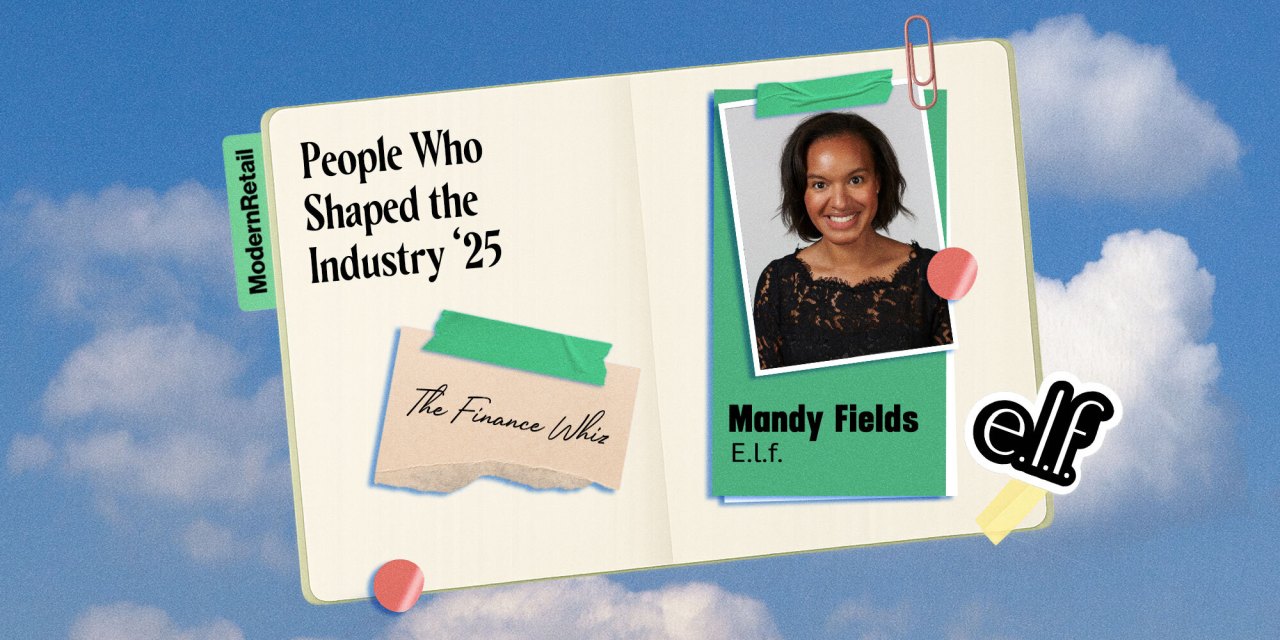
This story is part of a Modern Retail package on the People Who Shaped Retail in 2025, profiling the year’s most influential industry leaders.
This spring will mark seven years since Mandy Fields arrived at E.l.f. Beauty to take on the role of chief financial officer. Back in 2019, she said, the company was at less than $300 million in net sales. “We’re now north of a billion,” Fields said. “We have been on a tremendous journey over these last few years.”
That’s not the only way E.l.f. has transformed during Fields’s tenure. When E.l.f. –which stands for eyes, lips and face — launched in 2004, it was focused squarely on selling affordable makeup online. But now, it operates six brands across color cosmetics and skin care, all of which are at different stages of their retail expansion journeys. These include Well People and Naturium, which E.l.f. acquired in 2020 and 2023, respectively, as well as Keys Soulcare, a brand E.l.f. developed in partnership with musician Alicia Keys.
The most recent addition, of course, is Hailey Bieber’s Rhode, which E.l.f. acquired in a splashy $1 billion deal this year. E.l.f. also just reported its 27th consecutive quarter of growth and has largely managed to resist softness in the beauty and skin-care categories amid a challenging economic environment and fluctuating tariffs.
But Fields and E.l.f. have made all of this growth look easy. The ability to keep E.l.f. focused on the long term, even while steering the company through near-term macroeconomic challenges, makes Fields one of the people who helped define the retail industry this year, exemplifying what it takes to be a modern CFO.
Brett Benner, a U.S. consumer and retail consulting leader at KPMG, said that 2025 tested the ability of American CFOs’ to adapt. Benner said that for the past few years, the chief financial officer role has evolved to being “more of a true operations partner” to the rest of the C-suite. “It’s no longer just, ‘Can I manage the financials and the SEC reporting?'” Benner said.
Benner added that amid this year’s volatility, strong CFOs have demonstrated they can work with departments such as the supply chain team to identify solutions and mitigate inflation and tariffs. He added that this is an area where technologies like AI can help CFOs make these decisions through a data-driven approach. “As that role shifts to being more of an operations-focused, strategic business partner, you’re going to have to deal with more volatility,” Benner said.
In statements, other members of E.l.f.’s C-suite echoed Fields’s ability to be a true partner and a leader. Tarang Amin, chairman & CEO at E.l.f. Beauty, said in a statement that Fields’s “leadership at E.l.f. Beauty has fueled remarkable growth, and even more importantly, she creates space for others to thrive and make a meaningful difference every day.”
E.l.f. Beauty’s CMO, Kory Marchisotto, reiterated Fields’s ability to create the conditions necessary for people to thrive at the company. “Surrounding yourself with greatness means being around people who make you more powerful and more possible,” Marchisotto said. “Mandy’s gift to E.l.f. is that level of greatness, and it shows equally in our culture as it does in our results.“
Navigating a volatile year
It’s safe to say that 2025 was a unique year for Fields and her team, kicking off with an overall slowdown in the beauty segment, combined with looming tariffs and uncertain consumer sentiment.
“We started this year with the beauty category kind of not doing great. There was a lot of pull forward during the holiday time,” Fields said. Then, there was concern about a potential TikTok ban, followed by the Southern California wildfires, which Fields said “took a lot of conversation away from beauty,” as obviously, [there were] much more important topics people were focused on. What’s more, she said, “If you think about the epicenter of influencer activity, it really is L.A., and so that really put a lot of things on pause at the beginning of the year.”
Then came the whiplash of trying to deal with tariff policies. At one point, E.l.f. was facing a 170% tariff rate on its products, which are largely imported from China. That led to E.l.f.’s $1 price increase, a rare move for the company, which has become synonymous with affordable makeup.
“We never take pricing lightly,” Fields said. This is the third price increase in the company’s history, with the last one being in 2019, in response to a 25% tariff on imports from China. “We ran a thousand and one scenarios and combinations of the impact of pricing and where things are going to net out,” Fields said. “At the end, we had to [increase prices] portfolio-wide to try to mitigate as much of those tariffs as possible.”
Fields’s role as CFO has not only been to navigate E.l.f. through all of the short-term challenges, but also to consistently tell the story of the long-term opportunity E.l.f. is trying to build. And that came into full focus this year with the $1 billion acquisition of Rhode in May.
Fields said executing that M&A deal amid those outside challenges “helped send a message to Wall Street about the long-term opportunity we see to build this different kind of beauty company.” That includes acquiring and growing brands, Fields said, “that disrupt norms and shape culture and connect communities, which sets us apart from others in beauty.”
Reactions to the Rhode acquisition included some questioning about whether the price tag was justified. But Fields said E.l.f. carefully weighed Rhode’s long-term growth and valuation leading up to the deal. “The way that we structured the deal is quite fair,” Fields said. It consists of $600 million cash upfront, $200 million in equity and another $200 million earnout over the next three years, should certain milestones be hit by Rhode.
White space opportunities
Overall, Fields said 2025 signaled that E.l.f. is serious about going after the skin-care market. “We have an appetite for that, after the acquisitions of Naturium and Rhode,” Fields said, in addition to the success of the homegrown E.l.f. Skin line.
Fields noted that the acquisitions of Rhode, Naturium and Well People came very early in those brands’ life cycle. “We have been very selective about the brands we add to our portfolio,” she said. “But it also comes down to cultural fit, and that’s a filter that sometimes companies don’t consider as they go after some of these opportunities.”
Now, it’s all about increasing the distribution of these brands.
This fall, Rhode entered Sephora, its first physical retailer. It became the largest North American brand launch at Sephora and generated an estimated $10 million in sales in its first two days at the retailer, according to alternative data provider Yipit.
Meanwhile, Naturium launched in Australia after much anticipation from fans. And in recent weeks, E.l.f.’s namesake brand also landed at Sephora in the Middle East. “You’re going to hear us continue to talk about launching in new countries and expanding that awareness level across the world,” Fields said. “The rest of the world is our oyster.”
Indeed, international growth represents a potential major growth lever for the parent company, as only about 20% of its sales come from outside the U.S. Fields said entering the German drugstore Rossmann was the company’s largest international launch to date.
But reaching more customers involves more than just bringing E.l.f.’s brands to new retail destinations. It also means ensuring that a broad range of people feel seen by its brands. This year, E.l.f. has distinguished itself as one of the few publicly traded companies that continued to tout its diversity and inclusiveness efforts, both internally and in its marketing. That was even after President Donald Trump issued a series of executive orders targeting diversity, equity and inclusion programs in the public and private sectors.
When asked about E.l.f.’s decision to stand its ground on programs like DEI when others are pulling back, Fields said the company’s mission has always been to have its board room reflect its community’s diversity while bringing accessible beauty to the masses.
“People will say, ‘How can you be for everybody?’ We value the perspectives of everyone who wants to participate in this category,” she said. “And we’re just doing what we’ve done for 21 years.”
In 2026, Fields said people can expect E.l.f. Beauty to seek a bigger market share in color cosmetics and skin care, especially as consumers look for value in these discretionary categories. “We want to be the No. 1 color cosmetics brand,” Fields said. “We have plans to continue going after the white space opportunities we see.”