


Lowe’s wants to roll out personalized website to all customers by end of 2026
The humble e-commerce site is getting a major upgrade at Lowe’s.
The Mooresville, North Carolina-based home improvement retailer is expanding a feature that uses customer data — things like location, browsing behavior and past purchases — to personalize its website. The feature is now being rolled out to a percentage of customers — though Lowe’s declined to specify how many — with a broader launch planned by the end of the year.
The personalization will show up through modular content blocks on Lowe’s website that can be swapped, reordered or customized based on customer behavior. Cano said Lowe’s homepage is made up of different sections, or “modules,” such as featured banners and product recommendation areas, that can either stay the same for everyone or change based on the shopper. Lowe’s started to introduce these personalized content modules to its website at the end of 2025. One module that has already been fully rolled out is a weather widget that recommends projects based on local conditions.
It’s part of Lowe’s broader plan to revamp its e-commerce site. Lowe’s previously told Modern Retail how it was adding more AI-powered recommendations and personalization to its website, as well as beefing up its marketplace with expanded product categories and more video content on its product description pages. With its personalized website, Lowe’s is changing what customers see, including surfacing product recommendations, depending on who they are and what they are trying to accomplish.
“As you go to the Lowe’s website, and as I go to Lowe’s website, we’re going to see different content, depending on where you’re geographically located, what your preferences are and what your shopping behaviors are,” Joe Cano, Lowe’s svp of digital commerce said in an interview with Modern Retail at Shoptalk Spring. “If you bought an appliance, we’re not going to serve you up an appliance again, because you’re not going to buy another refrigerator,” Cano said. Instead, Lowe’s may recommend complementary purchases like water filters or kitchen upgrades, or surface new project ideas, he added.
Cano said early tests showed improvements in both engagement and conversion over its traditional site, though he declined to share specific figures. The company is now expanding the rollout as it adds more personalized sections across the site.
“My goal is that by the end of the year, this is rolled out across the board in the right modules,” Cano said. “Then, as we see and learn how customers are engaging with that, putting different modules in there, as well,” Cano said.
The weather widget is one example of how these personalized sections can change based on a shopper’s specific circumstances. If it’s raining, the site may suggest indoor projects and related products, such as kitchen cleaning or painting supplies. If it’s sunny, the site may instead highlight products tied to outdoor tasks, like gardening. The company is also experimenting with location-based recommendations tied to inventory availability at nearby stores. Cano said the experience can be personalized down to the ZIP code level.
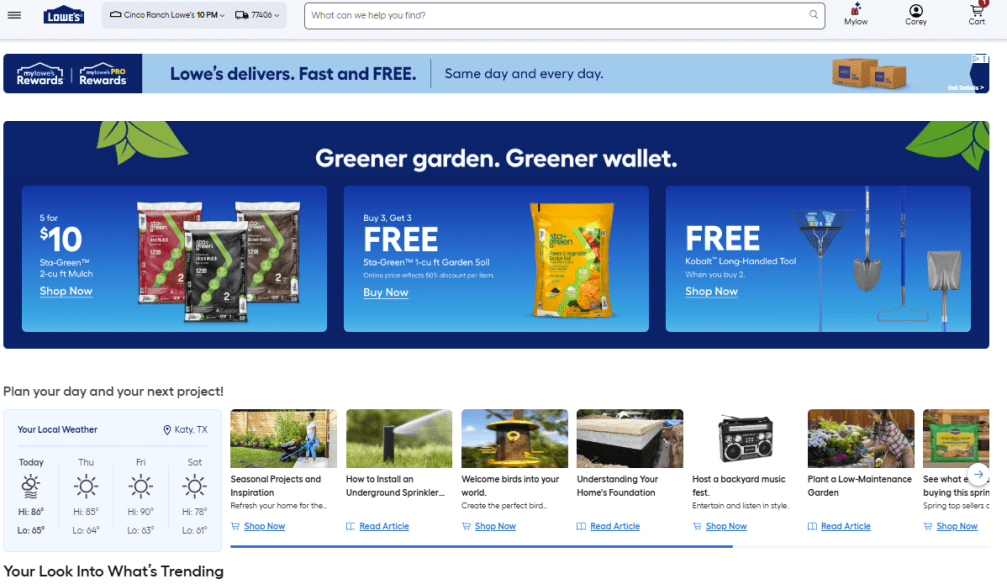
Over time, Cano said the level of personalization could become much more pronounced, with individual customers seeing meaningfully different versions of the site.
“Your page right now will look 15-20% different, but in a year, it could be 100% different from what I’m seeing,” he said. “We are basically personalizing a website for you.”
Lowe’s is also beginning to use purchase history to determine when customers may be ready for their next big purchase. Cano said the company is looking at typical replacement timelines for major home purchases — like appliances, which often last about seven years — to better time when it surfaces recommendations. With Lowe’s new personalized site, a homepage widget could surface product recommendations based on that timing — for example, suggesting appliances when a customer may be nearing the end of a typical replacement cycle.
Some of the personalization will also extend to the visual presentation of the site itself. Cano said Lowe’s is experimenting with changing the background imagery behind featured content to better reflect a shopper’s location. For example, a customer in Florida may see imagery tied to warm-weather outdoor projects, while someone in Wisconsin could see visuals more aligned with seasonal indoor projects, even within the same section of the homepage.
Melissa Minkow, director of retail strategy at CI&T, said personalization is becoming essential as online catalogs grow more complex.
“This is the future of online shopping,” she said. “We know that that’s what consumers are looking for, especially as retailers have larger assortment and there’s so much more to sift through for the consumer.”
Minkow said the home improvement category, in particular, is well-suited for personalization because many purchases require technical knowledge that the average shopper may not have. She added that using first-party data from past purchases could help retailers make more useful recommendations, such as suggesting replacement parts or compatible products.
“Just keeping track of those past purchases and not making it such a challenge to find them again when you need replacements is absolutely key,” Minkow said.
At the same time, she said retailers need to be careful not to over-filter what shoppers see.
“The one thing retailers have to be careful of is the FOMO of it,” she said. “If customers think you’re skipping on showing them too many items, they’ll worry that they’re not getting the full shopping experience.”
AI shopping gains traction
Lowe’s is also investing in Mylow, its AI shopping assistant, which Cano said is already showing promising results in driving purchases. Sessions that involve Mylow are converting at twice the rate of those that do not, he said.
The tool allows customers to ask questions about home improvement projects, get product recommendations and access how-to content. Inside its stores, Lowe’s has a version of the service called Mylow Companion for customers with questions about what items to buy or a specific home improvement task.
Cano said Lowe’s is continuously adding features based on how customers are actually using the assistant. For example, the company added photo uploads after seeing customers try to share images, along with Spanish-language support and order tracking features after seeing those requests.
“We’re taking what the customers are looking at, what they actually are asking us, and trying to implement them all within our AI shopping agent,” Cano said.
Usage also appears to be growing, with customers collectively asking nearly a million questions each month across Mylow and Mylow Companion, according to the company.
Looking ahead, Cano said he wants the assistant to become more proactive. “What I would actually love to see Mylow do is, when you log back in, say, like, ‘Hey, how did renovation go?’ or ‘Do you need any help with it?’” Cano said.
He added that a more proactive assistant could eventually suggest next steps in projects, recommend service providers or anticipate maintenance needs.
“I want Mylow to almost be like your personal assistant,” Cano said. “Because right now, customers are asking and we’re giving them that information, but I want to get to the point where we’re actually serving Mylow like a concierge.”