


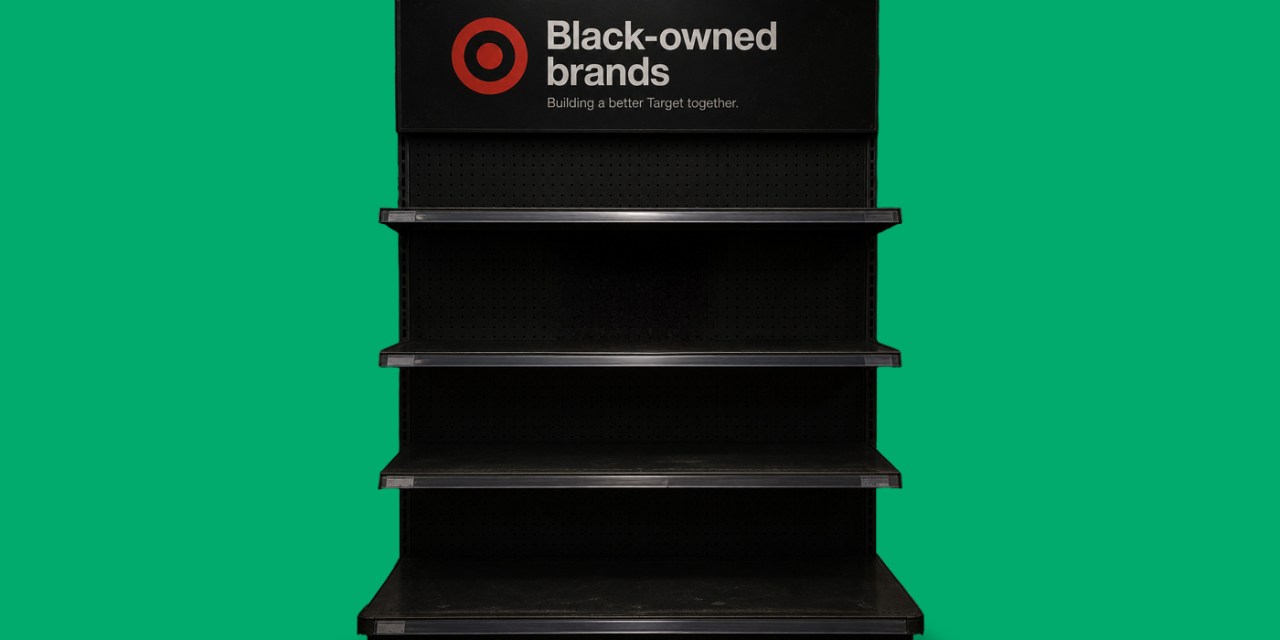
Target has alienated Black-owned brands, founders say, as some startups vanish from its shelves
In 2022, April Showers finally got her big retail break as her brand, Afro Unicorn, entered Target and Walmart.
Afro Unicorn is a licensed-character brand designed for women of color that sells hair-care products, books, apparel and more. For Showers, as a Black entrepreneur aiming to normalize Black beauty, getting into mainstream retail was a critical milestone.
“It wasn’t to help normalize it for us,” Showers said. “It was there to normalize it for everyone else, so that when a little white girl walks into the room and sees a Black girl, she doesn’t look at her any differently.”
Nearly four years later, however, Showers’ products are no longer found on Target’s shelves after the company pulled back from some diversity, equity and inclusion initiatives. Showers told Modern Retail that, as a result of Target’s decision, she decided to stop advertising Afro Unicorn’s presence at the retailer, adding that the brand’s sales at Target fell below the company’s standards and that its products were cleared from its shelves by the end of 2025.
Some Afro Unicorn plushes and a book are still available on Target’s website, but not in stores — speaking to how long it can take for a brand’s inventory to be cleared from warehouses. The brand is still available at Walmart and CVS Pharmacy.
This isn’t the way Showers wanted things to go. She said she initially pushed her community to do a “buyout” — as in buying all the Black brands at Target until they sold out — but they were resistant to it. She said her followers, Black or not, did not want to shop at Target as they felt like the company didn’t acknowledge it had made a mistake in how it pulled back from DEI programs.
“I never want to feel like I’m hurting my community or anyone around, so if you tell me we’re boycotting [Target], then we’re boycotting it; one band, one sound,” Showers said. “I did not like how Target never came out with a statement and really put it on the backs of the founders to figure this all out.”
Afro Unicorn isn’t the only Black-owned brand that has disappeared from Target’s shelves over the past few years. While Target’s DEI pullback hurt its reputation within the Black community, other Black founders Modern Retail spoke with said they found Target to be a frustrating wholesale partner, even before 2025.
A couple of founders said they struggled to get key information from their respective buyers, which hampered their sales. One described promotions they had to pay to participate in that they thought would be free. And, in the case of another founder, they only got an answer about their brand’s fate with Target — after months of unanswered emails — after going to a Target diversity executive, even though the brand wasn’t part of any supplier diversity program at Target.
Target representatives declined to share details on specific conversations or interactions with vendors, but said that it makes changes to its assortment based on how products are performing and what shoppers are looking for.
“Style, design and value are at the heart of our differentiated assortment, and emerging brands play an important role alongside national brands and owned brands,” a Target spokesperson said in a statement. “We’re proud of our long-term record of helping small businesses grow and reach new customers at Target, and will continue to create opportunities for new brands.”
Other Black-owned brands once featured at Target have been removed from the retailer’s assortment without explanation. These include Alikay Naturals and Oyin Handmade, which are still sold outside of Target. Some, like hair-care brand Curls Dynasty, have gone out of business entirely.
Entrepreneur and author Tina Wells said her luggage and accessories brand, WNDR LN, was built exclusively for Target but was canceled and removed from stores by late 2024. While some of her products are still listed on Target’s website, she said she hasn’t fulfilled an order to Target since August 2023 and that anything still available is back stock.
A representative for Black-owned skin-care brand GlowRx, in an email, said the brand “no longer being in Target was not our voluntary decision.”
Some brands may have been removed from Target due to their sales performance.
“I’ve seen them kick out eight brands — not because they were Black, not because they were woman-owned and not because they were Latina-owned, but because they didn’t perform,” Melissa Butler, founder of vegan lipstick brand The Lip Bar, said in an Instagram video last year. She was warning her shoppers that the same fate could come to Black brands if customers were to stop shopping for them at Target as part of a boycott.
Target, for its part, is trying to position 2026 as a comeback year. This month, Target reported its first quarter of sales growth in more than a year as CEO Michael Fiddelke and his team have worked to refine its assortment and invested hundreds of millions of dollars in payroll and store technology to improve the guest experience.
And, Target continues to expand the number of Black-owned brands it carries in stores. It has hundreds of Black-owned brands in its stores, double the amount compared to 2020, the company said in an email. Last fall, it added KBB by Kahlana to its stores, which a press release described as “one of Target’s most in-demand women’s apparel and accessories brands.” It continues to spotlight Black-owned brands on its website, such as through a Black History Month collection featuring Black designers.
But even as Target adds new Black-owned brands to its assortment, it has burned bridges with others.
“I personally don’t feel like we saw any benefit,” from being at Target, one Black founder who spoke on the condition of anonymity said. The founder said their brand was dropped in the fall of 2024 after several years with the retailer. “We invested a lot of money and a lot of time, and we spent much more money than we ever made at Target. We were doing so much better before we were in store at Target, and if I could redo it, I probably would have just not done the partnership at all.”
The lingering DEI problem
One of the big driving factors that led many Black entrepreneurs, like Showers, to pull back on their support for Target was the company’s decision last year to walk back some of its DEI goals, programs and initiatives. That decision — and Target’s murky communications around what led to the pullback — led to some shoppers boycotting the chain.
Last year, Target concluded its three-year diversity, equity and inclusion goals, concluded its Racial Equity Action and Change initiatives, stopped all externally diversity-focused surveys such as the HRC’s Corporate Equality Index and renamed its “supplier diversity” team to “supplier engagement.” Still, the company said that this year, it fulfilled its 2021 commitment to invest $2 billion in Black-owned businesses.
Showers said fellow founders would tell her they were waiting for Target executives to admit they made a mistake on DEI, but that she was never optimistic. Target’s pullback itself came off as performative, Showers said, given that it previously had embraced the Black and LGBTQ+ communities, such as by making public statements on racial equity and investing in scholarships, business consulting and sponsorships aimed to support marginalized groups.
“It was like a slap in the face to the community that basically felt that they helped build Target’s name in the urban sector,” Showers said. “The community was hurt. It was an emotional attachment that they had with Target, because they felt like Target was there for us.”
Target did eventually address the frustration last May, but in an internal email that communications professionals found vague and underwhelming and didn’t specifically address what the company did.
Target’s Fiddelke told the Associated Press in March that boycotts were among the things that impacted its sales last year. The company’s net sales decreased 1.7% to $104.8 billion from 2024 to 2025. “We’ve got trust to win back with guests, and we’ll be focused on doing it,” he told the outlet. “There’s no easy button to win back trust, but we’ll do the work.”
Shortly after Fiddelke’s comments that Target’s goal was to win back guest trust, Atlanta pastor Jamal Bryant in March said he was ending his boycott of the company after “productive” conversations with Fiddelke and others at the company, according to USA Today. Target, however, did not offer any concessions or reverse any changes it made to its policies, the newspaper reported.
However, organizers of another boycott — civil rights attorney Nekima Levy Armstrong, Jaylani Hussein of the Council on American-Islamic Relations and Monique Cullars-Doty of Black Lives Matter Minnesota — held a press conference, also in March, to say their boycott remains ongoing.
But the DEI pullback has continued to harm the company’s brand reputation, argues SOC Investment Group, Mercy Investment Services and Trillium Asset Management. The activist investors launched a campaign this month encouraging shareholders to vote against the re-elections of former Target CEO and executive chair Brian Cornell, as well as lead independent director Christine Leahy.
“Target’s brand has eroded, and it’s not from taking a stance, but from appearing disingenuous on social issues,” said Emma Bayes, deputy director of SOC Investment Group, in an interview. Her firm works with labor unions and their pension funds to promote good governance.
“Retreating from DEI commitments that once defined it as a leader, Target undermined its credibility, made the brand feel inauthentic at a time when consumers are actively seeking companies that stand firmly and consistently by their values,” Bayes said.
Showers said she’s not completely against working with Target again, but would need to see a statement made addressing its previous decision on DEI, among other things.
“I don’t see myself going back until Target actually does what they did [before] 2024 and truly embraces women, Black businesses and all other marginalized businesses, like they did previously, publicly,” Showers said. “I know that would never happen.”
Showers took a six-figure hit just within her hair-care line after leaving Target, she said. Her company lost a total of $600,000 in revenue from 2024 to 2025, according to her. She attributes those lost sales to retailer boycotts in response to DEI decisions in response to the Trump administration.
“We were collateral damage because of this administration’s policies,” she said. “It was this administration, with their fear that they did to these retailers for DEI, that caused the hurt.”
A costly bet on Target
For other Black founders, their issues with Target stem from their belief that the retailer was not a good partner in giving their brands visibility and accessibility nationwide.
When Trey Brown and his brother Donovan appeared on “Shark Tank” with their Ride FRSH line of air fresheners in 2023, the two co-founders said their goal was to expand the business at retail. Later that year, that dream became reality. They landed a deal with Target to get their products into stores, which was supposed to begin their launch into mass retail, in addition to an agreement with AutoZone.
Instead, Target has been a nightmare for the Black-owned brand, as Brown described to Modern Retail. Shortly. After the launch, he said, customers would complain that they couldn’t find the products in the stores. He discovered the stores would have the items but not put them on the floor, and instead hold them in the back room.
Brown said Ride FRSH only ever got an answer about what happened to his brand this year from a Target diversity executive, even though the brand was accepted at Target as any other supplier, not as part of any diversity program.
“Why do I have to talk to the diversity initiatives guy to get an answer when I’m not even in a DEI program, and never was?” Brown said. “I should be able to reach the owner of the specific section, the buyer of the section. But somehow, nobody’s following up, and nobody gave a shit. So it just was like, ‘OK, so I have to go talk to the Black guy to get a response?'”
He said the executive apologized and said that’s not the way Target handles it, but that their solution was to get in touch with Target Plus — a third-party marketplace program that only deals with products sold online, not in stores. Brown said he was told by the diversity executive that it was “not likely” that he would get his products back on the floor.
Ride FRSH no longer appears on Target’s website; Brown said he’s not exactly sure when Target stopped listing the product or selling it in stores. He said Target has sent invoices to the brand that buyers would tell the brothers to ignore.
“Even when they [Target] had an opportunity to tell us that we were no longer with them, they just didn’t tell us that,” he said. In recent months, he has struggled to get an answer from Target’s buyers on whether the retailer has discontinued the relationship, and if so, why they have done so. He also said he hasn’t gotten any information on how the brand performed at Target.
“We’re stuck with a whole bunch of inventory, trying to figure out what’s going on,” Brown said.
The founder whose brand was dropped by Target in 2024 went through a similar ordeal.
“We were told there was a change in product lineup, so they were just not going to move forward,” they said, adding that there was no other reason given as to why they were removed. “That was the whole conversation.” This founder, like Brown, said they had sent several emails to Target buyers without a response when trying to get information on a promotion they were supposed to be part of.
The founder said they paid for and warehoused at least $100,000 in product to be prepared for the next season with Target. Target had encouraged them to have the product stored in the U.S. rather than overseas, they said, so the brand would be able to get it to the retailer if the company needed a last-minute shipment instead of paying up to $30,000 to ship it from overseas.
“We’ve been, like, selling through it, slowly but surely, but we’re paying ridiculous amounts of money, like warehouse fees,” they said.
The founder said being at Target was costly overall, due to shipping costs, giving Target 50% of the proceeds and having to pay to change their packaging at the request of Target buyers. Additionally, the entrepreneur said they would have to pay if they wanted to be featured in certain promotions through Target’s Roundel retail media network, including Black History Month promotions. “If I wanted to pay $25,000 for marketing, I wouldn’t go in Target, I would just make an ad and go direct-to-consumer myself,” they said.
Finally, the founder said they had to pay for a certification in order to be featured on Target’s website as a Black-owned vendor. They said they had thought Target would give the brand free marketing opportunities during Black History Month or other events.
Brown, for his part, said he had no numbers on how Ride FRSH sold at Target, making it impossible to tell other retailers how they performed there. That could jeopardize future attempts at retail expansion. “If another retailer wants to come to us and ask us for numbers, we don’t have any,” he said.
He estimates he has lost $200,000 due to what happened with Target. What’s particularly frustrating, he said, is that it also compromises his direct-to-consumer business, because the brand stopped focusing as much on it to fulfill orders for retailers and because the capital it would use to invest in it is tied up with the retailers.
“You just want a chance to have an even playing field somewhere in this country,” Brown said. From his perspective, “there were never any issues with our products, and we did everything we were supposed to do. But if you don’t put the products out on the floor, then how are we supposed to compete?”