


How Shea Jensen is turning Urban Outfitters around in North America
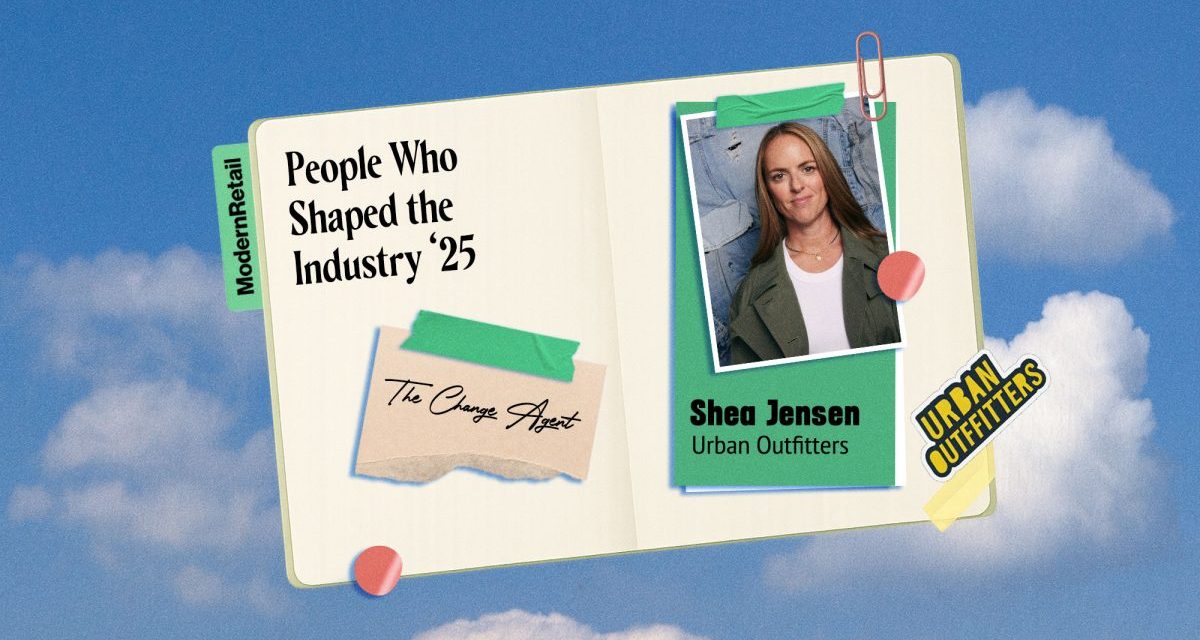
This story is part of a Modern Retail package on the People Who Shaped Retail in 2025, profiling the year’s most influential industry leaders.
Urban Outfitters was ready for a refresh when Shea Jensen joined the brand as president of North America in February 2024.
The brand had finished its 2024 fiscal year with comparable sales down nearly 14%. Executives at its parent company had called out Urban Outfitters’s “disappointing performance” in North America and Europe. Inventory levels, while better than months before, were still elevated. And Urban Outfitters, once a favorite of millennials, was scrambling to keep up with the fast-changing interests of Gen Z.
Jensen, who previously served as president of the denim brand Good American from 2023 to 2024, was tasked with helping to turn around Urban Outfitters in the U.S. and Canada. Her first step was market research. “We needed to learn from our [target] customer — both those that were shopping Urban Outfitters and those that weren’t,” Jensen told Modern Retail.
Jensen’s first order of business was to compile data, often in person. For weeks, Jensen’s team held focus groups and chatted with shoppers at malls, on college campuses and at stores. They asked all sorts of questions: How do you like to shop? How do you discover new brands? How would you describe your style? How do you express your individuality? What do you expect from a brand? How do you see Urban Outfitters fitting into your life?
Jensen’s team also scoured product reviews and tapped UO Insiders — a group of more than 10,000 Gen-Z shoppers, students and influencers — for surveys and “closet raids.” Finally, Jensen and her team used all of this information to chart a plan for Urban Outfitters going forward: Stay up-to-date with the customer, evolve the product selection, invest in marketing, adapt retail channels and operate with more discipline.
Nearly two years later, Jensen is “super proud” of the progress Urban Outfitters has made, she said in an interview. The company now has more full-price customers, a new localized store format and a college ambassador program called UO100. It has partnered with buzzy brands like Nike, Levi’s and Ugg through a retail concept called “On Rotation,” while also building up its private labels. And, it’s boosted its selection of dorm decor, experimented with platforms like Reddit, and connected with young people through concerts and college tours.
Numbers show the strategy is working. In May 2025, the Urban Outfitters brand reported a 2.1% jump in comparable net sales, its first positive comp since 2022. By November 2025, Urban Outfitters had reported a 12.5% jump in comparable net sales, its first double-digit positive comp since 2021. The brand also saw “significant profit improvement versus last year,” said Richard Hayne, the CEO of Urban Outfitters, Inc., which also oversees Free People, Anthropologie, FP Movement, Nuuly and Terrain.
It’s a promising direction for the brand, said David Swartz, who covers Urban Outfitters, Inc. for Morningstar. “Urban Outfitters had been struggling in the last few years, while [sister brands] Anthropologie and Free People had been doing much better,” he told Modern Retail. “But it takes time to figure out what is wrong and what needs to be changed, and then to get people into the stores. … It does seem like Urban Outfitters is turning a corner. They just need to post consistent, positive numbers.”
Jensen acknowledged that the company is operating in “a very agile, changing, dynamic market” but is focusing on what it can control. “We really try and keep pace with the customer,” she said. “We want to stay in sync with how [customers] are living their lives and where they shop. … Ultimately, our goal is to make sure our brand is not just seen, but also really felt.”
A tall task for a turnaround
It’s not the easiest environment for brands to execute turnarounds in, thanks to shifting tariffs, muted consumer sentiment and other macroeconomic concerns. In November, Urban Outfitters, Inc. forecasted that tariffs would negatively impact the brand’s fourth-quarter gross margin by 75 basis points — up from 60 basis points in the third quarter. “There is still a lot of uncertainty into this environment,” Frank Conforti, COO of Urban Outfitters, Inc., said on an earnings call last month.
But Jensen is no stranger to leading during a tumultuous period. During Covid, she was the executive vice president for men’s and women’s apparel at Nordstrom. She got her start there as a sales associate in 1990 and worked her way up until 2022. She then moved to Pressed, a juice brand, to serve as president from 2022 to 2023.
Throughout her career, Jensen earned a reputation for being “a strong leader with extensive experience across all retail channels,” Hayne, the CEO of Urban Outfitters, Inc., said when announcing Jensen’s appointment in January 2024. “We are delighted to have Shea join the brand and believe her authentic leadership style and customer-first mindset will be a great asset to the brand,” he said in a statement.
Now, in 2025, Jensen said her mission is to forge ahead and “stay focused on our customer and focused on our plan.” “The customer is voting every day,” Jensen told Modern Retail. “If you can follow their signal, you’ll be headed in the right direction.”
Meeting consumers’ expectations
At Urban Outfitters, Jensen remains focused on meeting customers’ expectations of what the brand should sell — and how it should sell it. When Jensen spoke with customers two years ago, many shoppers expressed that the assortment had “become unintentionally too niche.” “We needed more broad appeal,” Jensen said.
At Urban Outfitters, that’s meant building out categories like denim and lounge. For instance, Urban Outfitters has given more floor space to its private denim brand BDG Denim and private lounge brand Out From Under. After customers expressed that they liked the style, fit and value of those lines, the brand “work[ed] hard to innovate in fabric and to build out franchise fits,” Jensen said. “To date, those two brands have grown by more than 30%, and they represent a considerable part of our women’s apparel offer,” she explained.
Under Jensen, Urban Outfitters is also leaning more into national brands that its younger customers like. It’s doing so through its “On Rotation” program, which highlights select brands via dedicated merchandise displays. Urban Outfitters chose Nike to be its first partner, and in May, the two launched a limited-edition capsule collection. In August, Urban Outfitters set up a curated denim collection from Levi’s. In November, it hosted an Ugg installation in key stores.
Pricing has also remained a priority for Jensen. One of the first insights she gathered from talking with customers was around value. At malls and stores, shoppers mentioned the brand was too expensive. Now, roughly two years later, about 15% of the brand’s assortment is priced at an opening price point, up from low single digits before Jensen’s tenure. This varies by category, but an example is 30 tops under $30.
“We heard early on that customers felt that we were inaccessible and that we were priced too high,” Jensen said. “So, armed with that information, the team worked really hard to make sure we introduced more price accessibility. Customers responded really well.”
But, she said, “That doesn’t mean that we want to make sure we price everything cheap. We want to make sure that we offer the absolute best price-value equation for every item we sell.”
Exploring new channels
Today, Urban Outfitters fans can shop more ways than ever before, Jensen said. The brand has around 180 stores, an app and a website, as well as numerous social media accounts. With all of these channels, Jensen said, “We’ve been able to acquire a lot of new customers, to the tune of double-digit new customer acquisition.”
Refining the store experience has been key for Urban Outfitters. The brand’s new store concept, which it rolled out in October, brings a refreshed design to its brick-and-mortar look. “It’s lighter, a bit warmer and brighter, and gives us more flexibility, allowing us to tailor each store to the local customer and local environment,” Jensen said. Two stores currently feature this format — in Houston, Texas and Glendale, California — but Urban Outfitters is planning one more for 2025 and seven more for 2026.
The second location is in a mall — a bigger focus for Urban Outfitters under Jensen, too. “Malls are a really important part of our business today, and traffic in malls is definitely coming back,” Jensen said. Back-to-school shopping has been key to this; visits to Urban Outfitters stores, including mall locations, increased 5.8% in October, 3.6% in September and 5.5% in August, per Placer.ai. Jensen mentioned that “there’s lots of Gen Alpha out in the malls” and that she finds malls a great place to connect with younger shoppers.
The brand continues to have a presence online and on Instagram, TikTok, Facebook and Pinterest. Reddit is becoming a bigger channel for Urban Outfitters, Jensen stressed, and she mentioned Substack as a platform that has piqued her interest. “We really aim to meet our customers in the places that matter most to them,” she explained.
Getting through to Gen Z
Before Jensen took the reins, Urban Outfitters had a bit of an age conundrum, Morningstar’s Swartz said. The brand tends to cater to a younger audience than Free People and Anthropologie, but “it was clear they were struggling to attract younger shoppers,” Swartz said. “They needed to change the marketing, change the merchandising, target the right demographic and give them stuff they want to buy.”
Under Jensen, Urban Outfitters has tried to do just that, especially with the coveted Gen Z demographic. One way it has wooed these shoppers has been through college activations. In May, Urban Outfitters launched a back-to-school campaign, deploying trucks decorated as dorm rooms throughout New York City. In September, Urban Outfitters threw a concert with Yung Gravy at the University of Colorado. Last year, it toured campuses in Georgetown, D.C.; Athens, Georgia; and Tucson, Arizona.
For Jensen, spending time on college campuses and in stores — by talking to shoppers, hearing what excites them and learning what trends they’re after — is one of the best parts of the job. “That is where you feel the heartbeat of the brand and the customer,” Jensen said.
For this reason, events and experiential retail are important to Jensen. When the brand opened its new store in Glendale, it hosted a record signing with singer Khalid. In early December, the brand set up a club-like lounge in Terminal 2 at Chicago O’Hare International Airport, complete with makeshift igloos and sandcastles. The brand’s new localized store concept places an “emphasis on Gen Z’s favorite styles and brands,” per a press release.
The brand also recently partnered with Canva, a graphic design platform, on templates for holiday wishlists. According to a press release, Urban Outfitters collected insights from its UO Insiders and found that more than half (54%) of college-aged customers prefer using wishlists and presentations to share holiday gift ideas.
Jensen is now busy gearing up for the holidays, a season she expects to perform well. By her side are her colleagues, who praised Jensen for her clear vision and eagerness to meet shoppers’ needs.
“What I admire most about Shea is her ability to focus on the customer and build this into real business results,” Sheila Harrington, the Global CEO of Free People and Urban Outfitters, told Modern Retail via email. “She came in with a clear strategy and executed with purpose, strengthening product relevance, reigniting our marketing engine, and putting the customer back at the center of every decision.”
Harrington continued, “The momentum North America Urban Outfitters is seeing today is a direct reflection of her leadership. She’s thoughtful, sharp and endlessly committed to serving the next generation of customers.”
Correction: This story has been updated to correct the name of Urban Outfitters’s ‘On Rotation’ program in one instance, and to correct Sheila Harrington’s title. She is the Global CEO of Free People and Urban Outfitters.