


Ergobaby is revamping its website and packaging to better resonate with young parents
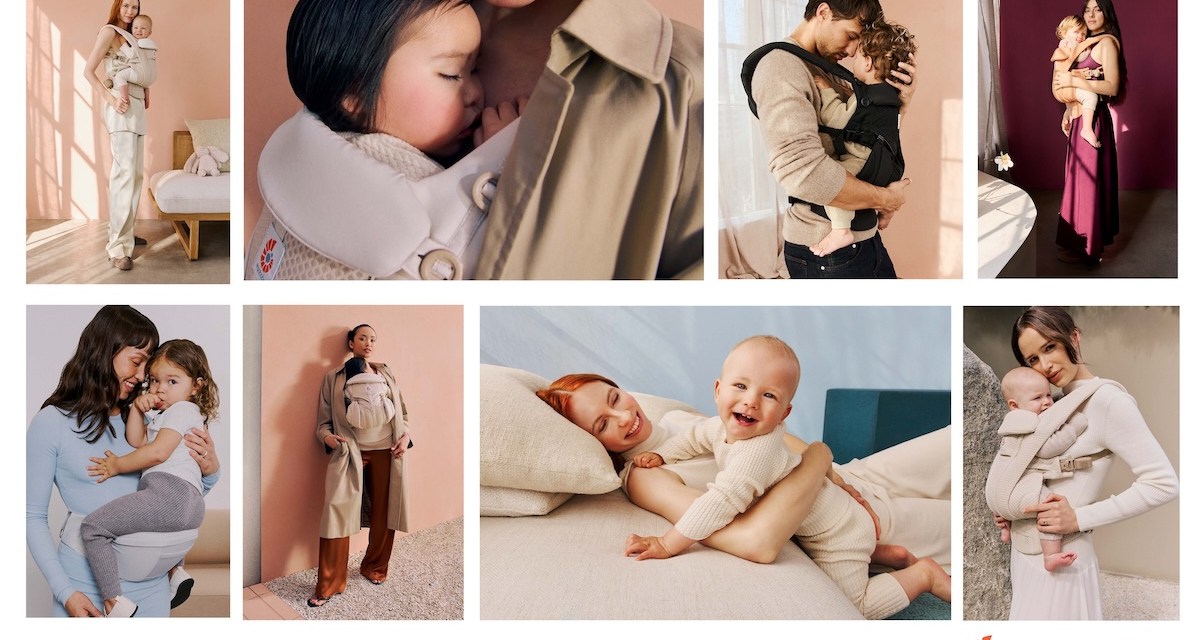
Ergobaby, which makes ergonomic baby carriers, is embarking on a brand refresh as it courts Gen Z and millennial parents.
On April 8, the company is debuting a new website with updated lifestyle imagery, CGI fit explainers and more educational content to help young parents better understand the brand, which aims to make baby carrying more comfortable and versatile. This spring, Ergobaby is also expanding its assortment in retail partners like Nordstrom and Target, while entering new partners like Crate & Barrel Kids and Shoppers Drug Mart. Finally, Ergobaby is in the process of redesigning its product packaging globally, with a planned rollout in August.
Ergobaby launched in 2003, after founder Karin Frost designed a baby carrier from her home in Hawaii. The brand was independent until 2010, when it was sold to a private-equity firm for $91 million. At the end of 2024, Ergobaby was acquired by Highlander Partners for $104 million. Today, Ergobaby is seeing strong growth as more moms and dads look for hands-free ways to carry their babies. Ergobaby saw double-digit percentage growth in year-over-year revenue, said Heberto Calves, Ergobaby’s chief marketing officer.
Baby carriers are not new. But the category is becoming more saturated as parents seek out ways to transport and bond with their infants while going about daily tasks. Many are looking for more modern, well-designed carriers. Now, as more young people become parents, Ergobaby aims to adjust its marketing and merchandise to be more informative, eye-catching and social media-friendly.
“Gen Z and millennials want less stuff, but better quality [items],” Calves told Modern Retail. “They want to make sure [a product] is made in a good factory and made to last. They’re eco-conscious and environmentally-conscious. Ergobaby lives up to all of the above, and we’re in a perfect place to help educate parents. [But before] we didn’t have enough sizzle to resonate with Gen Z and millennials who are very visual, on social media and want to see things that are aesthetically pleasing.”
Ergobaby hopes that redoing its website and adding new imagery to its Instagram and TikTok will be crucial to this effort. Before, Ergobaby’s website operated like a catalog, with minimal product descriptions. But the revamped website showcases the engineering and patents behind Ergobaby’s products and explains why the carriers are designed the way they are. It’s meant to help parents find information and compare products, as well as understand the health benefits of baby wearing, such as reduced crying. And, it has a product-finder quiz, 360-degree videos and a special section for customers’ “stories, adventures [and] selfies.”
“[The website] is really what websites should look like in 2026,” Calves said. He added that the company expects its “run rate growth to be 15-20% growth” from last year to this year, “and that’s without factoring in the relaunch.”
New imagery on Ergobaby’s website shows how its signature baby carrier centers the weight “on your hips, not your back” and provides neck support. Calves said that “education is really important for the health of the [baby-wearing] category,” especially as more brands enter the space. Today, there are several baby-carrier competitors, including WildBird, Hope&Plum, Mabē, and Tula.
With so many baby brands on the market, product education is critical for parents deciding what to buy, said Lily Walla, founder and CEO of the online parenting community Auggie. “Guidance over inventory is a really big thing,” she told Modern Retail. “Parents, especially today, want to be told not only what to buy, but also why. … We can’t discredit that decision fatigue is very real.”
With that, Ergobaby is stressing education on its social media channels, as well. As part of its refresh, Ergobaby is vowing to work more frequently with influencers, especially as AI engines like ChatGPT pull from social media to make product recommendations. “We’re looking for real authenticity, so we want to [bring in] credible creators and professionals in maternal health and in baby health,” Calves said. The brand also hopes its new packaging — which will include more product information — will take off with creators and everyday parents, as well.
“Maybe Gen X goes to a website first to learn about a brand or company, but Gen Z and millennials go to an Instagram and TikTok page,” Calves said. “So, educating there is really important.” He added that the brand wants its new packaging to be attractive, as “the unboxing experience is really important for moms, whether they’re at a baby shower or [taping] a piece of UGC on camera.”
In the end, Ergobaby hopes that overhauling its website and social channels, in addition to its look and feel, can help its growing number of retail partners clinch sales. The vast majority of Ergobaby’s revenue, about 80%, comes from wholesalers, Calves said. Ergobaby recently introduced a Target‑exclusive Omni Classic Carrier online and in stores, and it launched on Zola in March. “Targeting retailers is critical to reaching the parents that we want to reach,” Calves said.
Ultimately, Calves believes that adoption of baby carrying is at a “tipping point” and estimates the category is growing about 30%. “If you go back years ago, with strollers or car seats, those are categories where the importance of safety and engineering and quality wasn’t at the level that it’s at today,” he said. “That’s what’s coming to baby-wearing, and as one of the leaders in the category, we have to help drive that.”