


Dick’s Sporting Goods says it’s ‘still early in the Foot Locker turnaround’ as it cites footwear challenges
Dick’s Sporting Goods says it remains bullish on its Foot Locker business, even as it lowered its yearly guidance for the segment, citing “challenging conditions” in the athletic footwear market.
On Tuesday, Dick’s Sporting Goods reported that pro forma comps for Foot Locker declined 3.6% in the second quarter, versus a 0.6% increase during the first quarter. Dick’s Sporting Goods then slashed its yearly outlook for pro forma comparable sales at Foot Locker to a range of -2% to 0%. Comparatively, the Dick’s business reported 4.9% comp sales growth, buoyed by World Cup sales and increases in average ticket size and transactions.
On an earnings call, executives attributed Foot Locker’s slower performance to several factors, including a heavily promotional environment, elevated inventory of legacy footwear silhouettes, fewer footwear launches, and challenges in Europe, the Middle East and Africa. Dick’s Sporting Goods, as a whole, is also dealing with macroeconomic and geopolitical concerns such as higher fuel costs and supply chain headwinds. These, too, “weighed on profitability during the quarter,” executive chairman Ed Stack said.
“But let me be clear: We believe the Dick’s business remains strong, and none of this changes our confidence in the long-term opportunity at Foot Locker,” Stack continued. “We’re still early in the Foot Locker turnaround. We continue to invest to strengthen the business for the long term.”
Dick’s Sporting Goods acquired Foot Locker for $2.4 billion in 2025 as part of its effort to reach more customers and play a greater role in culture. At the time, Stack said Dick’s Sporting Goods was “confident that [it] will be able to prove the Foot Locker acquisition is the right decision.” The combined company operates more than 3,200 stores, plus e-commerce sites across 20 countries.
Despite recent challenges, there are some encouraging signs across Dick’s Sporting Goods. For the second quarter, the entire company reported $5.587 billion in net sales, an increase of 53.2% over the prior-year period. Year-to-date net sales were up 57.6%.
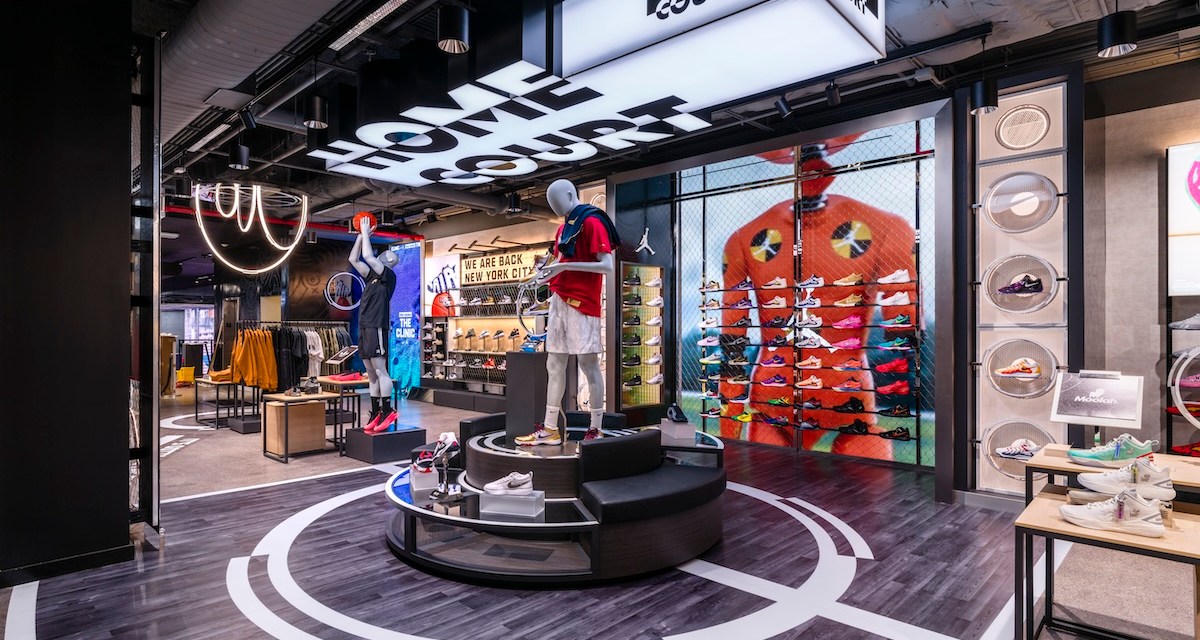
Stack also shared that Foot Locker is seeing strong results from its first major brand campaign in more than a decade and that it has increased payroll for its store associates, known as “Stripers.” Within stores, Foot Locker is making progress on “Fast Break,” its retail remodeling concept that includes clearer storytelling and a more focused shoe wall. Foot Locker redid 250 stores globally in time for the back-to-school season, and is already seeing “Fast Break” locations outperform legacy stores.
Meanwhile, Dick’s “House of Sport” concept is “driving athlete engagement and fueling sales growth,” said Lauren Hobart, president and CEO of Dick’s Sporting Goods. She also mentioned “outstanding results” from the company’s marketing efforts around the World Cup. In the last quarter, Dick’s relaunched its membership program, Scorecard, to include a $99-a-year tier, which the company thinks “will increase engagement, drive higher purchase frequency, strengthen loyalty and further reinforce our competitive position,” Hobart said.
Still, Dick’s Sporting Goods executives remain cautious about the rest of 2026 — especially as cash-strapped consumers pull back on discretionary spending or look for the best promotions possible. In the U.S., retail sales dropped 0.6% in July, the first decline in nine months. In August, U.S. consumer confidence hit its lowest level in seven months as gas prices stay elevated.
At this time, footwear companies across the globe continue to face headwinds. Earlier this month, JD Sports said that the market for footwear “remained tough” this last quarter as consumers faced cost-of-living pressures. Foot Locker also shared it’s expecting greater market pressure as brands turn to discounts, causing a ripple effect throughout the industry. “If a shoe is at a certain price in the marketplace, then we feel we need to be competitively priced,” Stack explained.
The footwear sector is facing other challenges, too. The sector has gotten more competitive over the last two decades, thanks to quick-rising entrants like On and Hoka. This year, shoe brands are struggling as the U.S.-Iran conflict squeezes the global oil supply and drives up the cost of raw materials. And the shoe industry has been particularly hit hard by tariffs, as some 99% of footwear sold in the U.S. today is imported. (Dick’s Sporting Goods said it has received $59 million in tariff refunds.)
Compared to the Dick’s business, Foot Locker is feeling the biggest effects of this slowdown, since footwear makes up the vast majority of its business. Right now, Foot Locker is having trouble moving lifestyle legacy silhouettes, although athletic performance shoes are performing better, Hobart said. Foot Locker’s launches this last quarter were also fewer in number than before, and “disappointing in the marketplace,” Stack conceded.
Still, Stack is not discouraged by what he’s seeing across the footwear industry. “I don’t think this is a demand issue,” he explained. “The consumer is looking for products that are new, innovative [and] different in the marketplace, and some of these older legacy silhouettes and franchises that have done so well have slowed.” He shared that Nike running shoes and Adidas’ women’s products are performing strongly, and that the company is looking forward to carrying new styles from On and Hoka.
In a note on Tuesday, Neil Saunders, managing director of GlobalData Retail, said he remains “confident” that Dick’s management can rebuild Foot Locker in the long term. Still, he wrote, “While we do see some early signs of progress at Foot Locker — including better store presentation and a more disciplined approach to inventory — these things are not sufficient to offset an unstable market that continues to wax and wane.”
M Science’s John Tomlinson and Sung Pil Kim used U.S. consumer transaction data to find that spending growth at Foot Locker decreased 17.4% year over year in the second quarter. The analysts pointed out that the next few weeks could prove crucial for Foot Locker. “Management has stated that its first big test for Foot Locker will be back-to-school, given it [will] be the first season where it curated the full product assortment since the acquisition,” they wrote.
Ultimately, Dick’s Sporting Goods executives shared they are staying positive, when it comes to the future of the footwear sector. “The footwear business is going to continue to be extremely important to this industry, and to Dick’s Sporting Goods and to Foot Locker,” Stack said. “Every once in a while, an industry has to go through a little bit of pain to reset, and we’re going through that right now. But we’re going to come out of this on the other side.”