


Brands Briefing: Canadian furniture brand Cozey is opening more U.S. stores while ‘going after IKEA’
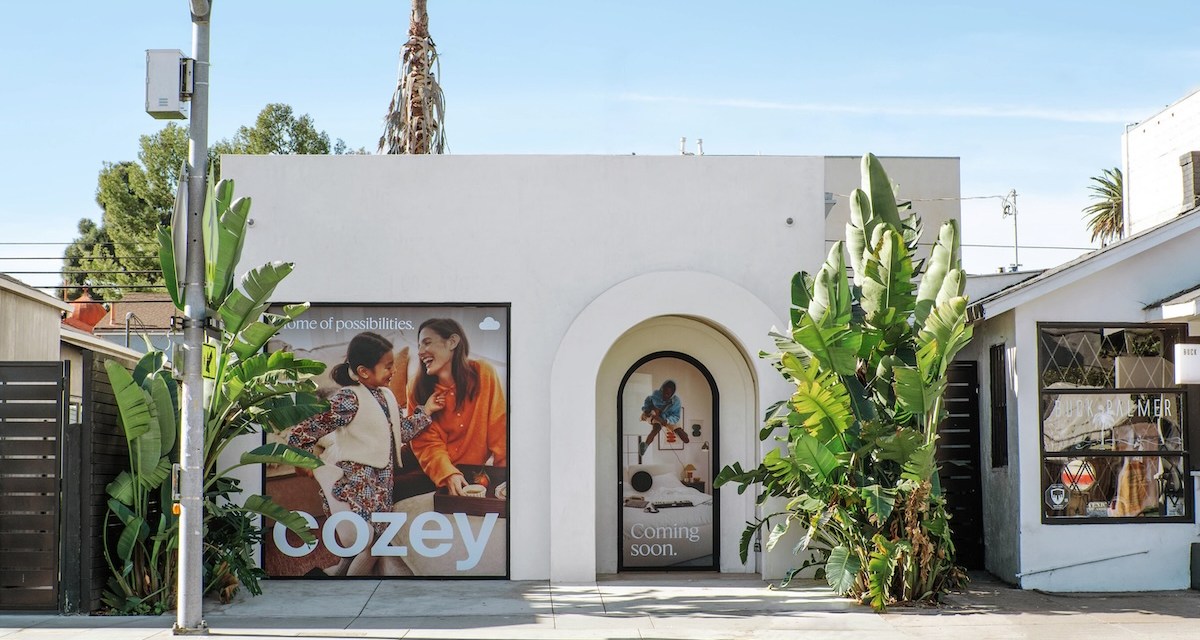
Canadian furniture brand Cozey is cozying up to more U.S. shoppers in its quest for global growth.
The Montreal-based startup, which launched in 2020, is focusing on brick-and-mortar retail as it scales in North America. On April 8, Cozey will open its first West Coast pop-up. Located on Abbott Kinney Boulevard in Los Angeles, the space is approximately 5,000 square feet and will be up and running until December. Cozey previously held two pop-ups in the U.S. — in New York City, in 2024 and 2025 — and is now planning a permanent New York City store for early 2027, CEO and founder Frédéric Aubé told Modern Retail.
Cozey’s ambitions in the U.S. come at a time of growth for the direct-to-consumer company, which is best known for its functional, modular “sofa in a box.” Cozey — which Aubé conceived while studying at McGill University — launched with e-commerce first in Canada, then expanded its online business to the U.S. in 2023. But “furniture shopping remains a very tactile experience,” Aubé said, so the company is now looking to invest more in physical retail.
Cozey set up pop-ups in Canada starting in 2024 and now has three permanent stores in Toronto, Vancouver and Calgary. As Cozey’s U.S. business is growing at a faster clip than its Canadian business, storefronts there are a growing priority.
“Canada is quite limited in the amount of large cities we have, so when we think about our retail strategy [there], there are only so many flagships and large stores we can do,” Aubé said. “More and more, when I think about Cozey, I think of an omnichannel model, and not so much e-commerce-driven. We’re going to look for large cities to establish a physical presence, and to us, the U.S. is really attractive, for that reason.”
Cozey achieved triple-digit percent growth across its global business in 2025. About 60% of the brand’s sales come from Canada, with the remaining 40% coming from the U.S. Cozey is best known for its sofas, like the Atmosphere and the Ciello, which start at around $1,000 for a two-seater and can come with storage. But Cozey has many products beyond couches, including beds, rugs and credenzas. The brand has distribution centers in Canada and the U.S., with plans for an additional location in the U.S., likely in the Midwest or the South.
As Cozey grows, it’s using its pop-ups to test whether a city would be receptive to a permanent store and to build broader brand awareness. It relies on its e-commerce data to pick locations; its two biggest markets in the U.S. are New York City and Los Angeles, so those were first picks for pop-ups. Cozey then evaluates the pop-ups to inform its larger physical retail strategy. In New York City, for instance, Cozey found that its Flatiron pop-up performed better than its Soho pop-up, in terms of foot traffic and conversion. Soho is more popular with tourists, and “the Flatiron clientele resonates a lot more with who we are at Cozey,” Aubé said. With that, Cozey’s first permanent location in New York City will be in Flatiron.
Cozey finds that its overall sales increase when it opens a physical location, Aubé said. The brand tries to create a uniform experience across its website and its stores. “Whereas [other] furniture stores try to create rooms for you to imagine, … we want to remain style-agnostic, for customers to see if [an item] fits in their space or not,” Aubé explained. “If you look at our website, everything is on a white background. If you look at our stores, everything is on a white background. It’s a very similar approach.”
Cozey isn’t without challenges as it looks to expand. It’s been a tough time for the home furnishings industry, thanks to tariffs, rising costs and recent bankruptcies. Last year, many customers put off home improvement projects, and those that did move forward dealt with higher prices across the board, per the research firm Consumer Edge. “Our data shows that year-over-year spend growth for the home furnishings subindustry in Q1 [2026] weakened slightly compared to Q4 [2025],” Michael Gunther, svp of research and market intelligence at Consumer Edge, told Modern Retail.
Today, the closure of the Strait of Hormuz is complicating matters even more. Iran effectively blocked off the crucial shipping lane in March, following an attack from the U.S. and Israel. The furniture industry relies on materials like plastics and resins, many of which are made from crude oil that’s transported through the waterway. In fact, approximately 84% of Middle East polyethylene capacity relies on exports from the Strait of Hormuz, according to Doug Lane, an analyst at Water Tower Research.
Now, many furniture companies that depend on that oil as a raw material are left in limbo or are looking to reroute deliveries. Consumers are also dealing with higher prices at the gas pump and are reevaluating where they spend money, including on bigger-ticket items like furniture. That’s tough for home brands, as “home furnishings is a textbook deferrable category,” Lane said.
Cozey manufactures its products around the world, in countries such as Mexico, Thailand, China, Canada, Cambodia, India and Malaysia. Much of its trade routes are through the Pacific Ocean, so Cozey is “not that impacted” by the Strait of Hormuz closure, Aubé said. Still, oil prices are affecting the entire furniture supply chain, Aubé said. “If oil prices remain this high, I think we’re going to see price increases [from suppliers],” he said. “That could be the biggest impact in the furniture industry this year.”
Still, Aubé is optimistic about Cozey’s future as it expands beyond Canada. The brand is going into Australia at the end of the month, and its product pipeline is “as exciting as it’s ever been,” Aubé said. Long-term, Cozey wants to be the biggest home furnishings company in the world.
“We’re going after Ikea,” Aubé said. “It’s going to take us 25 years, maybe 30 years, to get there, but that’s the goal.”
What we’re reading
- Allbirds’ fall from grace traces back to its desire “to grow too fast, too soon,” Footwear News writes.
- The owner of tween brand Claire’s is leasing a logistics hub in Illinois as it carries on with a turnaround, per Retail TouchPoints.
- Hasbro says it suffered a cyberattack that could lead to weeks of product delays, per a regulatory filing viewed by Retail Dive.
What we’ve covered
- Brands like Olipop and Goodwipes rolled out actual gag products for April Fools’ Day.
- After a successful stint in North America, Coach is stepping up its focus on Gen-Z consumers in Asia and Europe.
- E.l.f. Beauty’s chief digital officer says the company still views humans as the “conductor” as it scales AI.