


Brands Briefing: AI personalization tools become sales drivers
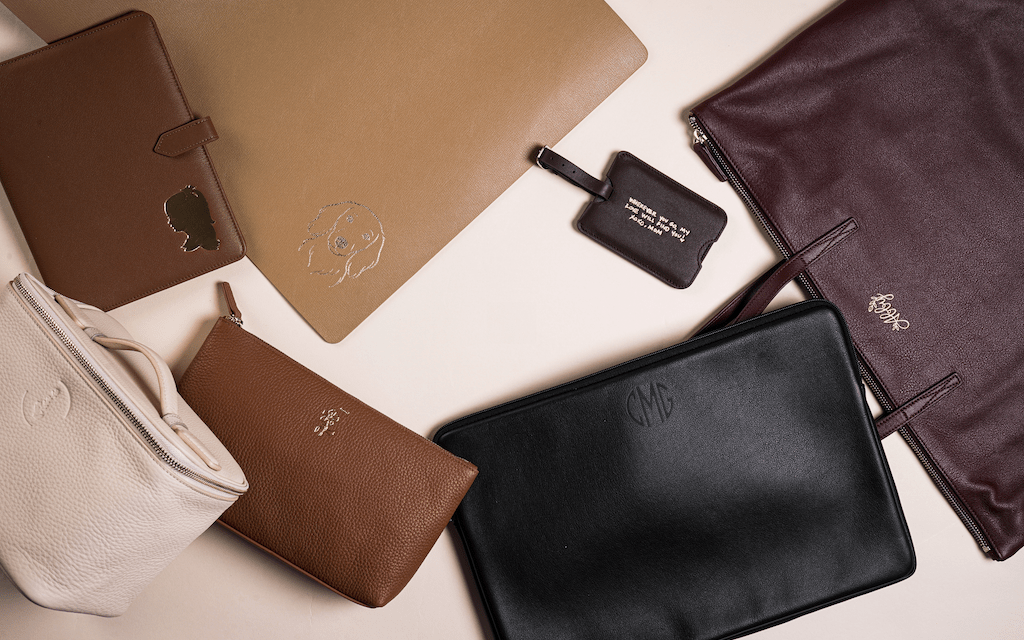
As brands dabble in customer-facing generative AI, some are leveraging these tools for product personalization.
Last fall, in the lead-up to Cyber Week, the leather goods brand Leatherology launched a proprietary AI design tool on its DTC website, called Yours, Truly. It’s a way for customers to create or upload their own designs to be debossed on select Leatherology items. After launching in October, products leveraging the design tool surpassed the brand’s holiday sales goal by 156%. This month, Yours, Truly orders represent 15% of personalized units and 11% of personalized revenue. But there were also some growing pains as Leatherology navigated capacity limitations due to higher-than-expected demand. Due to early production and fulfillment constraints, Leatherology hasn’t promoted the Yours, Truly tool heavily in its marketing. But after fine-tuning the ordering process, the company is tapping into the AI design tool to boost Valentine’s Day gifting.
It shows that some of the new AI personalization tools are no longer just marketing experiments, but they are also playing an increasingly important role in driving revenue. Leatherology co-founder Rae Liu said the strategy behind Yours, Truly is to build on the customization services the brand has offered for years, which mainly consist of monogramming and letter stamping. “It has been challenging to execute the new orders,” Liu said. “But I tell the team that if it’s challenging for us, it’s challenging for other brands to do.”
Liu told Modern Retail that, initially, the company expected the Yours, Truly personalization option to have slow customer adoption, as it’s more expensive than the brand’s existing personalization add-ons.
Part of the preparation for the launch included the purchase of a CNC leather machine for the in-house customization. Originally, Leatherology was going to print the dyes in-house before realizing a third party was needed to help catch up with scale. The company set production capacity buckets for different personalization options, which were surpassed by Cyber Monday. “It was good and bad to hit those that early,” Liu said, with many orders continuing to roll in even after the Christmas shipping cutoff dates.
“There have been a lot of learnings, from an operational standpoint,” Liu said. For example, Liu said some people’s orders had misspellings of proper nouns or names that the company wasn’t able to detect. “We had to add verbiage about how AI can make mistakes,” she said. The company also modified various prompts in the backend of the AI tool, to better be able to cut and print on different leather textures.
Some of the most popular designs have been initials, paired with an image representing a hobby or interest. Other customers have used Yours, Truly to emboss the logo of their small business or startup on merch. “We also see people making family crests and ordering multiples that I imagine they’re sending to their relatives,” Liu said.
Liu said these operational challenges are worth the effort, as they help Leatherology stand out in an ever-competitive category. One interesting pattern Leatherology saw from the launch is that customers are using the AI designer on lower-priced items, resulting in a bigger portion of their overall spend going toward personalization. This is also increasing the cart sizes of some customers who wouldn’t typically consider personalizing their product.
Katherine Black is a partner at global management consulting firm Kearney, where she leads food, drug and mass market retail. Black said that consumers have come to expect personalization, and all indications point to that expectation only increasing in the coming years.
“This is a great example of leveraging technology to take that one step further than what was on the market previously,” Black said. One of the things customers look for when personalizing items is the ability to create a product reflective of their identity, Black said. “That is an enduring consumer need that will not go away, so I think this capability has some longevity to it,” she said. At the same time, improvements in AI mean that this type of customization will increasingly become possible for more types of brands. “So it may be harder to maintain this as a unique advantage, and going forward, it is likely to become table stakes,” Black said.
Laura Osier, the executive director at Leatherology, said the company has gotten a better handle on logistics over the past few months. “A lot of variables come into play that can affect how an intricate design is debossed,” Osier said. So while the company wants to give the customer exactly what they envisioned when AI generated their design, realistic exceptions also have to be set.
Some of that starts with the actual designs the brand is showcasing in the promotional material on its website, in product listings and on social media. Since launching the Valentine’s Day Yours, Truly assets in early January, Liu said multiple customers have already reached out to order the featured love swans design that the team created. Liu said that, going forward, the company is considering featuring simpler design examples that can be produced quickly.
Another learning is that “Customers can be pretty literal,” Liu said. For instance, if the brand promotes an example of an AI illustration featuring a dog, many people end up just requesting a variation of that same dog.
That behavior also shows that it can be difficult to parse just how much customization a customer actually wants. “It’s interesting that, when given the chance, people are not as inspired as you might think they’d be,” Liu said. “So we’re making tweaks every day to try to narrow that decision for them,” Liu said.
At the same time, many people are giving the AI design tool more prompts to see more variations before settling on their chosen custom design. “We’re happy that they’re spending more time on the site and interacting with the tool,” Liu said. –Gabriela Barkho
How the Saks bankruptcy has impacted brands
Fisayo Che, the founder of apparel brand Elisamama, is one of the many small-business owners waiting on payment from Saks Fifth Avenue. Che began supplying merchandise to Saks Fifth Avenue in 2020. The last payment she received from the company — although not in full — was in August. Now, she says, she’s out six figures — and she has vowed not to ship more items until she gets her money back.
Che and several other entrepreneurs shared their experiences working with Saks Global with Modern Retail in our piece titled “Smaller vendors, still waiting on payments, debate their futures with Saks after bankruptcy.” Here is just some of what Che had to say about how the Saks bankruptcy has impacted her business:
“We have other retail channels that we are working with right now to launch. We’re looking … to partner with smaller boutiques that might not be able to place as large of an order [as Saks Fifth Avenue], but a few of them would at least add up. And we’re always looking to grow our own direct-to-customer [channel]. We don’t have the size and the attention that these large retailers have, which is why we partner with them. But our ultimate goal is to continue to grow our DTC business.”
“I wouldn’t say I was surprised [by news of the bankruptcy]. I feel like enough had been said in the press, for some time, about their financial woes. And while we weren’t really directly impacted until the middle of last year, I know that there were other brands that had been expressing complaints and concerns about lack of payment or consistent payment. I’d been hearing things.”
“Our team is essentially having to bankroll a large company. They still have our goods on their website. They’re selling. And we’re not getting paid.” –Julia Waldow
What we’re reading
- Skin-care brand L’Occitane is reportedly looking at banks for a U.S. IPO.
- Jennifer Garner’s baby food brand, Once Upon a Farm, is targeting a $764 million valuation in its IPO.
- Tracksmith, a 12-year-old brand known for its high-performance running gear, has named a new CEO: former Converse president and CEO Jared Carver.
What we’ve covered
- Behind Pacsun’s strategy for keeping a close pulse on the changing tastes of Gen Z.
- Floral delivery company Bouqs has launched a $5 million crowdfunding campaign.
- The shopping habits ofE.l.f. Beauty’s chief brand officer Laurie Lam.