


Barnes & Noble CEO James Daunt has mastered the art of the bookstore turnaround
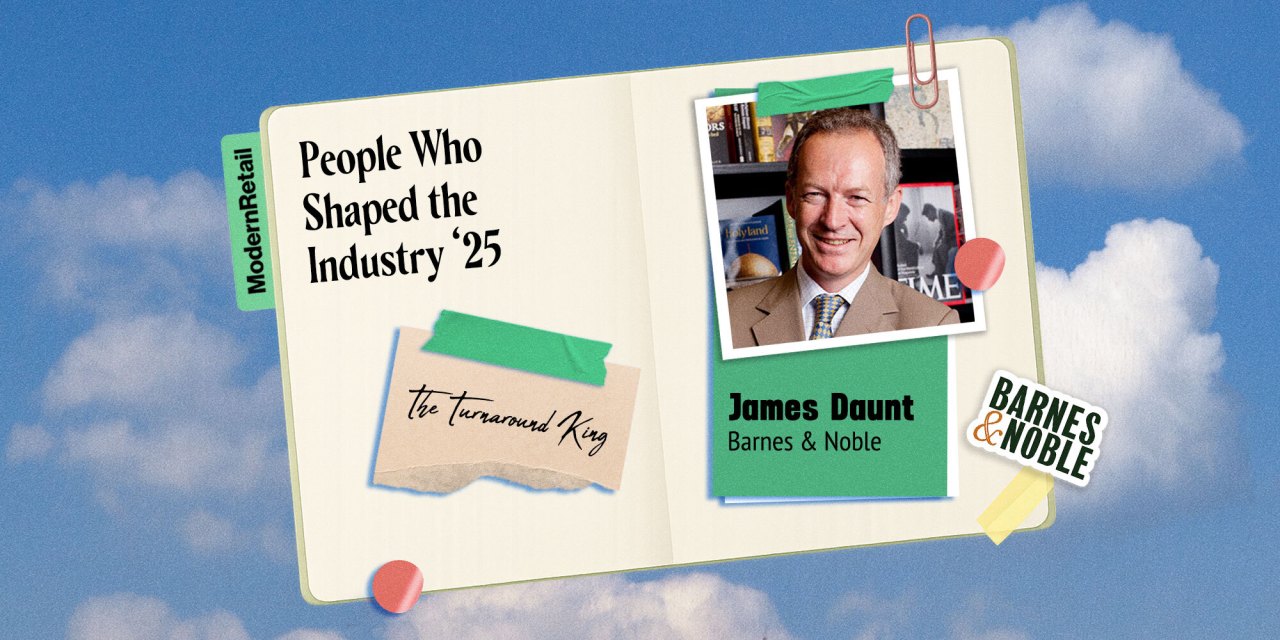
This story is part of a Modern Retail package on the People Who Shaped Retail in 2025, profiling the year’s most influential industry leaders.
Over the past six years, James Daunt has operationally flipped the U.S.’s largest bookstore chain upside down. Now in growth mode, the once-struggling retailer is a prime example of how to save one.
To best understand Daunt’s approach, one needs to look back several decades. Daunt, a former banker, set up his own indie bookstore called Daunt Books in the U.K. in 1990. “I wanted to set up a business of my own as closely aligned as possible to my personal interests,” Daunt told Modern Retail. “Reading topped these and, therefore, a bookstore seemed a good fit.”
The decade was a tough environment for a small bookseller, with the U.K. facing a recession and the Gulf War, as well as the emergence of Amazon as an e-commerce giant in the space and the growth of major chains like Waterstones.
This is where Daunt said he first honed his discipline and skills as a bookseller, driving his business to success through good times and bad. Daunt Books has grown to 10 locations today, mainly in London. His experience running the small bookstore chain was the genesis of Barnes & Noble’s new culture, rooted in flattening hierarchies and empowering people at the store level, letting individual stores control the makeup of their store teams, the presentation of products and even pricing.
His philosophy at Daunt Books was to “make the bookstore as interesting and attractive as possible, and have within it friendly, informed booksellers who enjoyed their customers and their jobs,” he said. “This shouldn’t be distinctively different from most bookstores, but it was.”
When Waterstones, a major chain bookseller in the U.K., went bankrupt in 2011, Daunt put out feelers to investors in hopes of taking on the business. He was confident in his ability to run bookstores and thought the loss of the biggest bookstore chain would considerably weaken the industry as a whole.
He had asked private equity firms for funding to revive the chain. but didn’t get takers, as performance of bookstore chains was struggling and the Kindle had just launched, putting the physical book industry’s future into question. But Russian businessman Alexander Mamut did acquire the brand in 2011, appointing Daunt as managing director. Daunt came into Waterstones with a central thesis: If he ran each individual store well, they could succeed.
“By ‘running them well,’ I mean having nicely presented stores with the right books in them that people wanted to buy, with a happy, well-trained, engaging team of booksellers within them,” Daunt said. “That is a retail experience really unmatched, almost, by any other.”
He reorganized Waterstones, getting rid of centralized directives for every store to sell the same book, removed planograms, or photos of display tables that had to be recreated in every store, and ended promotional deals with publishers to get their books in prime locations, according to The Guardian. In 2017, the chain returned to profit.
“Frankly, you can be the worst retailer in the world and do quite well in books; everything was set up for it to succeed,” Daunt said, noting that books don’t have a short shelf life and that retailers can return books back to publishers for full credit. “You just needed to turn the principles that were undermining the chain booksellers, and it could succeed.”
Taking a successful formula to the states
After the success of Daunt’s Waterstones, Elliott Advisors acquired a majority stake in the business in July 2018. And in 2019, Elliott acquired Barnes & Noble for about $683 million, making Daunt its CEO, in addition to his role as CEO of Waterstones. He moved from London to New York.
The hope was that, by employing the same tactic — focusing on each individual store rather than driving mandates from the home office — Daunt could also turn around a struggling Barnes & Noble. In the five years before the acquisition, Barnes & Noble had lost more than $1 billion in market value as it faced continued pressure from Amazon, according to CNBC.
Similarly to what he did at Waterstones, Daunt employed one of his core principles: The individual store teams would judge which books made the most sense to present to their own customers, and how to present them. He believed local booksellers have a better grasp of the nuances in which books their community is interested in.
“If you want to do it centrally, you need a huge infrastructure. It’s extremely costly, and that’s what we had — an extremely costly, large home office trying to do this job that it just did badly,” Daunt said. “The irony of decentralizing and pushing that responsibility down to the individual store is that they do it much, much better.”
Just like he did at Waterstones, one of the first changes Daunt made at Barnes & Noble was stopping the practice of accepting payments from publishers for prime in-store placements, as Modern Retail previously reported. Daunt has also prioritized promoting from within to create a workforce of dedicated booksellers, rather than managers who had previously worked for retailers in different categories.
While its financial figures are private, Daunt appears to have been successful. After a decade of falling sales and store closures, Barnes & Noble is expanding again. The chain opened about 60 stores in 2025 and expects to do the same in 2026.
Ditching the traditional retail approach
Whereas other retailers invest heavily in training and infrastructure so every store feels the same or has the same standards, the new Barnes & Noble has the opposite approach.
The company now encourages each store to develop its own niche in the categories its local shoppers care about. One may have a strong children’s section. Another may have a more robust collection of World War II or American Revolution books.
“We’ve completely reversed that rulebook,” Daunt said. “When you walk into a store, you’re not quite sure what you’re going to find and what it’s going to be priced at.”
Shannon DeVito, senior director of book strategy for Barnes & Noble, has watched this change firsthand, having been with the company for more than 12 years. She started as a bookseller in Ohio and worked her way up through corporate as a buyer.
“For decades, we were run like a retailer,” DeVito said, meaning that store-level decisions were mandated by the home office instead of locations operating somewhat autonomously. “We were told when to turn our brains off and ‘move this book here’ — literally, you’d get a sheet that had covers of books with stars on when you’d have to replace the book on certain dates. It was just infantilizing.”
DeVito said it has taken time to educate the stores on how to change that and educate the local booksellers on what makes a good bookstore, as each store has employees of varying levels of expertise. But she added that Daunt’s approach has come to life in breaking down the hierarchy of what used to be a rigid corporate structure. Store teams, she said, are now thinking more critically about what they can highlight and what they can build.
“Previously, we had been very much in a corporate bubble,” DeVito said. “It’s gotten so much easier to talk to people at the stores, to email back and forth and to build those relationships, and to know who has a really good fantasy store versus a really good science store. That has made my role a lot better and, frankly, a lot more interesting.”
Daunt maintains the attitude of a local bookseller, as DeVito can attest; she said they frequently trade opinions on books they like or dislike. She also said his leadership style involves him asking intentional questions.
“A lot of times, he’ll poke and ask questions so that you just think more critically about what you’re doing, and not just do it because you’ve always done it that way, or because that’s how you think you should do it,” DeVito said. But Daunt is also willing to trade opinions on what a good bookseller would do, she said. “He’s always open to debate. It’s not his way or the highway.”
A community gathering place
Alongside the localization of its stores, Barnes & Noble will now open bookstores in any size of space, from a 35,000-square-foot box to a 5,000-square-foot mall store.
“B&N is opening stores where there is judged to be a clear demand from the local community,” Daunt said. Opening smaller stores, in addition to bigger boxes, “allows us to open successfully in locations that would not previously have been considered,” he added. “In short, by being so flexible, we are able to open many more stores, and do so with consistent success.”
That’s made it more agile to meet the needs of more communities. The retailer even took over former Big Lots and Party City locations amid the decline of those chains.
“We are experimenting. We’re doing metropolitan cities, streets, we’re doing interior mall, small stores, we’re doing these large boxes in strips,” Daunt said. “We will do pretty much anything, and are just looking for the opportunity where there isn’t a bookstore.”
The changes at the retailer have made Barnes & Noble a more desirable tenant for landlords and real estate brokers, especially as malls have sought out more experiential concepts to lure in Gen-Z shoppers. Outlet mall and shopping center operator Tanger, for example, has been focused on adding more Gen-Z-preferred experiences and entertainment venues like Dave & Busters, Main Event, Chicken N Pickle and PopStroke in and around its outlets.
Justin Stein, evp of leasing for Tanger, said Barnes & Noble has become more of a gathering place as the retailer has increased its focus on the shopping tastes of local communities. He believes that keeps people in the store longer and improves sales.
“If a brand is focusing on curating the right product mix within their stores, they’re going to have more productive stores and higher sales, which benefits everybody,” Stein said.
Tanger has two Barnes & Noble locations within its portfolio of 41 shopping centers, but Stein imagines more coming in as Tanger works to broaden its lineup. The outlet mall operator has been working to appeal more to people who live near its centers, either in booming rural areas with a lot of homebuilding or in vacation destinations that have become more residential, given the advent of remote workers.
That means courting retailers that these shoppers are more likely to visit on a regular basis. That includes bookstores like Barnes & Noble, as well as grocers or beauty brands, rather than the discount stores that had previously defined outlet malls. Tanger opened its first new Barnes & Noble store at one of its properties in 2024, in Rehoboth Beach, Delaware. “We see Barnes & Noble as a really important partner to us as we evolve and grow our portfolio,” Stein said.
Leveling up the bookstore workforce
Another change Daunt has implemented is that there are now more opportunities for Barnes & Noble employees to get promoted internally. Daunt has worked to reinvent the store structure, which now has 10 levels of promotion at the local level, each with significant pay raises.
“As we’re developing and investing in our store teams, more and more of our people are in those higher ranks and advancing through them, and that keeps on going,” Daunt said.
Daunt admits that changing the makeup of the company’s workforce is a long-term, continued project, especially in the U.S. where stores are bigger and have longer operating hours.
“All of these things you can’t do by flicking your fingers. You have to do it by steady increments; success begets success,” Daunt said. “You can’t do any of this until you’ve got the business working better, selling more, sales going up, margins improving, opening new stores and all the rest.”
He’s worked to increase the share of full-time workers, from around 15% when he started to now about a third.
“If you want to run stores the way I run them, [having so many part-time employees] doesn’t work, because you don’t have enough people in the store who know what they’re doing,” Daunt said. “You don’t have enough tenure, you don’t have experience, and the customer service is pretty compromised.”
Additionally, instead of reporting to the corporate office, local stores are organized in groups of five or six stores. “They each help the other, which means that if you’re sitting in a store that’s struggling, the person who comes in and helps you speaks with the same accent, comes from down the road,” Daunt said. “You don’t get that obnoxiousness of sitting in Atlanta, having somebody from New York shout at you.”
Daunt doesn’t have anything flashy or new to share about the company’s plans for next year. He said he’ll be doing more of the same, but better — investing in legacy stores and opening new ones.
He said even though he’s changed jobs, he’s been doing the same thing he was doing as an indie bookseller, just adding responsibilities and improving his craft. He’s working methodically to fix things, slowly and incrementally. As a result, he’s developed not a solid blueprint for how to turn struggling bookstore chains around, but instead a playbook that serves up lessons for leaders in other retail sectors.
“You can only change cultures if you change how people work, how you pay them, how you reward them and how you recognize them, but it’s slow and incremental,” Daunt said. For example, he said he’s only able to open more stores today because he established a real estate team of construction experts and store designers a few years ago.
“All the good decisions that I make today will probably pay me back in three, four, five years’ time, just as I’m now being rewarded in the business by the decisions we made three to five years ago.”