


Brands take to social media to speak out against ICE’s presence in Minnesota
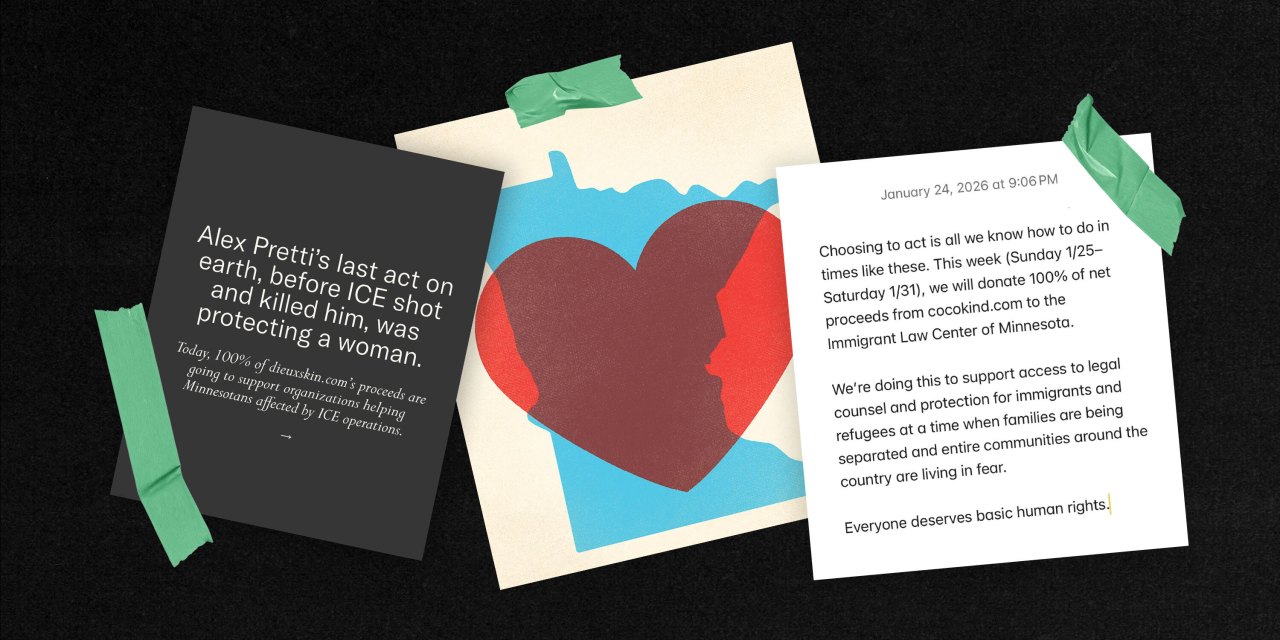
As thousands of Immigration and Customs Enforcement officers occupy the streets of Minneapolis, consumer brands are taking to social media to call for action, raise money and spread information.
Over the last few weeks, a rising number of brands have posted on Instagram to call out ICE’s immigration raids in Minneapolis — operations that have triggered fear, anger and political unrest, locally and nationally. Some brands, like Dieux, are sharing resources online and donating proceeds to organizations helping immigrants in Minnesota. Others, like Standard & Strange, called to abolish ICE and temporarily closed stores on Friday, Jan. 30, adhering to calls for a nationwide strike. While some of the brands speaking out are based in the Twin Cities — Peace Coffee and Seven Sundays, among them — many others are not.
In some ways, the posts call back to 2020, when dozens of retail companies spoke out in the wake of George Floyd’s murder. At the time, many boosted their diversity, equity and inclusion programs and gave money to causes advancing social justice. However, over the last year, several retailers, including Target, have dialed back DEI efforts under pressure from U.S. President Donald Trump’s administration. Still, many smaller brands have not swayed, earning praise from loyal customers. Many of those same brands are now taking a public stance against ICE, particularly after federal agents shot and killed two U.S. citizens, Renee Good and Alex Pretti, and detained 5-year-old Liam Ramos.
“During Covid, we were quite active [with social justice efforts], because we had a lot of extra time on our hands and enough extra cash to make a financial difference and also use our platform for something other than selling stuff,” Jeremy Smith, co-founder of the menswear brand Standard & Strange, told Modern Retail. “This is like we’ve reached full crisis, yet again. So, we might as well throw our weight behind it.”
‘It had just gone too far’
Standard & Strange decided to speak out about ICE after having internal conversations with employees. The company had heard about ICE conducting raids near its Berkeley, California store, and it agreed that it would close up shop should any agents try to come in, Smith said.
“My team had the full authority to shut the store down for the day, especially if we had any employees working who are not white people or look like the targeted groups,” he added. “Because, at this point, while legally, ICE can’t just wander into your business and start taking your staff, we also know that ICE doesn’t really function on legalities.”
On Jan. 27, the brand made its stance clear on a post on Instagram, writing, “ICE/DHS thugs are not welcome or permitted into any of our stores, and we will support any politician working to eliminate ICE and bring justice to the people in charge.”
Then, on Jan. 29, Standard & Strange posted on Instagram that it would close its three stores on Jan. 30 as part of a larger-scale shutdown, “in solidarity with Minnesota and immigrants throughout the country.” The company’s 16 employees were still paid for the day. Smith stressed that staffers could use the day as they saw fit. “My team is not required to go protest,” he said. The brand has locations in New York City and Santa Fe, in addition to Oakland, as well as an online store.
Smith said he wanted to participate in the shutdown — acknowledging he could lose thousands of dollars in revenue — because “it has an impact at multiple levels,” including no tax revenue for the day. “I’m fairly opposed to performative activism,” Smith said. If brands want to make a statement about ICE, “that’s great,” he said. “But, if there’s no substance behind it, it doesn’t really make sense.”
Clothing brand Faherty took to Instagram on Jan. 28, urging community members to “call Congress, march, donate, look out for your neighbor, reach out to people you love who are scared.” The brand shut down its Minneapolis store on Jan. 23 and donated $25,000 to the Florence Project, an organization that provides free legal services, social services and advocacy to immigrants. Several Faherty stores also shut down on Jan. 30. Employees were still paid, the brand told Modern Retail.
Faherty signed its Instagram post, “From The Fahertys (a family, before a brand).” (Its founders are twin brothers Alex and Mike Faherty, and Alex’s wife, Kerry Docherty.) “We felt like our values as people and a company and a community were just not in line, at all, with what we were seeing go down in Minneapolis,” Alex Faherty told Modern Retail. “It had just gone too far, and we needed to make a statement that could be heard by people and hopefully get to politicians.”
Faherty’s post — like that of Standard & Strange — garnered mostly positive comments, including one that read, “I’m proud to support this brand.” Others were more negative, with one poster vowing to “move on to another brand.”
When asked about public reaction, Docherty said, “How people will respond doesn’t deter us.”
“We believe it’s powerful to use our voice, and if people want to use their voice to disagree with us, that’s perfectly acceptable,” she said.
A brand’s role in advocacy
As more brands post about ICE on Instagram, they’re also igniting questions about where corporate advocacy begins and ends — and whether it belongs in brand marketing, at all.
On Jan. 25, for instance, 60 business leaders in Minnesota signed an open letter, calling for a “de-escalation of tensions” and cooperation among local, state and federal leaders. Signees included then-incoming Target CEO Michael Fiddelke and Best Buy CEO Corie Barry. The letter did not refer to Trump or any other political leader by name.
For some people, the letter was “a big move,” said Anjali Bal, associate professor of marketing at Babson College. Others, she said, saw the response as “milquetoast” and didn’t think it went far enough. The mixed reactions, she said, “are telling of where we are as a society, and that can be scary for brands.”
“Brands don’t want to get into the middle of these ‘culture wars,'” Bal said. “But, I think they’re being dragged into them, whether or not they want to be.”
Ari Bloom and Hill Harper are the co-founders of A-Frame Brands, whose portfolio includes Loved01, a skin-care brand founded by John Legend, and Kinló, a skin-care brand founded by Naomi Osaka. Bloom and Harper believe it’s important for founders to champion their values publicly and encourage employees to do the same. (Legend spoke out against ICE in October, telling Trump to stop sending agents to “torment communities.”)
What doesn’t work, however, Harper said, is if “it looks like [the brand] is whipsawing around to where the wind blows.” Without specifying, he shared that a brand he knows once “seemed to be the biggest champion of wanting diverse voices and products out there.” Then, he said, “The political winds changed, and they said, ‘I don’t know.'”
That flip-flopping is obvious to consumers, especially loyal ones, Harper said. “Folks are pretty savvy these days,” he said. “If we can know the difference between AI and not, certainly people can feel the difference between authenticity and not.” Bloom agreed that a brand’s employees catch on, too, and that “there are serious morale issues when companies are not consistent.”
Whether a brand speaks out on social issues should hearken back to its values, Bal explained. For instance, if a brand consistently advocates for social issues, then posting about ICE makes sense, she said. But if the brand isn’t known for that — or has a history of taking the opposite stance — then doing so “could be seen as a marketing ploy,” she said.
Brands are opening themselves up to criticism from the public, either way, Bal believes. “If you do nothing, then you’re kind of saying something about where your brand stands,” she said. “And if you do something, then you’re saying something about where your brand stands. Silence is not silence anymore.”