


State fairs are the hot new pop-up spot for brands like E.l.f. and Levi’s
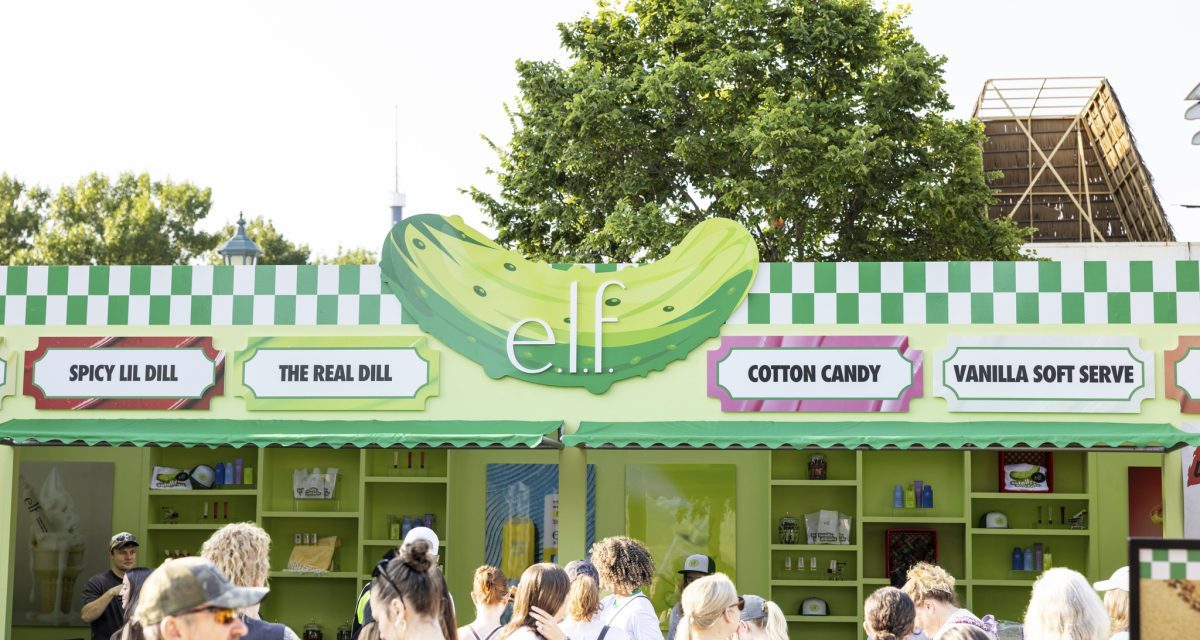
Patrick O’Keefe, chief integrated marketing officer at E.l.f. Beauty, is constantly on the hunt for “places and spaces” where other beauty brands aren’t showing up. A couple of years ago, one of the company’s agency partners, eGen, pitched E.l.f. on a “beauty desert” that it believed was worth paying attention to: state fairs, specifically the Minnesota State Fair and the State Fair of Texas.
“It became kind of our obsession over the last six to eight months” to figure out how to show up at state fairs, O’Keefe said. This culminated in a “real dill”- themed pop-up held from Aug. 27-30 at the Minnesota State Fair, which showcased three pickle-inspired flavors from E.l.f.’s Glow Reviver Melting Lip Balm collection. Nearly 64,000 attendees passed through E.l.f.’s pop-up over four days, with an average dwell time of eight minutes. It was the first time in at least 20 years that a beauty brand had shown up at the Minnesota State Fair, according to organizers.
Next up, E.l.f. will be a sponsor at the State Fair of Texas, where it will join other brands like Coca-Cola and Lucchese; Levi’s, another sponsor, will make a custom set of jeans this year for “Big Tex,” a 55-foot-tall cowboy statue and the official mascot of the State Fair of Texas.
O’Keefe, who attended the pop-up, said he was “blown away” by the number of people who attended the Minnesota State Fair. “I’ve never, ever seen crowds like this,” he told Modern Retail in a Zoom interview.
In an age where branded pop-ups are now a given at most major cultural events, state fairs are getting a closer look from companies like E.l.f. that want to show up in places that their competitors haven’t yet tapped.
State Fairs got their start in the 19th century as a way for states to promote their agricultural industries. They hosted livestock competitions and showed off new equipment and techniques to farmers. So, in that sense, there’s a long tradition of different entities using state fairs to promote something to a captive audience.
But the idea of national retail chains hosting Instagram-worthy pop-ups at state fairs, between the corn roasts and corn dog stands, is a newer concept. Large corporations do often sponsor the fairs of the states where they are based. Wegmans, for example, has sponsored the butter sculpture at the Great New York State Fair since 2017, and has been involved with the fair in other ways, like hosting a demonstration kitchen. But a beauty brand showing up with influencers in tow to promote a dill-pickle-flavored lip balm? That’s most certainly a phenomenon unique to the 2020s.
Jennifer Schuder, the senior vice president of customer engagement for the State Fair of Texas, likes to point out that “the fairs have always been a gathering place for the community.” Her team oversees all of the brand partnerships and activations for the State Fair of Texas. When she spoke with Modern Retail on Wednesday morning, she was at a fitting for the jeans Levi’s is preparing for Big Tex.
Compared with other events national retail brands are now expected to show up at — national music festivals, college football game days — state fairs attract far more attendees.
“Each year, we have between 2.3 [million] and 2.5 million visitors that come through the grounds. If you average that out over 24 days, you can kind of think about it as a Super Bowl a day,” Schuder said.
There isn’t a unilateral uptick in corporate sponsorships across all state fairs. The Minnesota State Fair and the State Fair of Texas attract the most interest as the two most visited state fairs in the country. The Minnesota State Fair attracted 1,940,869 visitors over 12 days last year. The State Fair of Texas, meanwhile, runs for 24 days each fall and attracted 2,020,064 attendees in 2025.
Schuder, for her part, said the State Fair of Texas has been able to accommodate more corporate sponsors in the past “five to seven years,” largely because her team has grown and internal processes have improved.
The one thing that’s certainly changed, she said, is that sponsorships have gotten more complex. “Our sponsorships over the last few years have had to evolve from just, ‘You’re sponsoring the pig races,’ or something like that,” she said.
Now, brands want to know about, say, what kind of email marketing the State Fair of Texas can do to promote their event. They have influencers they want to fly in and give tickets to. They want to talk in-depth about the social campaign they have tied to their State Fair pop-up.
“All these brands are also thinking through, ‘How do we bring our activations to life outside of just the square footage that’s on the ground?” Schuder said.
Everything’s bigger at state fairs
Schuder said brands are typically interested in showing up at the State Fair of Texas for a few reasons. For starters, state fairs typically attract a more diverse cross-section of attendees relative to, say, a three-day-long music festival where tickets start at $500. State fairs attract everyone from families to college students, and draw in people from both rural small towns and large cities. Most fairs also have a core audience of die-hards who attend every year, plus out-of-town visitors experiencing the event for the first time.
“Fairs are cutting across every ethnicity; it’s cutting across every level of income,” she said.
She said that she’s also heard more from national brands that Texas is a big growth market for them. Specifically, the Dallas-Fort Worth area, where the State Fair of Texas is held.
Schuder said one of her first questions for a brand interested in sponsoring the State Fair of Texas is who they are trying to reach. That might change how, and when, they show up at the event. For example, one of the most heavily attended periods is the weekend of the Texas-Oklahoma football game. But on those days, the fair is typically dominated by college football fans.
“If you’re sampling beer on Texas OU weekend, you’re going to do great, right?” she said. “If you’re trying to reach moms and want to get the newest flavor of yogurt in their hands, that’s probably not going to be the day for you.”
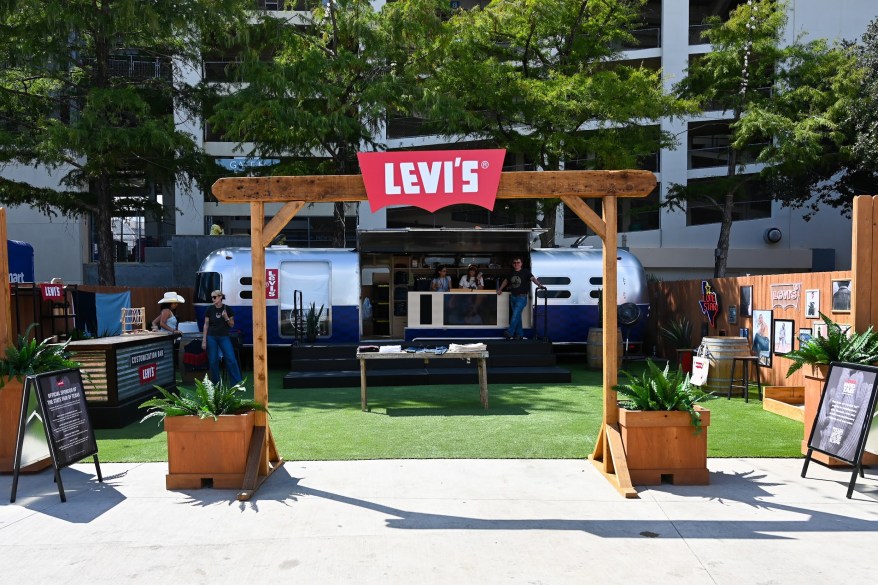
Levi’s pop-up at the 2025 State Fair of Texas. Photo Credit: State Fair of Texas
There’s also a focus on figuring out where exactly in the fairgrounds an installation may make sense for a particular brand. Geico, for example, is taking over the parking lots.
“Our goal is never just to make it feel like we’re slapping a logo or a sign somewhere,” Schuder said.
For E.l.f., its line of pickle-flavored lip balm — which includes three products, The Real Dill, e.l.f. von Dill and Spicy Lil’ Dill — proved to be the perfect anchor for its pop-up at the Minnesota State Fair, where pickle-flavored products have become an obsession for attendees. Nearly 2.1 million pickle chips are consumed at the event each year, according to the Minnesota State Fair. This year’s event featured new foods like a pickle pie, a pickle cider lemonade and white chocolate chip cookies featuring chopped dill pickles.
E.l.f. first released a pickle-flavored lip balm as a limited edition in February, and it sold out within eight minutes. But E.l.f. decided to bring it back and introduce two other variations in August.
E.l.f.’s pop-up, held from Aug. 27-30, featured a 10-foot-tall pickle jar next to a booth where people could spin a wheel to win prizes like an E.l.f. lip product or a Target gift card. E.l.f. also gave away sunscreen and samples of its hair products.
“I was fascinated by how people were pointing at the booth, going, ‘Oh my god, E.l.f. is here.’ It was so unexpected,” O’Keefe said. He said it was also fun to see how different members of a family reacted to E.l.f.’s activation: “Fathers pointing at the booth and going, ‘E.l.f.? What is E.l.f.?’ And then the mother saying, ‘That’s a beauty brand,’” O’Keefe recalled.
“When sponsorship activations are done well, they can add tremendous excitement and create those buzzworthy moments that guests remember. E.l.f.’s activation did exactly that,” a Minnesota State Fair spokesperson said in a statement. We also know that the most well-executed activations appeal to a wide range of our guests, and we saw that firsthand with E.l.f. — there was genuine anticipation, interaction and delight.”
‘Forget Coachella, I’m trying to go to the Minnesota State Fair’
E.l.f’s activation didn’t just involve showing up at the state fair.
When hosting pop-ups in different cities, O’Keefe said, “We always make it our priority to find those influencers in the local markets to come and hang out, to come connect with a brand.” Over 200 influencers showed up to E.l.f.’s Minnesota State Fair pop-up over four days, according to O’Keefe.
On Friday night, E.l.f. hosted a party in Minneapolis in partnership with People magazine, inviting local influencers and community members to come celebrate the start of the Minnesota State Fair. And there was ample influencer content promoting the state fair pop-up. One sponsored video showed a creator going to pick up E.l.f. Beauty products in Target on her way to the Minnesota State Fair.
“We are not prescriptive with our influencers; we give them a basic framework, but what they do and how they show up is up to them,” O’Keefe said.
Influencer content is indeed becoming a bigger focus for many state fair sponsors. “’We have influencers we want to bring in and give tickets to’…we’re having those with more sponsors this year than I’ve ever seen,” Schuder said.
It’s also breathing new life into state fairs, which have become gold mines for food influencers, who post their rankings of all of the new foods this year. That, in turn, has introduced state fairs to a national and global audience and is attracting new attendees.
“Forget Coachella, I’m trying to go to the Minnesota State Fair,” Atlanta-based influencer Sierra Nicole Reece posted on TikTok in April.
That video attracted more than 4,300 comments and got the attention of Explore Minnesota, the state’s tourism and marketing arm. Explore Minnesota ended up flying Reece out for the fair this year.
“This is the premier event of the summer for Minnesota, … and it really showcases all of the elements that make our state a great place to live,” Ben Johnson, director of external relations at Explore Minnesota, said. He said the Reed partnership was born out of an “authentic viral moment” that made sense for the group to jump on.
While many state fairs have now wrapped up for the year, brands still have time to pop up at the biggest one, the State Fair of Texas, which runs from September 25 to October 18. “This is where we go into operational mode,” Schuder said. Her team is doing a lot of measuring, making sure that everything from the jeans on Big Tex to a 110-foot-armadillo sculpture for another sponsor, Reliant Energy, is ready to go by the time the fairgrounds open.
“I do think that the fair industry really does have a unique opportunity with sponsors … This is where, in the 1800s, people came to see the latest tractors, to see the latest things — and they still want to do that. And our sponsors help build [on] that,” Schuder said.