


Rising raw material costs are hitting everything from stickers to foil
Below is the latest edition of Modern Retail’s Supply Chain Weekly newsletter, which goes out on Mondays at 10 a.m. ET and dives into all things logistics and supply chain during a tumultuous time for the retail industry. To receive this weekly in your inbox, click here.
Product manufacturers are feeling pressure to protect their margins as raw material costs are climbing across the board, specifically for products like vinyl, resin or PVC that rely on oil.
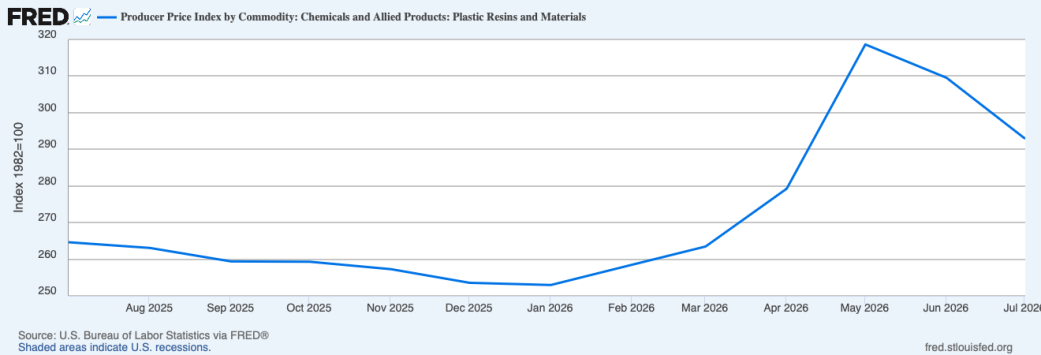
Ontario-based Sticker You, founded in 2008, specializes in making custom stickers with the key differentiator of no minimum order quantities. But vinyl, one of its key materials, has gone up in price this year due to rising oil prices following the war in Iran. Vinyl prices are up nearly 6% in 2026, after a 2.9% rise last year and a 1.8% increase the year before that, per federal data sources.
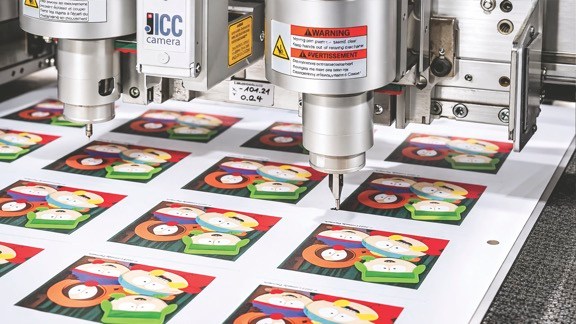
Founder and CEO Andrew Witkin said Sticker You has been able to insulate itself from the recent price spikes in part by relying on automated retouching software that helps it process orders faster. It also employs both domestic and international workers who can use the software, allowing the company to have workers processing orders 17 hours a day.
“We’ve created some more innovative software to allow that process to be more automated and more seamless, and that has reduced the amount of labor touch time on those files,” he said. “They get just as improved and just as looked at as before, but we’ve done it in a more automated fashion.”
Being able to handle small, fast orders has helped the company offset cost pressures without raising prices. So far this year, the company is averaging double-digit sales growth, keeping pace with the last several years.
Witkin also said having multiple suppliers has helped insulate the company from cost pressures. Ever since the disruptions in supply chains caused by the Covid-19 pandemic, Sticker You has looked to have two, if not three, places to source from. Additionally, Sticker You’s manufacturing hubs are domestic, which Witkin said helps keep transport costs low. As of late August, Witkin said the company’s products wouldn’t likely be affected by the new Canada-U.S. trade deals.
“In the custom business, especially when the quantities are reasonable and you’re not making millions of something, domestic production has the big advantage,” he said.
Sticker You’s case is just one example of how a company is handling the widespread pressure of raw material price increases this year, particularly those that rely on oil-based derivatives. PVC prices, for instance, hit record highs in April, which affects industries that make signage or flooring. Oil-based resins may be driving up prices for companies in a variety of sectors that rely on plastic packaging, such as Mattel and Procter & Gamble.
While not an oil derivative, aluminum prices are also surging due to shutdowns at the Strait of Hormuz that have limited supply. Reynolds Consumer Products, which owns brands like Hefty and Reynolds, said during its second-quarter earnings in July that it expects approximately $400 million of incremental commodity costs this year. CFO Nathan Lowe said on the company’s earnings call that that’s up from the company’s $200 million estimate reported in April due to more recent changes in commodity prices.
Reynolds has leaned into pricing changes to make up the difference, meaning aluminum foil is more expensive than it used to be. But CEO Scott Huckins said the category’s performance is still in line with past years. “We attribute the resilience of our performance in the foil category to both our strategy of more frequent but smaller pricing changes and the fact that Reynolds Wrap consumers use foil for many applications across cooking, prep, storage and portability, resulting in a lack of one-for-one product substitutability,” Huckins said, according to a transcript.
Similarly, cooler company Yeti has had to deal with higher prices for stainless steel, magnets and resins that go directly into its products. CEO Matthew Reintjes said the raw material cost pressures come on top of ocean and parcel headwinds, plus shipping delays across some Asia trade lanes. In response, the company is looking to further diversify its supply chain.
“We’ve taken proactive steps to reduce risk, including qualifying additional raw material sources, further diversifying our supply chain and scaling our structural enterprise productivity programs,” he said, according to a transcript.
Witkin from Sticker You said his company has weathered the increase so far through strategies like automation, supply chain diversity and domestic production, but there’s still only so much a company can do to mitigate risk when it comes to something like global oil markets.
“It certainly has affected everything,” he said. “Input costs are input costs.”
The week in tariffs
- New Canadian tariff policies are causing a back-and-forth that’s affecting a myriad of industries, with Canada announcing it will roll out retaliatory tariffs of 15%, 25% and 50% on certain products beginning Sept. 8. “Canada’s counter tariffs will apply to products covering $27.6 billion in imports from the U.S. and will focus on sectors, such as steel, dairy, appliances, agricultural equipment, pulp and paper, and electronics, that are most impacted by U.S. tariffs,” read a fact sheet from the Canadian government posted last week.
- Toilet paper products, in particular, are potentially going to see 25% to 50% tariffs, according to reporting from The Guardian. That could be a massive blow for major U.S. retailers and conglomerates given that Canada is a primary exporter of the products to the U.S., according to the World Bank.
- The retaliatory tariffs come after negotiations broke down in late August, with Canadian officials saying the United States offered terms that were “a bad deal that would undermine Canadian workers, businesses, strategic sectors and our national interest,” according to a press release.
What we’ve covered
Walmart finally starts supporting Apple Pay and Google Pay
The world’s largest brick-and-mortar retailer is no longer holding out on contactless payments: Walmart recently announced that it will begin to support Apple Pay and Google Pay at select Walmart and Sam’s Club locations beginning in late August.
MR’s Mitchell Parton reports that Walmart plans to roll the options out to all U.S. stores and clubs by the end of 2026 and to fuel stations by mid-2027. The switch includes contactless card, phone or smartwatch payment options.
It’s a novel development, given that Apple Pay rolled out over a decade ago and is now accepted at more than 85% of retailers in the United States. But Walmart has spent years trying to push its own payment options, like OnePay.
Beauty service Ipsy is becoming a marketing solutions company, too
MR’s Julia Waldow published a story this week diving into Ipsy’s latest B-to-B offering: Ipsy Marketing Solutions. The service uses first-party data from Ipsy’s 15-year history as a beauty subscription service and product trial ecosystem. It will aim to help support brands looking to build awareness, generate demand and drive retail sales, supporting projects from event sponsorships to paid media investments.
It’s a unique value proposition for brands looking to grow, as Ipsy curates 4,000 products from some 500 brands a year, CEO Galen Smith told Modern Retail. This gives it a deep knowledge of largely Gen Z and Millennial female customers who subscribe to its service, fill out quizzes on their preferences and curate monthly boxes.
Right now, Ipsy’s biggest challenge around Marketing Solutions is education. “Ipsy has been in the marketplace for a long time, but [we’ve] got to now educate [people] that these are additional services,” Smith said.