This is the latest installment of the Marketplace Briefing, a weekly Modern Retail+ column about the ever-changing e-commerce marketplace landscape. More from the series →
Online merchants are encouraged by a new Trump administration effort to crack down on customs fraud after a surge in tariff evasion over the past year.
President Donald Trump last week signed an executive order directing U.S. Customs and Border Protection to tighten enforcement against importers that underpay duties, conceal the true origin of products or use shell companies to avoid responsibility for customs violations.
For many online sellers, the order targets a problem they watched grow over the past year as freight companies, suppliers and middlemen increasingly pitched ways to make tariff costs disappear.
The executive order is aimed at closing loopholes that merchants and trade experts say have allowed some importers to evade tariffs while giving them an unfair pricing advantage over competitors that follow the rules. Sellers interviewed by Modern Retail said they largely support the move because they believe it will make competition more fair and discourage practices that became more common as tariffs rose. The order also targets the use of shell companies and imposes stricter requirements on importers of record, the parties responsible for customs filings and duty payments.
The schemes themselves are not new. Importers and freight companies have long looked for ways to reduce tariff bills, according to David Forgue, a partner at law firm Barnes, Richardson & Colburn who advises importers, said customs fraud schemes have existed for years. But the offers became more frequent last year as desperate importers looked for ways to mitigate the impact of costs related to Trump’s trade war. Unscrupulous suppliers would promise to deliver goods at prices that seemed improbably low despite rising tariffs.
“This is a longstanding issue,” Forgue said. “Tariff volatility last year made these all‑in offers especially tempting, because they promised to flatten out all that uncertainty.”
There was a record $112 billion gap last year between what China reported exporting to the U.S. and what was declared to Customs and Border Protection.
One common arrangement involves using delivered duty paid shipping, or DDP, where an overseas supplier or logistics company handles shipping, customs clearance and duty payments. DDP is not an inherently criminal practice. The fraud occurs when the parties handling the import process understate the value of goods, misclassify products or otherwise provide inaccurate information to customs in order to reduce duties owed.
In some cases, those imports are routed through shell companies that act as the importer of record, the party legally responsible for customs filings and duty payments. Those shell companies often have few assets, making it difficult for the government to recover unpaid duties or hold anyone accountable if customs violations are discovered.
“People are setting up these LLCs that are one person operating out of a garage. There are no assets,” Forgue said. “You can pursue forever, but you’re not going to get the assets.”
Forgue said DDP-based schemes “didn’t really used to be a thing,” but now he sees a couple of such matters crossing his desk every month. As tariffs increased and importers looked for more predictable costs, DDP-based schemes have surged in popularity as the latest iteration of a long-running game of whack-a-mole between regulators and tariff evaders.
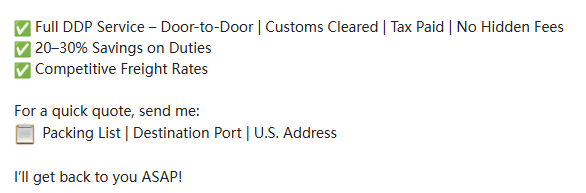
Judah Bergman, founder of baby products company Jool Baby, which manufactures its products in China, said he has received repeated offers over the years from factories and logistics providers promoting shipping arrangements that promised to reduce tariff costs. Bergman said those pitches became more common as tariffs increased over the past year. He said he never accepted the offers and believes stronger enforcement could help address not only tariff evasion but also broader concerns around product safety and accountability.
An email that Judah Bergman, founder of Jool Baby, received on Monday, May 11, 2026.
Chuck Gregorich, whose outdoor goods company Net Health Shop used to predominantly source products from China before he diversified production last year, said he is regularly approached by firms offering DDP services that appear to reduce costs far beyond what legitimate shipping savings would allow. Some providers have promised to deliver containers directly to his warehouse at prices roughly 20% below what he would otherwise pay after tariffs and shipping costs. The pitches typically come through email, LinkedIn and WeChat.
Shinghi Detlefsen, president of the supplement brand Wholesome Story, said many sellers feel trapped in a system where competitors appear to gain an advantage through aggressive import practices.
“It’s a cat-and-mouse game with everyone,” Detlefsen said.
Monil Kothari, founder of jewelry brand Haus of Brilliance, said stronger enforcement should benefit businesses that follow the rules.
“At the end of the day, it should be a level playing field for everyone,” Kothari said.
The executive order seeks to make many of these schemes harder to execute by tightening requirements around importers of record and increasing scrutiny of customs filings. Forgue said one potentially significant aspect of the order is its focus on the companies that provide services to importers, including customs brokers and sureties that issue customs bonds. As those providers conduct more diligence on customers, he said, fraudsters could find it more difficult to obtain the services needed to move goods through the import system.
Penalties can be severe for businesses that participate in tariff evasion schemes. Forgue said customs violations can result in fines that exceed the value of the imported goods and, in extreme cases, criminal charges. While jail time is uncommon, he said it remains a possibility under customs law.
Part of the problem, Forgue said, is that many importers do not fully understand the risks they are taking on when they accept unusually cheap shipping offers or allow someone else to handle customs filings with little oversight.
“It’s heartbreaking dealing with people who probably should have known better, but just didn’t,” Forgue said.
For merchants tempted by unusually low shipping offers, he offered a simple rule.
“If it looks too good to be true, it probably is,” Forgue said.
What I’m reading
Walmart Deals, the company’s savings event, will run from June 22 through June 28. (Walmart)
Amazon has inked a $17.5 billion loan from a group of banks led by Citigroup. (Bloomberg)
U.S. inflation tops 4% for the first time in three years as oil prices surge. (CNN)
While other DTC footwear brands like Allbirds struggled, Rothy’s surpassed $200 million in sales by growing carefully, testing retail and wholesale, and managing to avoid DTC's costly expansion traps. Rothy’s CEO and president, Dayna Quanbeck, joined the Modern Retail Podcast to talk about the brand's expansion strategy.
After years as a predominantly direct-to-consumer brand, Unilever-owned The Laundress is entering Target stores with a fresh take on laundry care. Here's why The Laundress is finally launching into brick-and-mortar for the first time.
Year to date, 94% of revenue on TikTok Shop from luxury resale in the U.S. is coming from lives, the platform revealed during a presentation to members of the media during Fashion Week. Here's what else TikTok Shop had to say about its burgeoning luxury resale business.