


U.S. CPG manufacturers are sitting on excess capacity, which could be a boon for brands

Below is the latest edition of Modern Retail’s Supply Chain Weekly newsletter, which goes out on Mondays at 10 a.m. ET, and dives into all things logistics and supply chain during a tumultuous time for the retail industry. To receive this weekly in your inbox, click here.
CPG manufacturers in the U.S. are sitting on excess capacity that’s just waiting to support a new wave of brand growth.
Keychain, a platform that connects brands with manufacturers, released its 2026 CPG Intelligence Report this week, which included a survey of over 1,000 CPG manufacturers. Results showed that one major theme they’re grappling with is significant overcapacity: About 1 in 10 factories is running more than half-empty, and about 1 in 3 has at least 31% of its production capacity unused.
“You have more machinery and more people available to run it, but very few factories are running 24/7. Most are running one to one-and-a-half shifts a day,” said Keychain CEO and founder Oisin Hanrahan.
How did we get here? Hanrahan said it’s partly a result of investments made six to eight years ago, when manufacturers took advantage of 0% interest rates and tax breaks to build out their products. Then Covid-19 arrived, disrupting overseas options and consumer behavior. Hanrahan said that time led manufacturers to invest in more capacity to meet forecasted demand.
“Those factories made those investments three or four years ago,” he said. “The machines are just showing up now, but the demand curve has changed.”
For brands, excess capacity means a moment of leverage, such as obtaining lower minimum order quantities or becoming more competitive on pricing. This means it’s a ripe time for CPG startups, Hanrahan said. “If manufacturers were super busy, you wouldn’t see so many new brands getting started because they simply couldn’t get made,” he said.
There can be an upside for the manufacturers, too. Those who added more capacity are 2.1 times more likely to expect revenue growth of 20% or greater, according to the Keychain survey. Last year, about 15% hit that number, Hanrahan said.
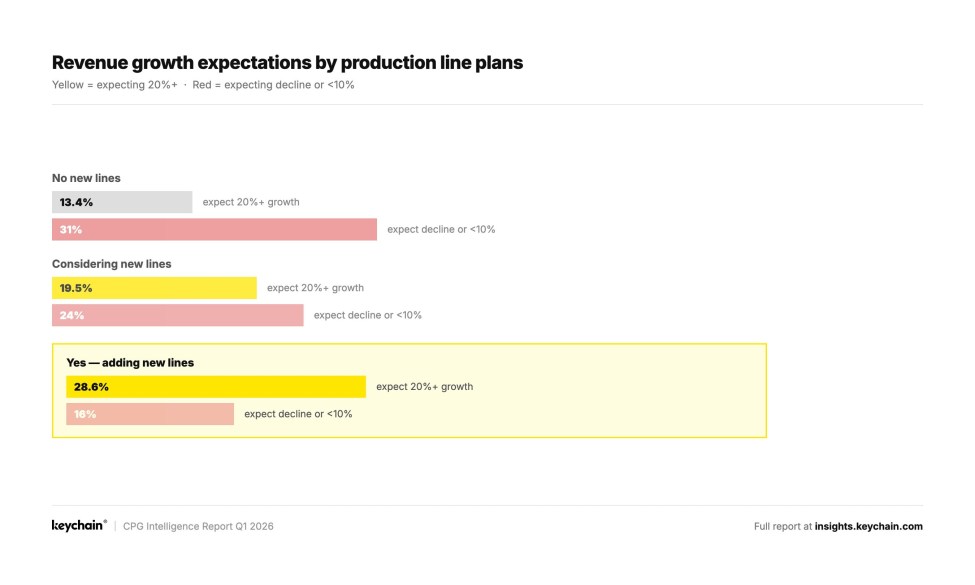
Overall, meaningfully shifting manufacturing usage can take multiple quarters or even years. Hanrahan said manufacturers have long lead times because they need to train employees and adjust operations to get new lines up and running. He also said that the current slowdown of the population growth curve and the rise of GLP-1 drugs are poised to shift CPG demand in the medium to long term.
All this leads to a more measured approach to growth, Hanrahan said, and a greater focus on how software and AI can help manufacturers reduce errors or run more efficiently with the systems they already have. Some examples are implementing faster sensors that can detect if something is off in a new batch, or software that can forecast consumer demand more accurately.
“The lead time for machinery is long. You can actually change your software stack relatively quickly,” he said.
The week in tariffs
- President Donald Trump’s visit to China included a meeting with President Xi Jinping, but as of Friday, there was little clarity on any new trade deals or plans between the countries. The BBC reports that Trump said they discussed “fantastic trade deals, great for both countries.” The president also said that China committed to buying 200 Boeing jets, a number that sent the aircraft manufacturer’s stock down as markets had hoped for a higher commitment. Trump also said China will be buying more American-grown soybeans. But the BBC reported that Chinese officials had not confirmed any deals or purchases.
- U.S. Customs and Border Protection says it has processed tariff refunds, including interest worth over $35 billion as of May 11, according to court documents. The refunds are for now-unconstitutional tariffs that companies paid for imports following Trump’s issuance of new duties under the International Emergency Economic Powers Act. Another update from CBP is expected on May 26. Click here to read the full refunds update from CPB.
What we’ve covered
Marketers’ AI use rises, but tech skills stall
The latest Modern Retail + Research report focuses on how marketers are navigating AI applications, agentic AI, AI search and GEO/AEO. Not surprisingly, usage is on the rise: About 86% of brand and agency pros said their companies are investing in AI technology, up from 71% last year and just 57% in 2023.
The findings also suggest that marketers are mostly using AI tools out of the box, with just 19% saying their company is building or training its own LLM.
How GameStop went from struggling retailer to eBay bidder
Last week, eBay rejected GameStop’s $56 billion takeover bid, with board chair Paul Pressler saying that the proposal was “neither credible nor attractive.” And he also said the company took into account “GameStop’s governance and executive incentives.”
But how did GameStop get to this point anyway? MR’s Mitchell Parton dove into how the company’s ambitions have grown under CEO Ryan Cohen, and why it sees promise in growing its collectibles business.