


UrbanStems and Quince say wine is driving bigger Valentine’s Day sales
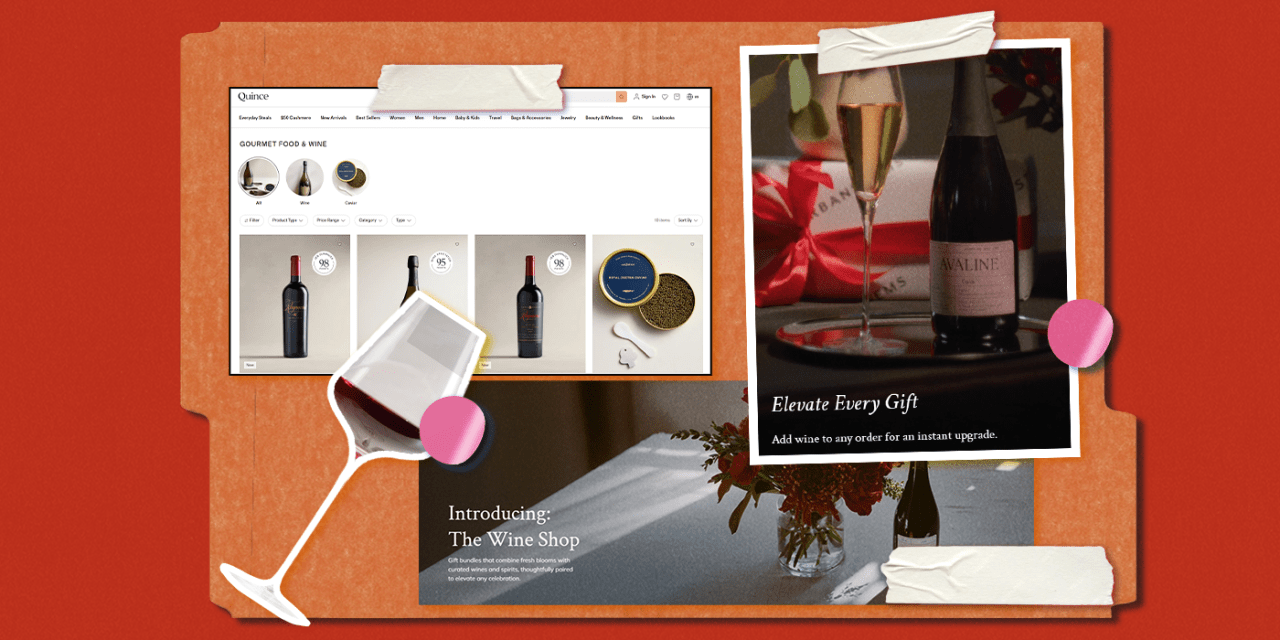
Flowers may be the traditional Valentine’s Day gift, but this year, some e-commerce brands are betting that shoppers want to add something a little stronger to their cart.
In the run-up to Feb. 14, companies including UrbanStems and Quince have added wine to their assortments. For brands, the wine add-on helps lift average order values without asking customers to shop somewhere else. It also deepens customer loyalty and creates a new stream of repeat sales.
For UrbanStems, the floral delivery company founded 12 years ago on Valentine’s Day, adding wine felt like a natural next step. Over the past few years, the company has increasingly positioned itself as a premium gifting brand, said Meenakshi Lala, CEO of UrbanStems. UrbanStems saw that customers were willing to spend more for the right gift and were looking for more variety and ways to make their orders feel personal. Over the years, UrbanStems has expanded its assortment with add-ons like candles, gummies and chocolates.
“It was really about responding to our customer demand,” Lala said. “To us, wine and flowers are a natural pair.”
In November, UrbanStems partnered with Drinks, an AI-powered e-commerce alcohol platform, to begin selling wine. Customers can pair select bouquets with bottles from brands like Avaline and Schramsberg. Lala said the timing was intentional, aimed at “capitalizing on the holiday surge” when gifting spikes around Thanksgiving and Christmas.
Since launch, adoption has grown steadily. UrbanStems measures attachment rate — its internal KPI tracking how often customers add extra items like a vase, truffles or wine to a bouquet — and the share of shoppers adding a bottle has increased about 20-30% week over week, according to Lala. Wine is also outperforming other add-ons, with its attachment rate running roughly 62% higher than comparable products on the site.
Wine bundles have also pushed up spending, with the company’s average order value for wine purchases just under $200. That lift is becoming even more noticeable ahead of Valentine’s Day, when demand typically surges. UrbanStems expects to fulfill 60,000-70,000 bouquets for the holiday, and Lala said alcohol sales are projected to increase 45% during the Valentine’s period compared to normal levels. Valentine’s Day, she said, is “our Super Bowl and Black Friday combined into one.”
The timing aligns with rising Valentine’s Day spending. Despite ongoing economic turbulence, consumers are expected to spend a record $29.1 billion on the holiday this year, according to a January survey from the National Retail Federation and Prosper Insights & Analytics. The average shopper plans to spend $199.78 on gifts, up from $188.81 last year, after 2025 saw roughly 11% year-over-year growth in Valentine’s Day sales, per PwC.
The move into wine is part of UrbanStems’ ongoing efforts to scale its business. UrbanStems raised $5 million in a Series C extension funding in 2024. In 2021, Bloomberg reported the company’s valuation stood at more than $100 million.
“This is a good overall strategy for retail: expand into adjacent product categories that are highly complementary,” said Sky Canaves, a principal analyst at eMarketer. “That way, you can sell more to your existing customers instead of trying to acquire new ones and start from scratch.”
Dom Pérignon and $50 cashmere
Quince is making a similar bet. The direct-to-consumer retailer, best known for its $50 cashmere sweaters, began selling a curated selection of wine in December, as part of a broader push into new categories. Last year, the company expanded into fragrance, wellness and men’s shoes, Modern Retail previously reported.
Although the affordable luxury brand started out in the apparel, jewelry and home categories, Quince’s mission has always been “to bring essential products to customers at the best quality and best price,” said Daphne de Chatellus, the company’s head of emerging categories.
Quince first tested consumables about a year and a half ago with a caviar launch that sold out in under a week. Wine followed as a logical next step. “It’s a big market in the U.S.,” de Chatellus said, adding that most wine sales still happen in physical stores. For Quince, the opportunity was to offer strong pricing, curated quality and free delivery in one place.
“The response has been really strong,” she said. During the Valentine’s Day period, wine sales have risen 28% compared to the company’s typical weekly average, according to the company.
Quince’s wine assortment leans premium, featuring a curated selection of high-end labels. The cheapest bottle is a red blend for $74.99, while the most expensive is a bottle of Dom Pérignon Champagne for $259.99. The upscale lineup reinforces the company’s broader brand message around quality and value. “That can really help to maintain their elevated reputation or add prestige to the Quince brand overall,” Canaves said, “because you see Dom Pérignon alongside $50 cashmere sweaters.”
While gifting played a key role in the initial rollout, over time, Quince plans to broaden its assortment beyond celebratory bottles to include wines suited for more regular consumption. Longer-term, Quince is also looking to add other alcohol varieties, such as spirits, to its offerings.
“We definitely want to expand the assortment to lend itself even more to weekly consumption for customers,” de Chatellus said. “You’ll certainly be seeing the Quince wine assortment grow, in terms of product offering, this year.”
Last year, Quince raised more than $290 million in Series D funding, which the company said would be used to “accelerate our growth and continue delivering exceptional quality at radically fair prices.”
Making alcohol e-commerce work
Behind the scenes, selling alcohol online is complicated. Rules vary by state, and companies must verify customers’ ages and handle special taxes. To manage that, both UrbanStems and Quince partnered with Drinks, a company that provides the technology and compliance tools that brands need to sell alcohol.
“We enable any business to be an alcohol business,” said Zac Brandenberg, co-founder and CEO of Drinks.
Alcohol is a large market in the U.S., worth about $285 billion, Brandenberg said. But only a small share of those sales happens online. Drinks helps brands sell wine without having to hold their own licenses or inventory, handling age checks, state restrictions and payment rules in the background.
Brandenberg said the opportunity is straightforward. Many shoppers would buy alcohol from brands they already trust if it were offered. In a recent survey conducted by Dynata and commissioned by Drinks, which polled 1,000 U.S. consumers, roughly two-thirds of respondents said they would be somewhat or very likely to buy beverage alcohol from their favorite retailers.
For brands, the payoff can show up quickly. Drinks expects partners to see “one and a half to 5% incremental GMV from beverage alcohol,” depending on how they promote it, Brandenberg said.
At UrbanStems, the focus was on keeping the shopping process easy. Customers can add wine just like they would add a vase, directly within UrbanStems’ own checkout, without being redirected to a third-party site. As Lala put it, “Our focus was on keeping the experience as seamless and effortless as possible, and fast for you.”