


The end cap is about to change forever
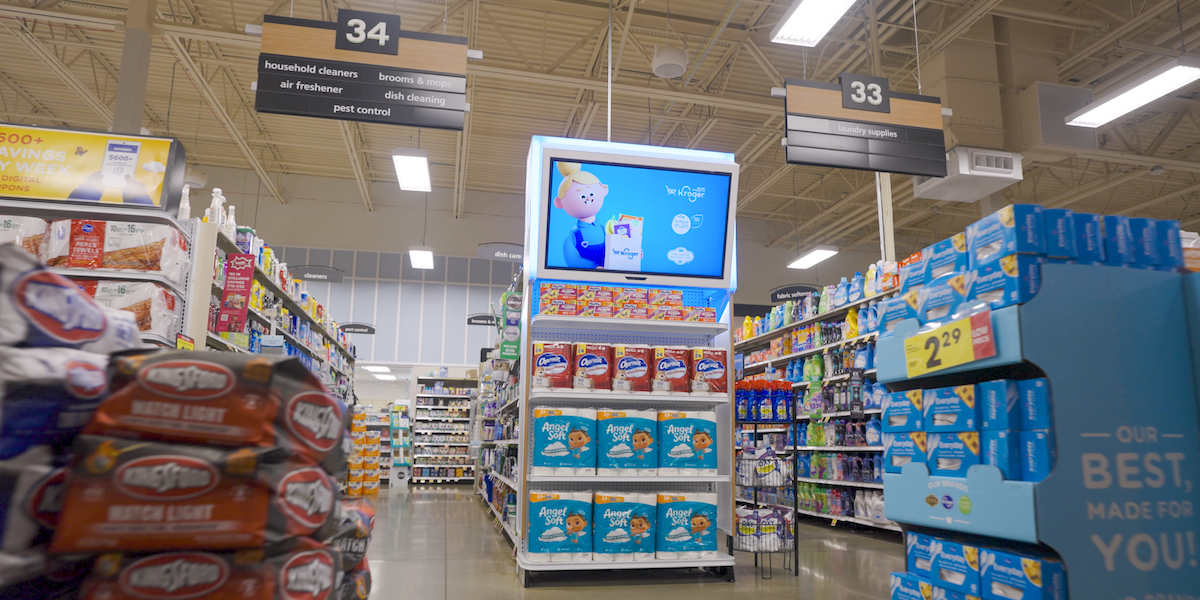
The retail media revolution is coming for one of the most recognizable shelf placements in any store.
Retailers such as Kroger and CVS Pharmacy are beginning to install digital screens on end caps as they expand their in-store advertising networks. The screens may show videos about the items below it on the shelf or about related products in the category.
This marks the beginning of a new era for the end cap, one in which digital ad campaigns merge with physical merchandising.
The end cap is “the grand prize of in-store retail media,” said retail media analyst Andrew Lipsman of Media, Ads + Commerce. “It’s probably the most influential point in the store.”
Lipsman said he sees the end cap as the connection point between customers walking the stores and picking items up off the shelf.
“It creates a center of gravity that pulls you in; it encompasses the best aspects of branding, because it’s a big activation, it catches the eye,” Lipsman said. “It also helps drive conversion. It does everything at once; it’s really valuable.”
CVS now has digital end caps in more than 600 stores in high-traffic aisles — about three per store — according to Parbinder Dhariwal, vp and gm at CVS Media Exchange, CVS Pharmacy’s retail media network. Dhariwal said, according to CVS’ research, 70% of its customers have said they find the screens useful.
“We deploy digital screens on end caps because they measurably improve the shopping
experience and can help drive results for brands at the exact moment decisions are made,” Dhariwal said in an email. “What appears on the screen reflects common shopper mindsets and the in-store moment, balancing brand storytelling with useful, timely messaging such as seasonal promotions and key sales events.”
Dhariwal said the company’s goal is to make the content feel informational or educational, rather than promotional. In addition to product advertising, they may show information about seasonal promotions or sales events.
“This format allows us to think more personally about the shopper’s journey and tailor messaging to the moment, something traditional end caps simply can’t do,” Dhariwal said. “Compared to static signage, digital screens are more flexible, more informative, and better at guiding discovery and decision-making.”
Kroger, in partnership with Barrows Connected Store, is also bringing digital screens to many of its end caps. The company declined to share the number of screens or stores. Kyley Rouse, lead for in-store media strategy and activation at Kroger Precision Marketing, said the company is currently prioritizing grocery aisles and health and beauty for end-cap screens.
“We know that customers shop [health and beauty] very differently than core grocery,” Rouse said in an interview. “That’s really our opportunity to inspire more dwell time for that category and to capture customer attention with really stunning animation in stores that’s eye-catching for a customer.”
Rouse said end caps have seen the most brand interest of any digital screen placement in the stores because of how the content sits near the products themselves. The screens make it possible to quickly switch out flavors or show recipes and other content alongside the products. Kroger’s screens also have the ability with sensors to measure impressions and dwell time.
She said, ideally, the end-cap products will match what’s on the screen, but they could also be products in the same category.
“We want to make it as easy as possible for customers on their journey to find the right products and to be inspired,” Rouse said. “It just makes it foolproof for a customer to see the media and then the corresponding product, so that they’re not having to run across the entire store to find what they’re looking for.”
Barrows, the company working with Kroger and other grocery, drug and specialty retailers, has installed more than 10,000 digital screens, including both end caps and in-aisle and perimeter screens. The company also works with U.K. retailers such as Tesco, John Lewis and Waitrose.
Each rollout is customized to the retailer’s store layout, category strategy and shopper flow to make sure it feels native to the store experience, James Hay, global CEO of Barrows Connected Store, said in an email.
“The vast majority of shopper decisions are made in-store. By meeting shoppers at the point of consideration, brands and advertisers can improve ad impact with less dependency on ad recall due to greater relevancy and proximity to purchase,” Hay said. “Retailers like Kroger have not only significant audiences but also qualified, high-intent shoppers.”
Still, Lipsman added that while end caps can be attractive for advertisers, they’re also among the most guarded spots in stores by merchants. Merchants “never want to interrupt anything having to do with the customer experience,” Lipsman said. “There’s a negotiation that has happened a certain way for a long period of time, with the most important suppliers and the ones who end up on the end cap, and so it just throws something new into the mix.”
Additionally, Lipsman said not all end caps are created equal. “The one on the store perimeter isn’t as valuable as the one on the inner aisles or near the front of the store, but generally speaking, they’re highly trafficked areas and create a lot of visibility for the brand.”
Hay argued that, compared to traditional physical end-cap displays, digital screens are less operationally complex to execute at scale because campaigns can easily be swapped out digitally. Additionally, he noted the screens are measured and optimized in the same way as digital ads, enabling campaigns that span the full shopper journey.
“Digital end caps deliver stronger visual impact, faster creative refreshes and far greater flexibility, turning a single physical placement into a dynamic media asset,” Hay said. “Because the screens are networked, brands can activate campaigns with precise timing, location-based relevance and proof of play — without the challenges of printing, shipping, store-level compliance or teardown.”