


Little Spoon launches baby formula in bid to expand feeding portfolio
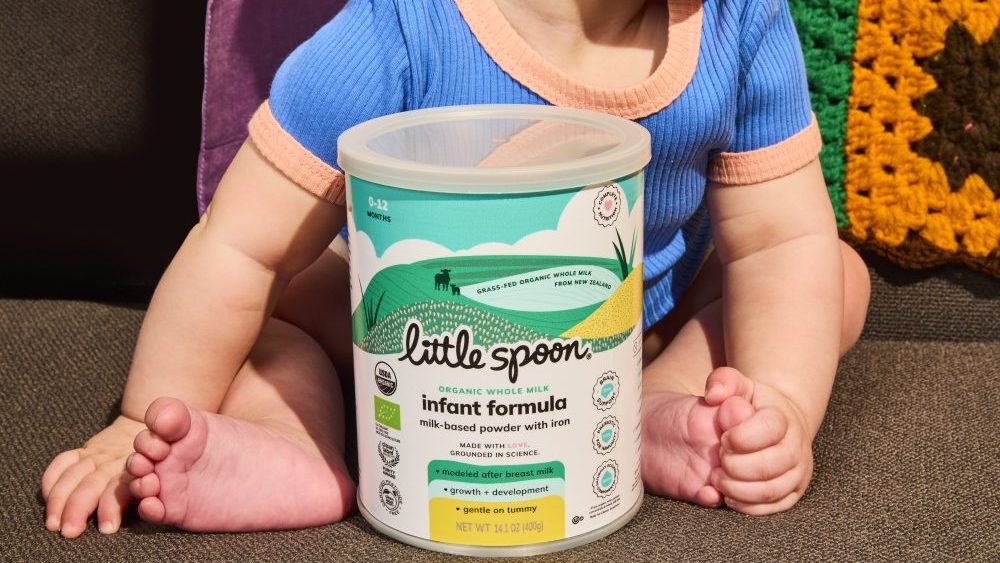
Baby and kids food company Little Spoon is getting into baby formula, a move that aims to capture customers at the start of their parenting journey.
CEO Ben Lewis said in an interview with Modern Retail that infant formula has long been on the brand’s to-do list. But it’s less about becoming a competitor in the increasingly crowded formula space and more about getting on parents’ radars as soon as they have a new baby.
“Our goal isn’t to be the biggest player in formula. It’s to be the only end-to-end feeding solution for parents,” Lewis said. “We’d rather go deep with fewer customers across the entire feeding journey than build a massive business in a single category.”
Little Spoon, which surpassed $150 million in direct-to-consumer revenue last year and made its first wholesale launch in September at Target, already sells 130 products across nine categories. Its launches have aged up with its customers — starting with a baby’s first foods, then getting into toddler snacks and ready-to-heat meals.
But the launch also makes Little Spoon a new player to watch in the increasingly competitive formula industry, which has been rocked by recalls and shortages in recent years. Most recently, formula company ByHeart recalled its products in November after it was linked to a botulism outbreak associated with 48 hospitalizations.
But the space has been growing overall since the U.S. experienced formula shortages in 2022, caused by Abbott’s recall of Similac on top of ongoing supply chain issues from the Covid-19 pandemic. The category has since exploded with twice as many brands entering the market, according to research shared by Dominique DeLope, the senior insights manager at What to Expect.
Formula company Bobbie, which launched in 2021, gained significant customers and reach after the Similac recall, and ByHeart also gained traction after becoming the U.S.’s fourth fully integrated formula manufacturer in 15 years in 2022. Nara Organics launched last year and had a Target debut in January. Baby company Munchkin launched a formula line in late February.
“In 2015, we only reported on seven major players, but our latest data from June 2024 tracks 39 brands in the competitive set,” DeLope said. Of those, 19 have captured at least a 2% market share, according to What to Expect’s research.
Little Spoon’s formula will exclusively be sold on littlespoon.com at its debut. It’s made by a U.S.-based contract manufacturer using grass-fed whole milk from New Zealand, and is certified both USDA Organic and EU Organic. Little Spoon co-founder and CPO Angela Vranich said the product was formulated with safety and transparency concerns in mind, with testing that goes beyond what’s required in the U.S. in the face of declining consumer trust.
“When we decided to make a formula, we wanted to bring the same level of ingredients sourcing we do to all of our other product lines,” she said.
A safety-first category
Lily Walla, founder and CEO of online parenting community Auggie, said formula recommendations are among the most frequent topics discussed by new parents in forums with 75,000 members. Formula feeding can still be stigmatized, she said, but recent recalls have made the choice even more fraught for parents.
“The formula industry over the last five years has been rocked by what happened with ByHeart,” she said. “And that is upsetting, because at the end of the day, as a parent, the only thing we want is to make sure we are keeping our babies safe and healthy.”
For brands entering the space, maintaining a focus on transparency and trust will be key to winning parents over, Walla said. Many parents will use whatever formula brand is provided by hospitals, while others may be more inclined to do more research or meet specific health requirements.
Vranich said the company has considered getting into formula since the beginning. “We knew there was a big opportunity there, and it was really about making sure the timing was right,” she said.
The ongoing disruption in the category changed the way the company approached its development. Little Spoon’s own research showed just 9% of parents say they trust baby and kids’ food companies, which led to a product development strategy focused on rigorous testing and transparency. Little Spoon already tests its baby products for over 500 toxins and contaminants, including heavy metals, beyond required regulations, Vranich said.
The issue of heavy metal contamination in baby food began to gain mainstream attention in February 2021 after a Congressional report uncovered “significant” levels of heavy metals in several top baby food brands. Removing such elements has been a federal focus as part of the Closer to Zero initiative due to concerns about exposure causing health problems, while a 2024 California law now requires companies to disclose the results of such testing. “It was really something that our customers were asking us for,” Vranich said.
Formula batches, in particular, will also be tested for sulfite-reducing clostridia — a pathogen that can cause botulism — at levels that are 10 times more stringent than what global guidance requires. Little Spoon also told Modern Retail it has started funding independent research with the University of Wisconsin–Madison Food Research Institute, with the goal of informing clear, data-backed safety benchmarks for formula. Little Spoon will also publish specific heavy metal results for every batch of formula that customers will be able to look up online
“Trust is obviously at an all-time low,” Vranich said. “We play in some of the most scrutinized categories of food — baby and kids food — and we really feel like we’ve earned the right to bring an infant formula to market.”