


Brands Briefing: Why Anthropologie is embracing print catalogs for both acquisition and retention
This is the latest installment of the Brands Briefing, a weekly Modern Retail+ column about the growth strategies of modern brands. More from the series →
Anthropologie is turning a new page with its print catalogs this year.
Using a “test-and-learn” approach, the company is increasing its number of annual issues from five to seven in 2026, Barbra Sainsurin, global chief marketing officer for Anthropologie Group, told Modern Retail. Anthropologie is also trying something new by sending catalogs to customers it would like to acquire, in addition to existing customers. The changes will increase the catalogs’ total circulation from 2 million to 2.5 million.
It’s all part of Anthropologie’s sustained bet on print materials and so-called “traditional media.” Anthropologie has rolled out print catalogs since its inception in 1992, but it’s now putting more money into the channel as digital marketing and retail media costs continue to rise. “We’ve always seen print as a meaningful engagement channel, and now, with the rise of analog [media], we’re excited to invest even more in that channel,” said Sainsurin, who assumed her role last year. Catalogs “become a collectible item, and they help us reinforce what we stand for … in a tactile way,” she added. Anthropologie is looking to use its catalogs to talk up its private labels, like Maeve, as well as highlight high-growth categories, like sneakers.
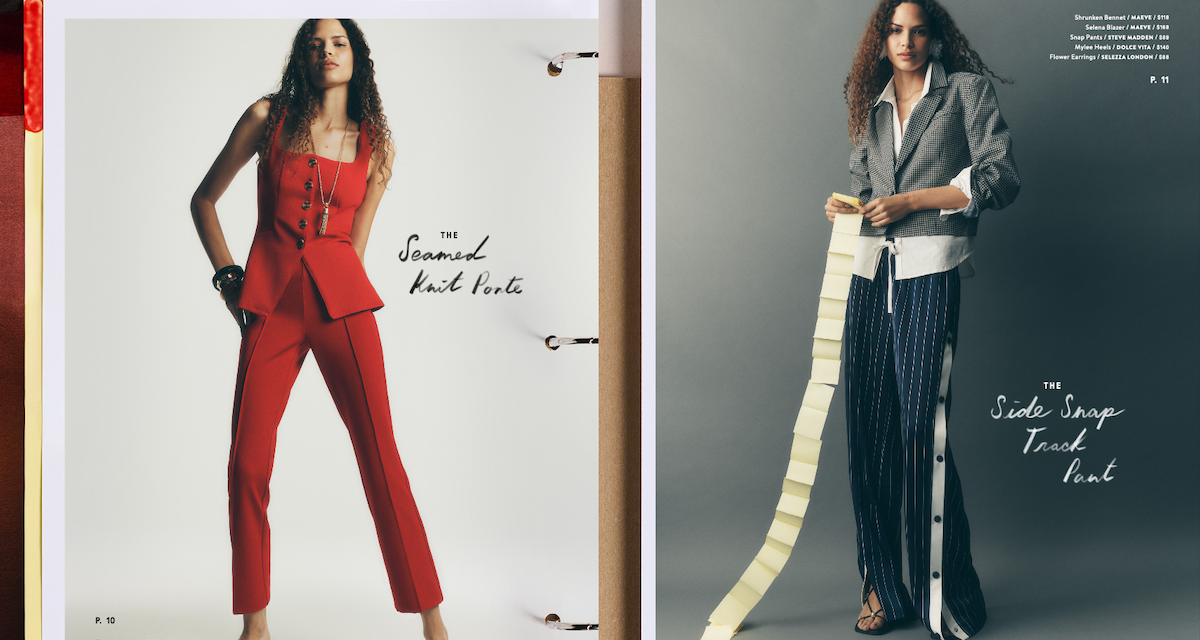
Anthropologie mails the catalogs to people’s homes, but it also carries them in stores. On Monday, Feb. 2, Anthropologie debuted its latest catalog, which is focused on pants and coincides with its larger “Spring Looks Loading” campaign. The catalog has a more “hands-on approach” that mirrors Anthropologie’s print strategy, Jisoo Kang, chief creative officer of Anthropologie Group, told Modern Retail. The team made paper collages for the most recent issue to play up “a sense of craft,” she said. Products featured in the issue include culottes, balloon pants and wide-leg trousers.
After the February catalog, Anthropologie will publish four additional large-format catalogs. These will come out in March, April, August and September. Two more issues will be smaller-format ones, likely 10-panel bifolds. They will go live in the summer and winter and highlight products across Anthropologie’s portfolio, including its private brands like activewear brand Daily Practice and resortwear brand Celandine.
The smaller format “gives us an opportunity to be a bit more focused,” Sainsurin said. One hypothetical issue may focus on shoes, while another could focus on accessories, for example. “We’re excited to see what the response is and how that helps build consideration for categories and brands that may not get airtime in our larger books,” Sainsurin added.
In the past, Anthropologie has largely used catalogs as a retention tool by sending mailers to its best customers. This year, it plans to also use catalogs as an acquisition tool. It’s working with a direct-mail partner to identify customers who buy similar brands and then send catalogs to them, too. “We see this as an opportunity to broaden our target strategy,” Sainsurin said. “Right now, we’re prioritizing fashion [audiences], but the idea is that this could scale to home, as well.”
Other brands are doing more with print catalogs, too. In March 2025, clothing brand Faherty launched a quarterly catalog called “The Faherty Chronicles.” It’s akin to a coffee-table book, with a focus on interviews, profiles and product photography. In August 2025, Walmart published its first home and decor catalog to try and build demand ahead of the holiday season.
Spice company Burlap & Barrel is another brand that recently published its first catalog, which ran in the spring of 2025. “We’re going offline in our effort to reach consumers,” the brand’s co-founder, Ori Zohar, told Modern Retail. “Instead of [just] paying for video ads, we can mail people really nice, 24-page catalogs. It’s a way to [introduce] our best customers to more of our [product] lineup. And now, we’re also getting new customers.”
For many brands, physical media, like catalogs, paper coupons and mailers, is becoming a more attractive marketing play, especially as customers tire of scrolling on social media. With a catalog, brands can play around with photography, do more long-form writing and curate a theme. Catalogs are also a cheaper alternative to digital marketing, a field that is getting increasingly expensive. Marketing agency Belardi Wong shared with Modern Retail that CPMs on Meta were up 5% year over year in 2025.
This doesn’t mean Anthropologie will replace its digital marketing with print catalogs, though, Sainsurin said. The company uses both in its media approach, and it will continue to do so. However, Anthropologie finds that catalogs are strong engagement drivers — especially among young people. “Because we’re this multigenerational brand, mothers are handing catalogs on to their daughters, who then become Anthro customers and Anthro fans,” Sainsurin said.
What we’re reading
- Starbucks is reintroducing tiers to its loyalty program to encourage more visits by rewarding its most loyal customers, while nudging infrequent visitors to spend more and move up tiers.
- Claire’s new private equity owners have brought on a new chief brand officer.
- Allbirds is closing all of its U.S. stores except for two outlets.
What we’ve covered
- Why brands like Standard & Strange, Faherty and more decided to take a stance against recent ICE activity in Minnesota on social media.
- The unique way that Cassey Ho of Popflex is calling out dupe culture.
- What hemp brands want from federal regulations.