


Sam’s Club aims to make free samples more measurable using kiosks, tablets
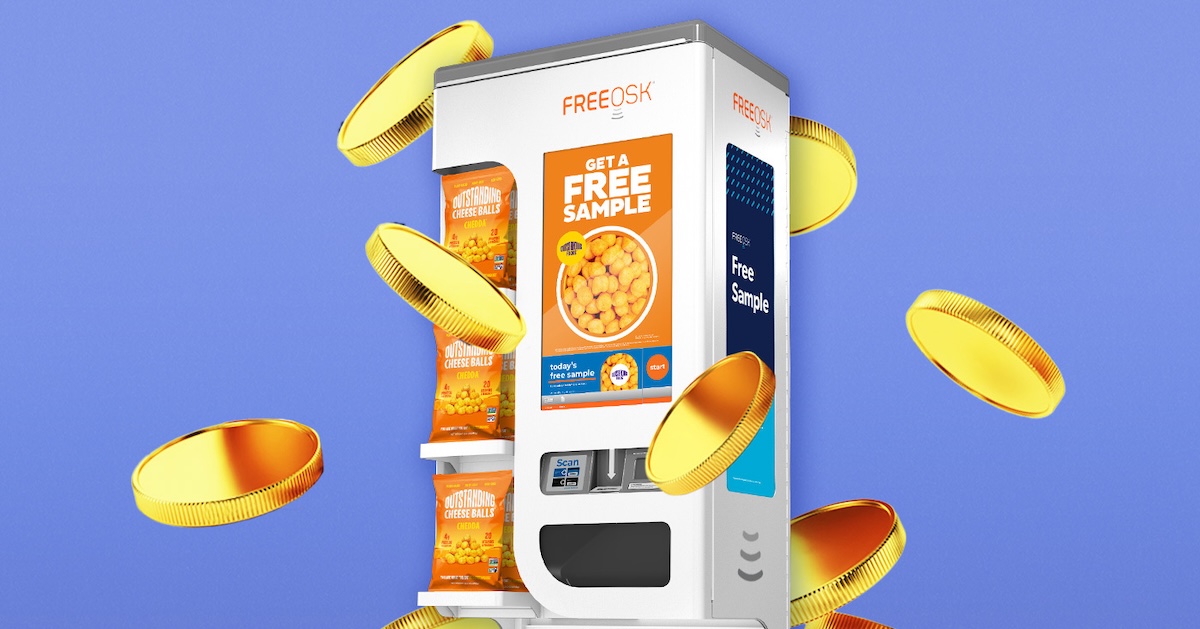
Sample carts are a staple of club retailers, and members have grown accustomed to huddling around a small table to try a bite of jerky or sip on a new energy drink. But at Sam’s Club, members can also find vending machines offering up free samples. Now, the club retailer is increasingly trying to make these kiosks a more notable part of its retail media business.
The machines, operated by Chicago-based technology company Freeosk, are not new to Sam’s; they first launched as a pilot in 2012 and rolled out to the entire chain in 2014. But the retailer has been making significant changes to how they operate within the company — pointing to its confidence in the machines and free samples, in general, advertising drivers.
Beginning this year, through a new contract, Sam’s Club plans to reskin the machines with its own branding; they have previously displayed the Freeosk logo on the top. It has also brought the process of selling opportunities around the machines in-house, now treating them like any other asset controlled by the Member Access Platform, which is the name for Sam’s Club’s retail media network.
The way these vending machines work is that members can scan their membership card and are then offered a free sample, which could be a small package of products ranging from laundry detergent to powdered beverages or cookies. The full-size versions of the products are on display on a shelf next to the kiosk. Additionally, customers may be offered a coupon for another unrelated product before they receive their sample and receive emails with product offers, as well.
Harvey Ma, vp and gm of Sam’s Club Member Access Platform, said the point of these changes was to make the quality of the products and advertising on the machines consistent with the rest of the shopping experience.
“Putting together a member experience that feels seamless and feels very much like Sam’s Club is the best way to go about it,” Ma told Modern Retail. “Last year, it felt very much like you were walking up to a different machine owned by a different company, with a different product than we were focusing on in the club. Bringing that all together in one holistic experience and tying it into all of our advertising capabilities and assets, that’s a winning formula for everybody.”
Additionally, Sam’s rolled its entire demos and samples business into the Member Access Platform last year, Ma added.
Ma said the kiosks are yet another touchpoint for Sam’s Club to track its customers beyond a single ad campaign. That tracking is already a key advantage Sam’s Club’s retail media network has over others, given that it is a members-only business that scans membership cards each time customers walk through the door.
“We call that longitudinal behavior over time; it is so much different than what the industry is used to, which is single-campaign performance,” Ma said. “The ability to see that [free sample] happening in a member’s life cycle is something that makes this value proposition really powerful for us.”
Embracing kiosks as an advertising tool
The new contract with Sam’s will allow Freeosk engagement data to be used by the MAP team for measurement purposes and give brands a one-stop shop for campaigns that can span both the Freeosk machines and other physical and digital offerings from Sam’s, according to Freeosk.
“That is done so that we keep that ecosystem tight, contained and consistent,” Ma said. “When you have third-party partnerships, and they feel like they’re operating on an island and they’re not part of the core ecosystem, that’s always where these things fall apart.”
Ma said the company is evaluating putting more machines into the clubs. In the meantime, in October, Sam’s also started to deploy interactive screens, also operated by Freeosk, next to live, staffed demo carts.
On the tablets, customers can review the products and have their reviews uploaded to the product page on Sam’s Club’s website. The devices are now available in all U.S. Sam’s Club locations, in addition to the kiosks. The retailer also has portable Freeosk machines that it can use for events.
“We are one of the first to have real-time member feedback that feeds directly onto a product description page,” Ma said. “Reviews are a fuel, especially for big-ticket purchases nowadays. The ability to monetize and influence a single demo event with a tablet like that is part of what this connected ecosystem is all about.”
Matt Eichorn, CEO of Freeosk, told Modern Retail that in 2026 the company will focus on expanding with its existing kiosks, as well as new, smaller models.
Including the new tablets, Freeosk said it now has 2,000 devices at stores across the U.S., including Sam’s Club as well as Wakefern grocery stores, which include ShopRite, Price Rite and The Fresh Grocer, among others. “It expands the same identifiability and closed-loop measurement our automated sampling kiosk offers and brings it to the live staffed demo carts,” Eichorn wrote in an email.
“What we focus on is creating measurable media,” Eichorn added. “Retail media is different from other place-based media because it can drive shoppers from screen to shelf. What makes Freeosk distinct is the ability to turn those moments into identifiable, incremental and interactive experiences that drive short- and long-term impact.”
Enhancing measurability, driving full-funnel campaigns
Sam’s Club’s Ma said the Freeosk machines are a key component in what he calls a “retail experience network” that incorporates taste, touch, smell, senses and emotions, rather than just selling search and display ads online.
“We believe the reason why members choose to shop Sam’s Club is [they] want the experience,” he said. “What better way to create an experience than to have all your senses engaged, versus just what you see and click with on a screen?”
Ma said the brands in the machines range from large CPGs to small- or medium-sized businesses.
“Rather than organic, grassroots marketing campaigns, this is the best way to get a product in front of somebody,” Ma said. “You’re not just giving something away; you’re giving something away, and you’re getting data performance back. That in itself tells a smaller startup how best to spend their advertising or marketing dollars, versus just putting a tent somewhere and giving stuff away.”
By scanning the Sam’s Club membership card at the kiosk, members open up the opportunity for Sam’s to serve them emails or notifications related to the free sample. Or the fact that a member was interested in a free sample of a product could be used to personalize and target a different campaign.
“This is really an advertising machine now,” Ma said, contrasting its usage now with what it started out as — a free-sample machine to drive sales lift for a single product. “You might actually see a different type of electrolyte water sitting on the screen itself [than the one being sampled], and you might get a targeted offer for a snack that encompasses those two things in your email afterwards, with some kind of Sam’s cash offer or promo.”
Retail media industry analyst Andrew Lipsman of Media, Ads + Commerce, who has done consulting work for Freeosk, said product sampling can be much more valuable for brands in acquiring new customers than running digital advertising at scale.
For brands, “[free samples] tend to be more expensive, but it’s exactly the sort of thing that can get people to buy into the future,” Lipsman said. According to Freeosk, households that engage and sample with the kiosks buy 57% more units over time than those that don’t. “A big part of the lexicon of CPG brands is how brands grow, and how brands grow is all about new customer acquisition.”
Eichorn said, as retail media networks have matured, it has become clear that physical experiences need to be treated as measurable media rather than just merchandising.
“Freeosk offers RMNs a way to connect awareness, trial and conversion in one moment — inside the store, with clear attribution,” Eichorn said. “We have evolved from being focused on automated sampling for one brand to providing an engaging multimedia, multi-brand experience that engages all the senses and connects the physical store to the digital shopper.”