


Brands Briefing: Inside Cotopaxi’s plans to double its store count by 2029
Travel bag and backpack brand Cotopaxi is setting out on its next adventure: opening more stores.
The brand plans to double its North American store count from 20 locations to 40 locations in the next three years, CEO Lindsay Shumlas told Modern Retail. Cotopaxi opened its most recent store in Jackson, Wyoming at the beginning of March. Less than 20% of the brand’s sales currently come from stores, although Cotopaxi hopes to grow this number. Cotopaxi also sells merchandise on its website and through retail partners like REI and Dick’s Sporting Goods.
Cotopaxi is placing a bigger emphasis on stores as it expands beyond its online, direct-to-consumer roots. A year ago, the brand took time to “really understand our existing fleet and what made those stores special,” Shumlas said. The answer, Cotopaxi found, was in strong product education and tailoring each store to the needs of the local community. The Allpa Daypack, for instance, is popular with students at Cotopaxi’s Boulder, Colorado store, so those are now featured year-round. Stores also host community events, like back-to-school giveaways, and partner with local organizations, like Wyoming’s One22.
Shumlas told Modern Retail that the company’s retail stores have been “very strong” for the last year. “The team has done a really good job ensuring that the product in each store is … [where] we’re seeing the strongest sales, both on e-commerce and within the stores,” she said. “It also comes down to a good partnership between our e-commerce and retail teams. They’re ensuring we draw that red thread through our launch strategy, whether it’s a new seasonal cadence or how we’re marketing to customers.” Cotopaxi expected about $150 million in sales in 2025.
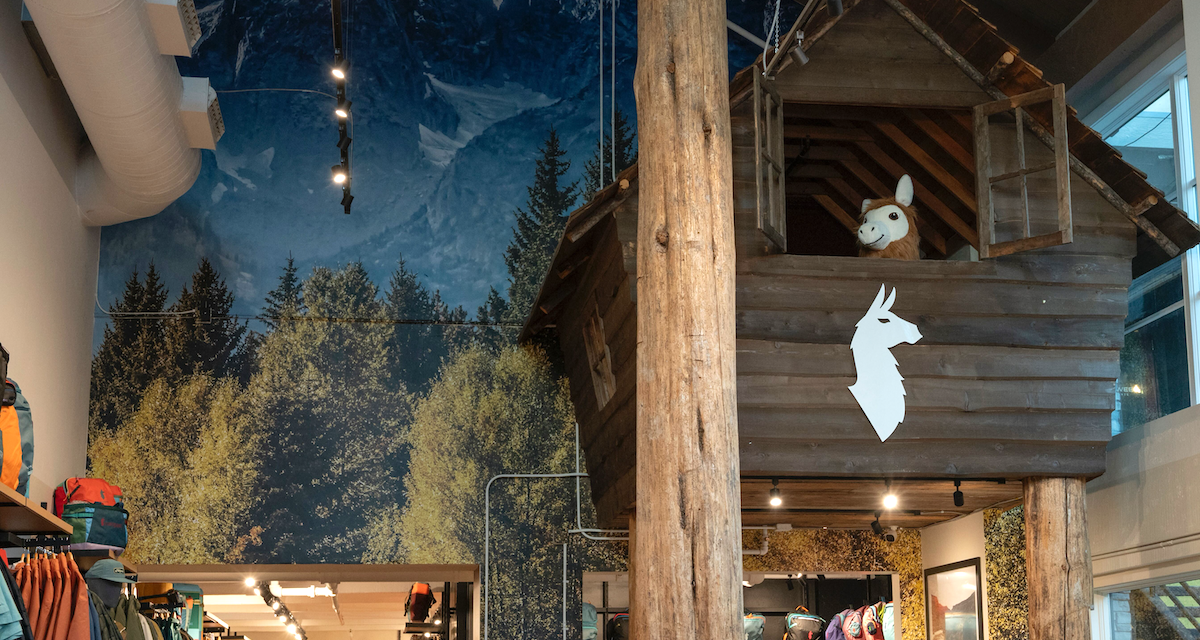
Cotopaxi, which is known for its colorful products and repurposed materials, was founded in 2014. Its stores are woodsy and whimsical, with vivid outdoors imagery, sprawling murals and the occasional tree house. Store locations tend to fall into one of three buckets: places with big outdoors communities (like Jackson), places near college campuses (like Boston) or places near cities that cater to travelers (like New York City). The brand will expand to other markets with those qualities, while taking direction from zip codes with strong digital sales.
Rebekah Kondrat, founder of the retail consultancy Rekon Retail, said she always advises brands to set up stores where their e-commerce sales are high. “You have the data; go where your customers are,” she told Modern Retail. After that, she said, she advises brands to go “where your customers should be.” In the case of Cotopaxi, zeroing in on places with a heavy outdoors culture — like an Aspen, for instance — “makes a ton of sense,” Kondrat said.
Being an omnichannel brand, Cotopaxi tends to see its e-commerce sales go up when it opens a new physical store. Its average order value is “consistent” across both e-commerce and physical retail, per Shumlas. Some products, like Cotopaxi’s Allpa Travel Pack and Allpa Gear Hauler, are best-sellers across both channels. Cotopaxi is in the middle of rolling out its spring line, including rain jackets and convertible totes.
Cotopaxi’s existing U.S. stores are in nine states: Utah, Colorado, Idaho, Washington, Oregon, California, New Hampshire, Massachusetts and Wyoming. The company also has a pop-up in Georgetown that it will convert into a permanent store, and a pop-up in Brooklyn. Cotopaxi works with partners to run four stores in Japan and a pop-up in South Korea. Those markets are not part of the aforementioned plan, although Cotopaxi does hope to expand into Canada.
Cotopaxi’s expansion comes at a moment of change for the outdoors industry. REI is set to close three U.S. stores in 2026 — in Paramus, New Jersey; Soho, New York City; and Boston — following declining revenue and rising costs. Meanwhile, Eddie Bauer is preparing to close some 200 North American stores after filing for Chapter 11 bankruptcy. Athletic apparel brand Outdoor Voices closed all of its stores in 2024 to go online-only.
“It’s smart of Cotopaxi to now look to fill that void,” Kondrat said. The only challenge Cotopaxi may face when expanding quickly, as Kondrat sees it, is around forming “a consistent brand identity, holistically.”
“You can have your [store] fixtures, and you can have your materials, but it’s also about making sure the brand is able to draw the right type of employee to service the customer — [one] that’s knowledgeable about hiking, that’s knowledgeable about the technical aspects of the bags,” Kondrat said. “The most common breakdown in a rapid expansion is actually the soft side of the experience, and not the hard side.”
Cotopaxi, for its part, is looking for “sustainable growth,” Shumlas said. And while Cotopaxi knows where its competitors are setting up stores, it isn’t flocking there right away, choosing to instead take a cue from its existing customers. “When we try to chase what everyone else is doing, that hasn’t worked the same,” Shumlas said.
“Probably the biggest issue for us [with store expansion] is pacing it out,” Shumlas continued. “It’s about ensuring we’re in the right location and the right center. We have a lot of markets we’re excited about, so the only challenge for us is making sure we get those markets right.”
What we’re reading
- Blank Street is embracing bigger coffee shops in its quest to take on Starbucks.
- Urban Outfitters has tapped Vans for the latest edition of its “On Rotation” in-store concept; Vans will have a display in five Urban Outfitters stores celebrating the 60th anniversary of its ‘Off the Wall’ campaign.
- Business of Fashion has a case study on what it takes to lead a challenger brand today.
What we’ve covered
- Little Spoon is getting into baby formula, adding to its line of toddler snacks and ready-to-heat meals as it seeks to become an end-to-end feeding solution for parents.
- What Poppi founder Allison Ellsworth splurged on following her big exit to PepsiCo.
- Shopify says purchases are coming ‘inside ChatGPT’ through agentic storefronts.