


Drone delivery isn’t just an experiment anymore
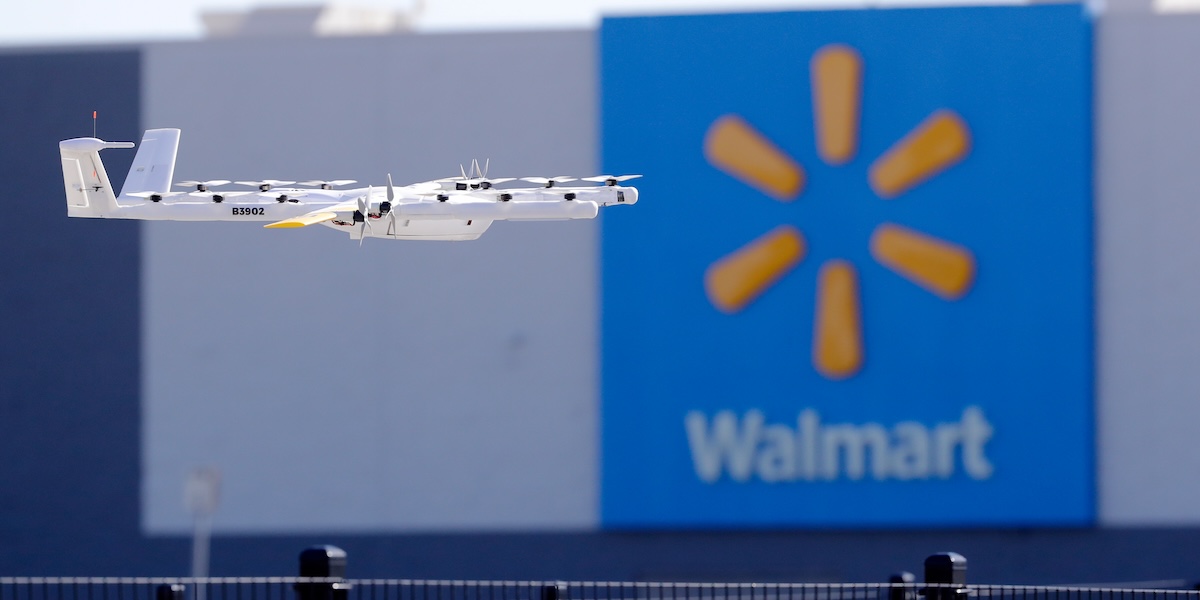
The concept of a drone flying over your home to deliver items from a store is moving further away from a “Jetsons”-like fantasy for most Americans and toward reality.
Alphabet-owned Wing and Walmart are bringing drone delivery to an additional 150 Walmart stores over the next year, the companies announced earlier this week. That will make the service available to an estimated 40 million-plus people in cities including Los Angeles, St. Louis, Cincinnati and Miami.
People can check if their address is within the service area on Wing’s website. If it is, they can place an order for free through the Wing app. Then, Walmart and Wing staff will prepare the order and load it onto a drone that can fly at about 150 feet, at up to about 60 miles per hour.
Wing and Walmart also said they would establish a network of more than 270 locations for drone delivery throughout the U.S. by 2027. The services also launched in Houston this week, and are also planned to expand to Tampa and Orlando. The company previously delivered from Walmart stores in the Dallas and Atlanta metro areas.
This wide-scale expansion of drone delivery by the nation’s largest big-box retailer is a big sign of confidence in the emerging technology: What last year was a test run in a few cities is growing into a more mainstream last-mile delivery method.
Meanwhile, Amazon has been expanding its Prime Air drone delivery service. This week, media outlets reported that Amazon started testing flights in the U.K. after previously flying in U.S. regions such as San Antonio and Tampa Bay. It will launch in the U.K. for customers later this year.
Greg Cathey, svp of digital fulfillment transformation at Walmart, told Omni Talk in an interview at the National Retail Federation conference in New York that the company decided to futher invest in the technology after success in the Dallas area. He said that there, the company found that not just one cohort of customers would use it; instead, customers across demographics have been using it in situations such as ordering a charger at the last minute for a trip or ordering eggs for breakfast after forgetting them on their trip to the grocery store.
The customer demand in places like Atlanta and Houston has been “overwhelming,” he added. A Walmart spokesperson told Modern Retail that the company will add drone delivery where it makes sense and can add the most value based on customer demand, feedback and local needs.
“The reason why we’re expanding it is customers want us to do it,” Cathey told Omni Talk. “The No. 1 piece of feedback we get regarding drone [delivery] is, ‘When is it coming to my neighborhood?’ ‘When will I have the ability to do it?’”
In the leadership ranks behind the expansion effort sits Heather Rivera, Wing’s chief business officer. She joined the company in August from Instacart, where she was global head of strategy for corporate development. “I don’t think they would have created that role and brought me in if we were not ready to scale,” she said. “We’re really at an inflection point.” Beyond Walmart, she said that many other retailers have expressed interest in working with Wing and that Wing will take calls to expand with others where it makes sense.
Rivera said the service solves a “real, immediate need” for a way to fulfill small-basket deliveries that have been difficult for traditional delivery companies to serve. They can include grocery items, household products and over-the-counter medicine. The company also began working with DoorDash in 2024 to fulfill orders from restaurants and other merchants.
“There’s a lot of latent demand that we will begin to unlock when people realize, ‘Oh my gosh, I can order a latte and get it delivered,’ and that it’s going arrive hot and it’s not going to be spilled,” Rivera said. “It’s really just getting consumers to think about what more they could do if I tell them that the average flight time is less than five minutes.”
Still, most of Wing’s drones can only hold about 2.5 pounds — only enough for maybe a few small items. But the company is beginning to roll out a new drone model that can handle up to five pounds.
“It’ll continue to unlock a number of additional SKUs,” Rivera said. “But I think people are generally surprised by how many of Walmart’s SKUs can actually fit into the 2.5-pound box already. … It’s much more about just making sure that we’ve gotten the ability to deliver to more Americans.”
Others in the retail industry agree that the larger rollout of drone delivery represents a forthcoming shift in how retailers get products to customers.
“Walmart is trying to monetize the assets they have — the 4,600-plus stores, that density — so what better way than to add another delivery layer, a speed layer, and make their stores, their assets, more productive?” said Mohamed Amer, founder and principal of Strategy Doctor and an adjunct strategic management professor at Pepperdine University. “You get your customers a new purchase behavior, a new expectation, which then locks out those retailers that can’t fulfill on that new expectation.”
Anne Mezzenga, co-CEO of Omni Talk and a former Target executive, said she expects this expansion to catch the attention of other retailers in the same way Walmart helped normalize electronic shelf labels and same-day pharmacy delivery.
“It’s going to set the tone for future customer behavior and what customer expectations are, in the same way that Amazon set the tone for what our expectations are as consumers for when products should be delivered, how much it should cost us and what that whole [e-commerce] experience is,” Mezzenga said. “When the store is flying down and dropping something on your doorstep, that’s an entirely new era.”